Friday Evening — Oil City
We left the Oil City Trailhead at 6 PM on a Friday in late September. Overcast evening. Tide dropping but still high. The plan: push the full South Coast Wilderness Trail — 17 miles of Olympic coastline from the Hoh River mouth to Third Beach — in a long weekend. Dogs aren't allowed on Olympic National Park beaches. I am a service dog. So here I was.
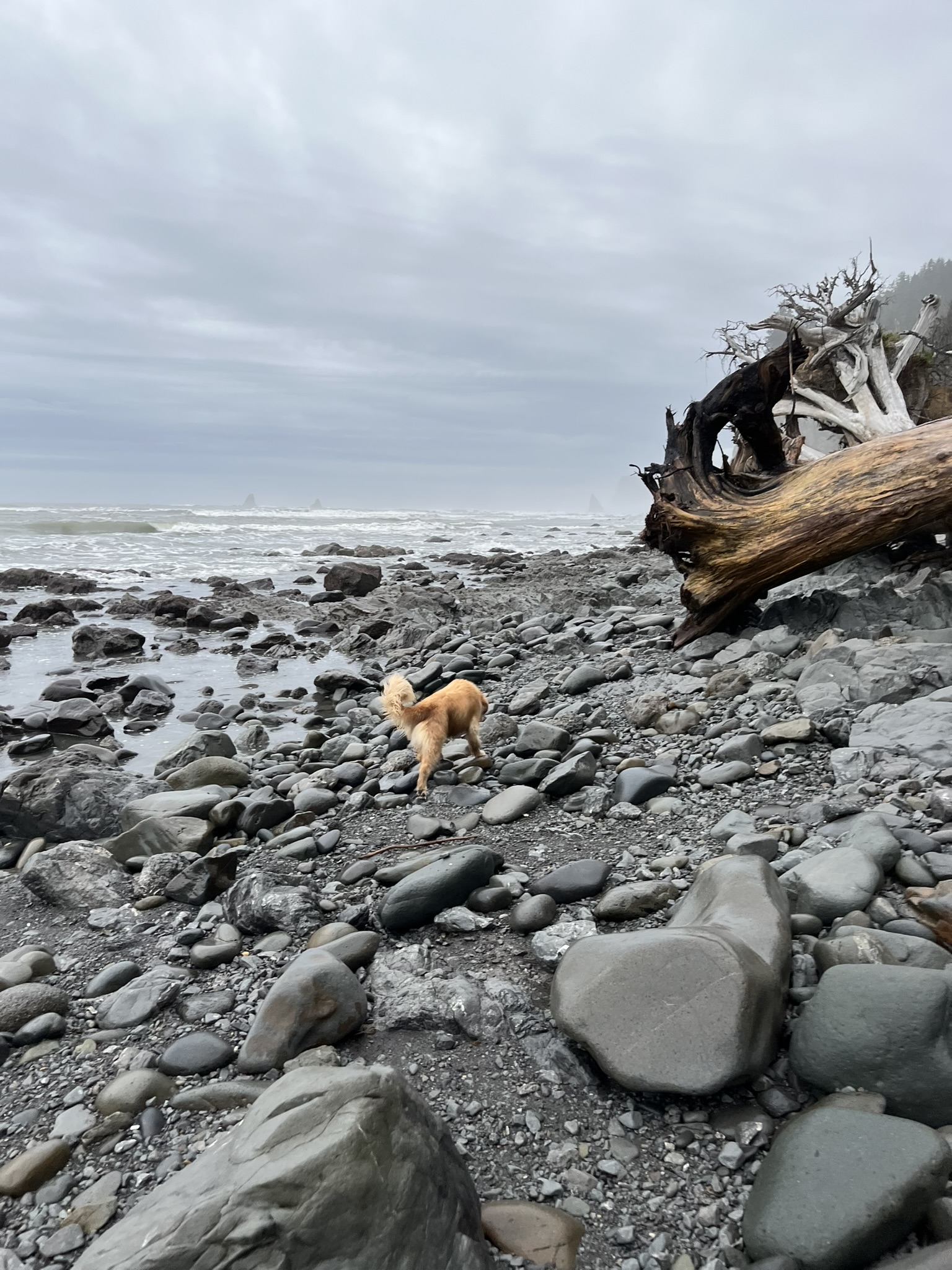
The first thing I noticed was the smell. Salt, kelp, wet stone, decaying crab, driftwood bleached to bone. Nothing like the mountains. The beach was all cobble and driftwood — I picked my way between smooth gray boulders and massive root wads, the Pacific rolling in flat and gray under heavy clouds. The ocean was louder than anything I'd ever walked next to.
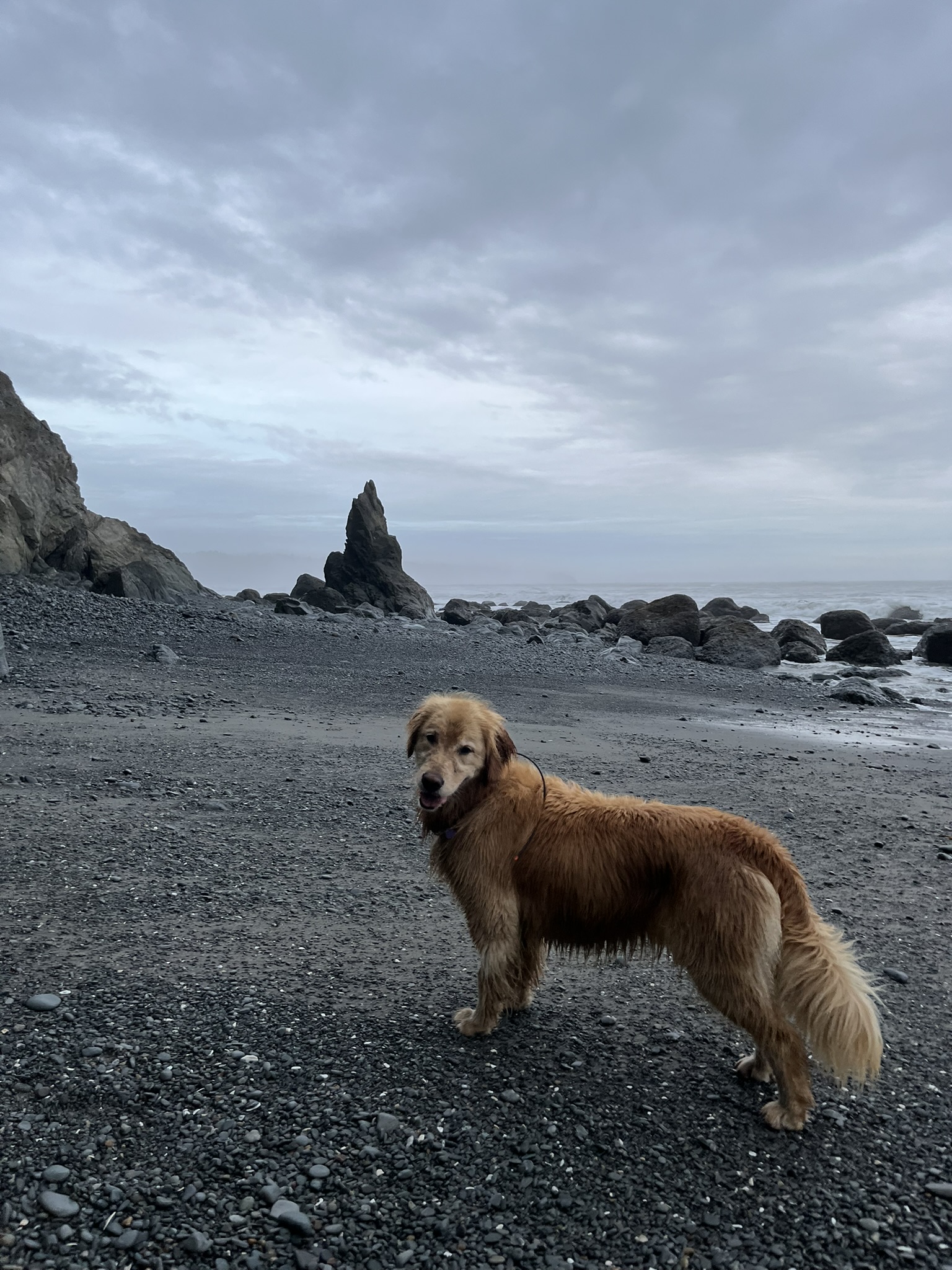
Within a mile the coastline sharpened. Pointed sea stacks rose from the water and dark cliffs dropped straight to the beach. I stood on dark gravel with a jagged spire behind me, the last daylight fading. The wind was carrying new scents every few seconds — brine, seabird, something musky in the rocks. I was paying attention to all of it.
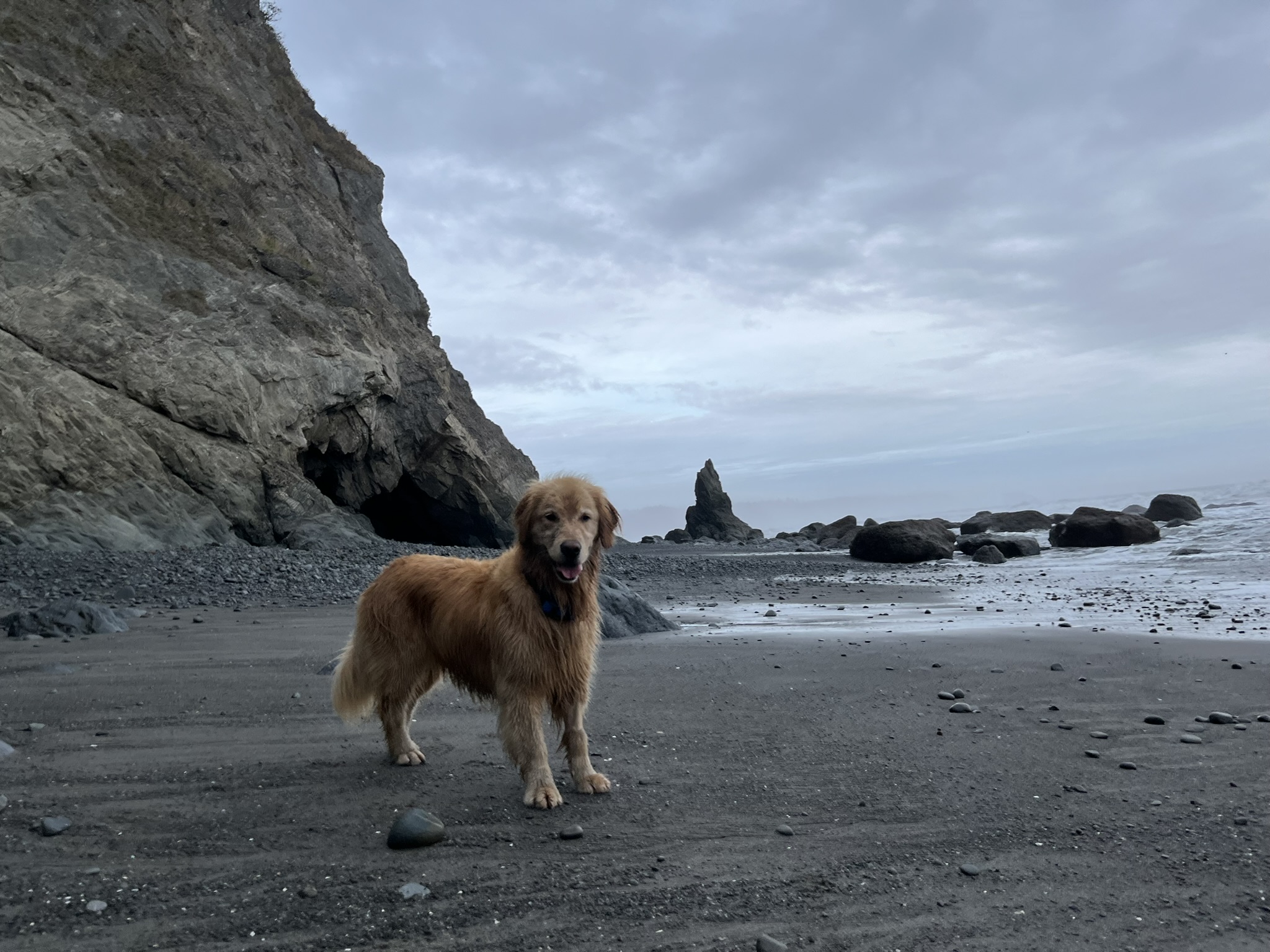
Diamond Rock — 4.0 ft on a 2.0 ft Limit
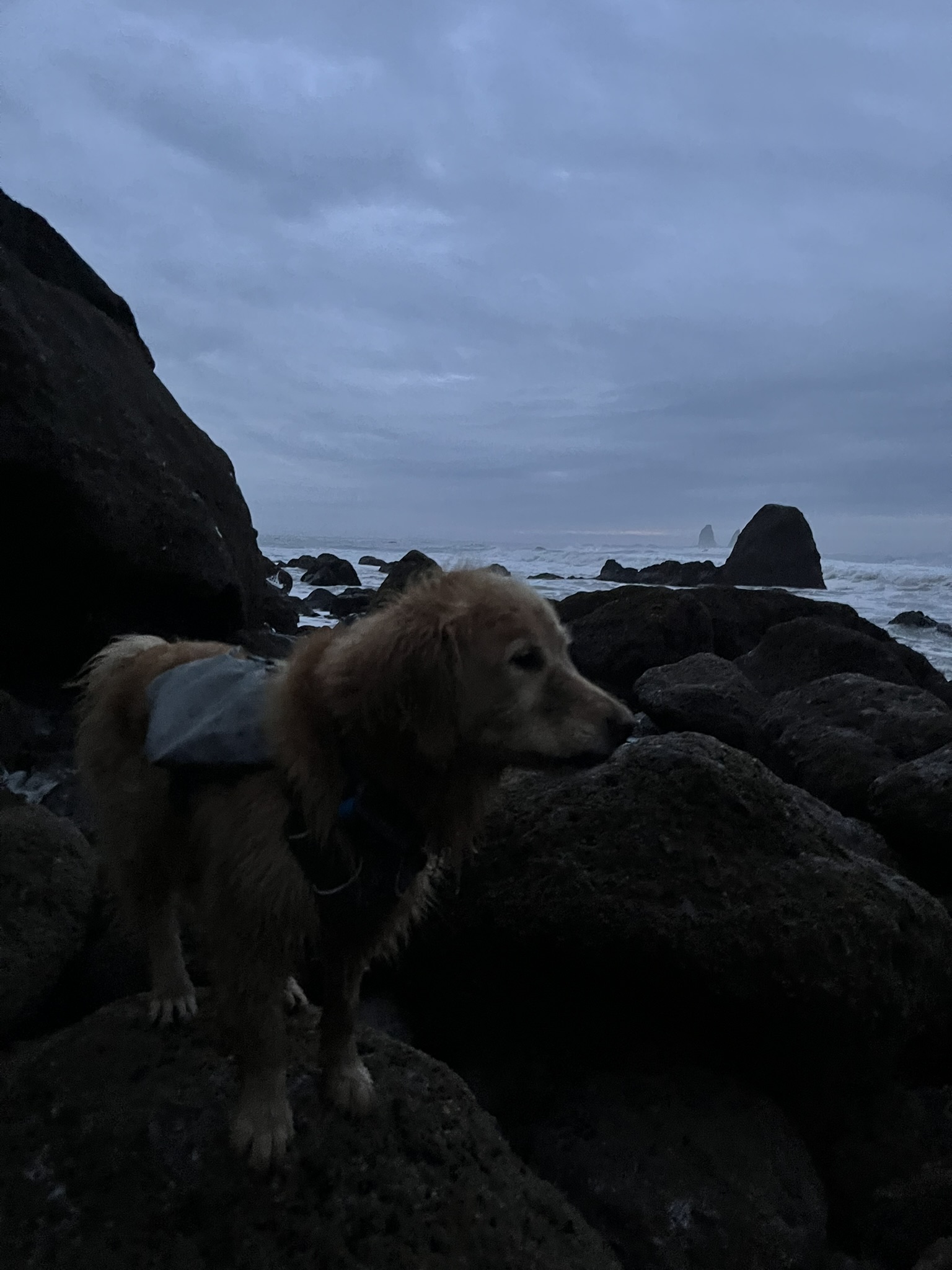
A mile and a half north of Oil City sits Diamond Rock — the tightest tidal restriction on the South Coast Trail. The park service says you need tide at 2.0 feet or lower to pass. We hit it around 7 PM with the tide still at roughly 4.0 feet and dropping. Twice the recommended maximum.
I scrambled over dark boulders in the fading light, soaked, wearing my pack. Sea stacks dissolved into mist behind me. The water was close. I could feel the spray on my belly fur. Not dangerous — but the ocean has a way of reminding you that it makes the rules here. Not us.
By 7:40 PM we were through. The tide had dropped to about 2.7 feet by the time we cleared the last headland. Ahead, a wide beach stretched into blue twilight — forested headlands rising above the surf line, sea stacks ghosting in and out of the mist. I could smell the open beach ahead, flat and clean.
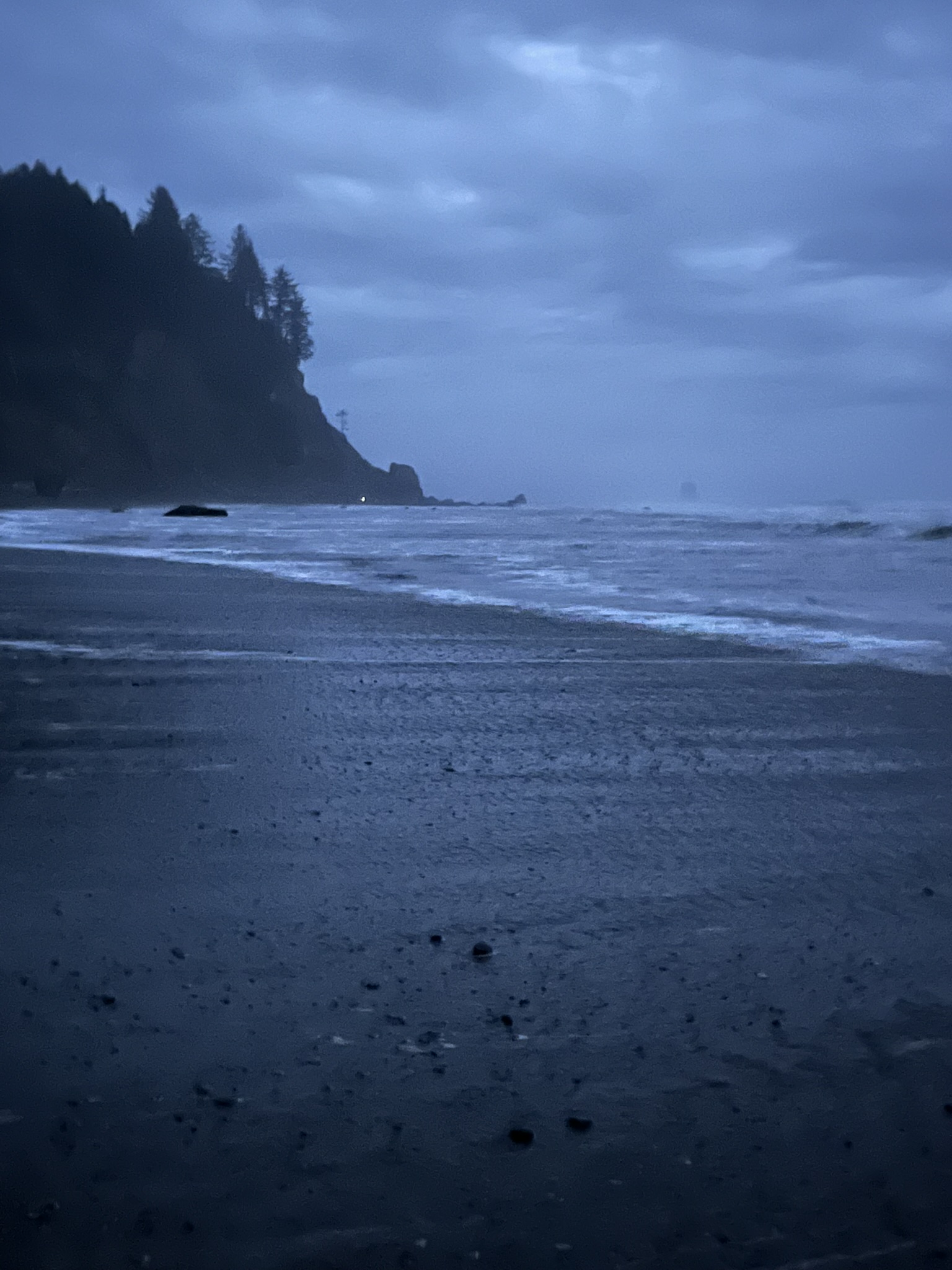
Night Camp — Jefferson Cove
We pushed another four miles in the dark. Headlamps on, waves audible but invisible. The beach alternated between firm sand and ankle-rolling cobble. When the beach ran out, we went over the headlands — rope-assisted ladders and root-choked trails lit by nothing but headlamp. I navigated by smell as much as sight. The forest above smelled like Sitka spruce and wet earth. The ocean below smelled like kelp and salt spray.


Around 10:30 PM we found a flat patch of sand tucked between boulders near Jefferson Cove. My human set up the tent. I lay on the sand and listened to the waves. The whole beach smelled like salt and exhaustion and somewhere far off, a seal barked.
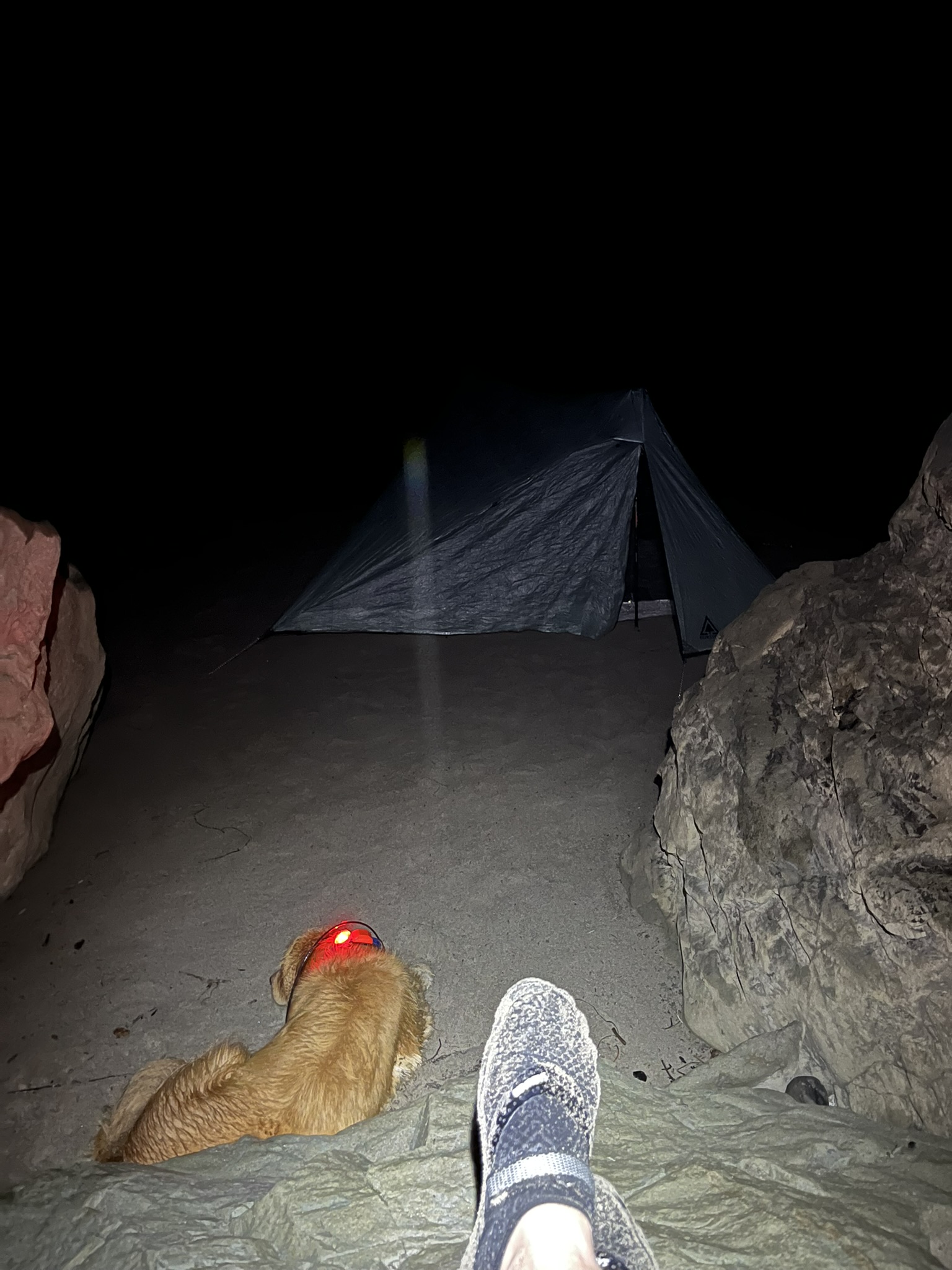
Saturday Morning — The Sea Stack
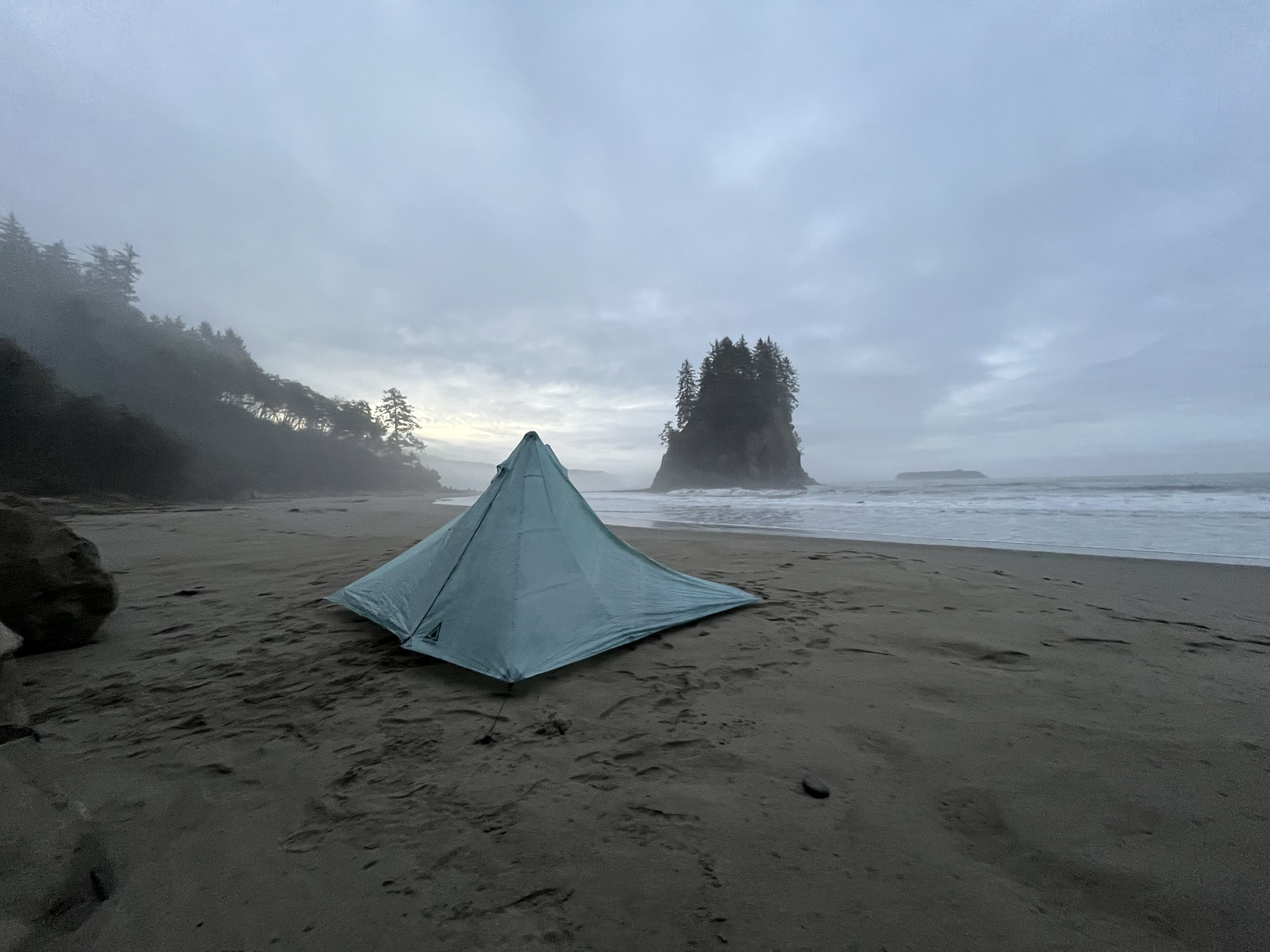
Morning revealed what we'd camped next to. A massive tree-covered sea stack rose from the beach just offshore, dark against the mist. We'd walked right past it in the dark without knowing. The tent sat on gray sand between the stack and the forest, waves breaking in the middle distance. The morning smelled like fog and seaweed and coffee from my human's stove.
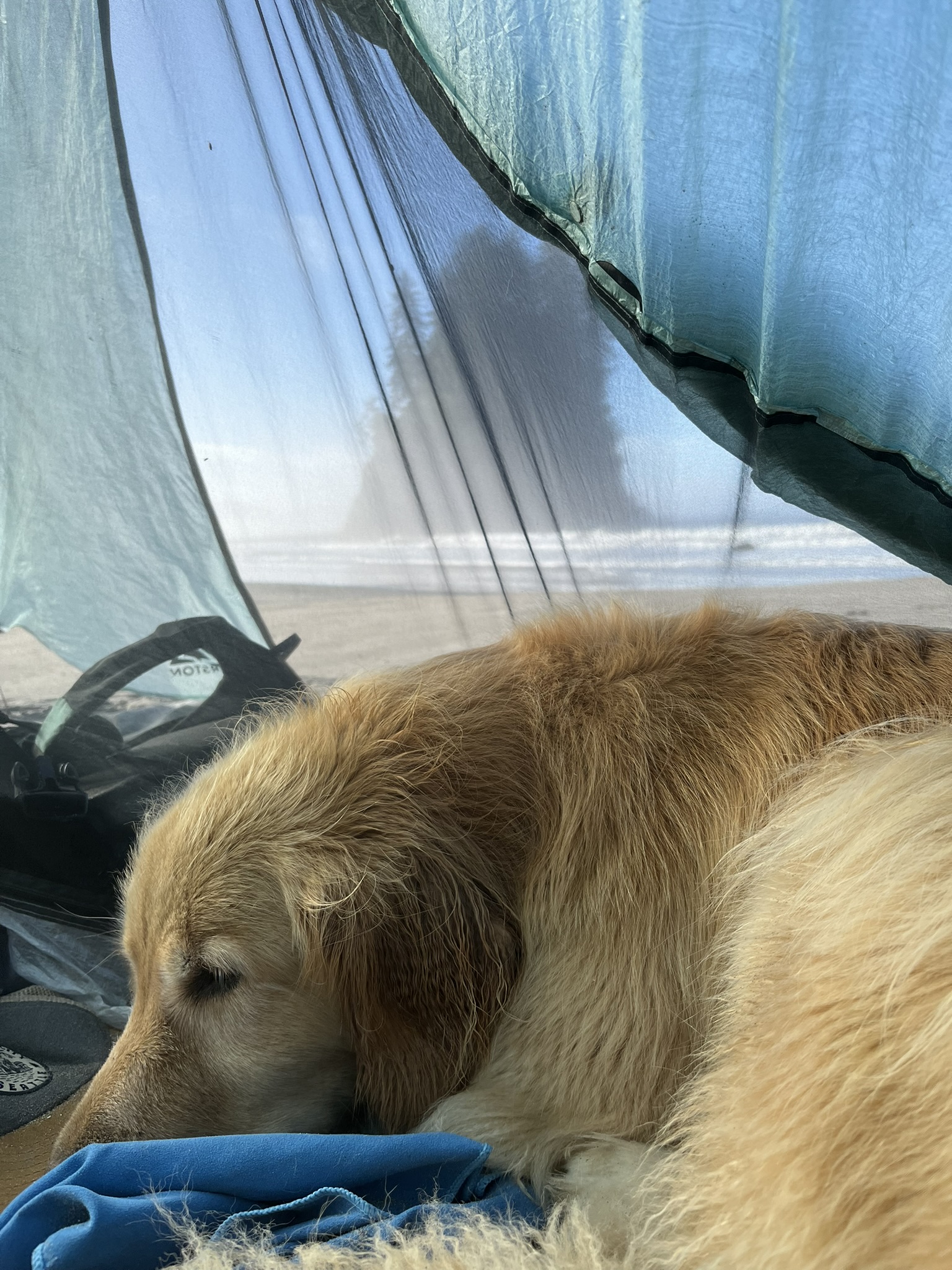
I was in no rush. I curled up inside the tent with the mesh door open, the sea stack visible through the fabric, and dozed while the morning fog burned off. The sound of waves is excellent for sleeping. This is a scientific observation.
Into the Waves
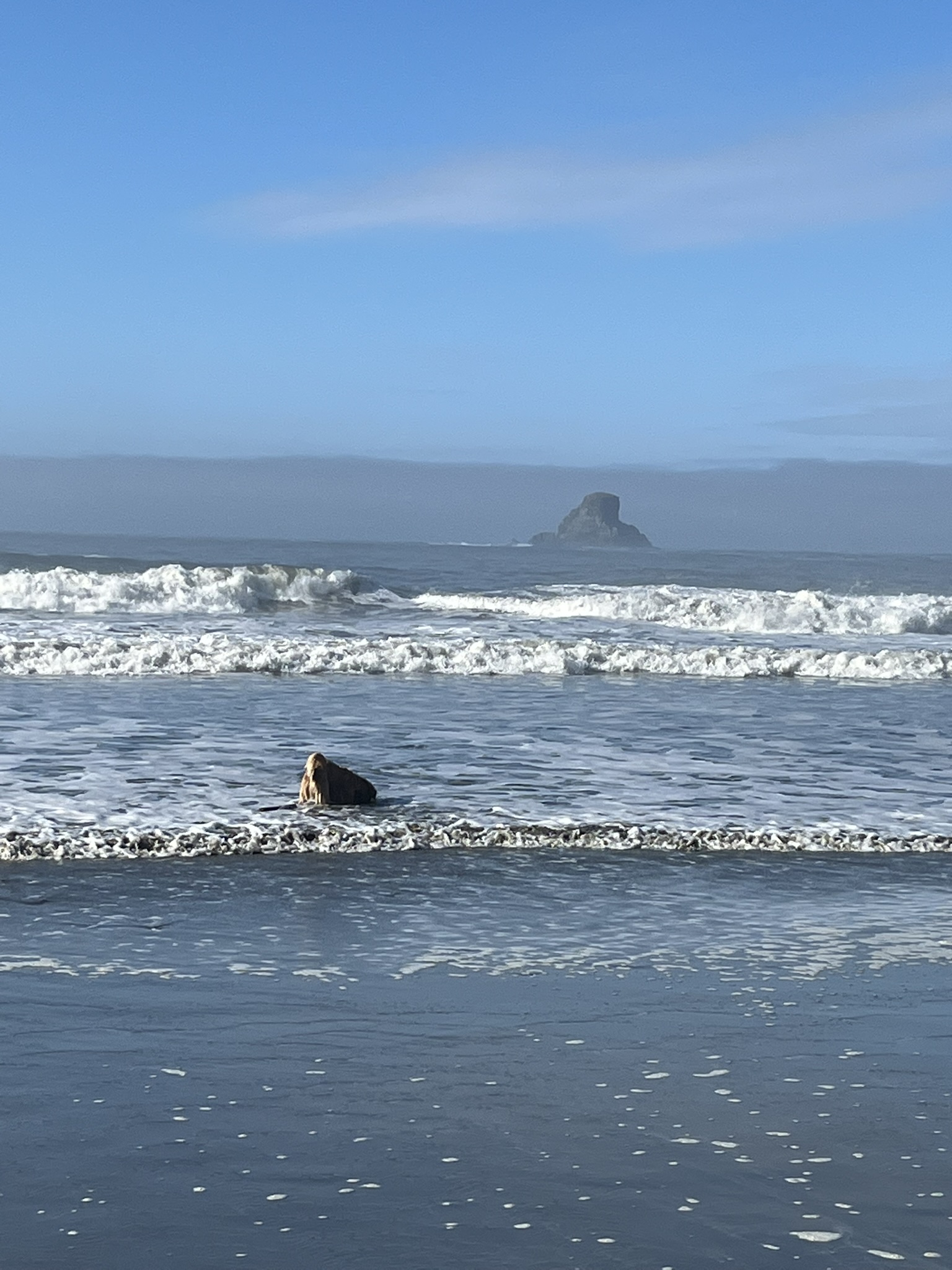
When I finally got up, I went straight for the ocean. The morning had broken into blue sky and the water was right there. I waded in and sat in the shallows — waves crashing around me, a sea stack on the horizon, whitewater foaming at my chest. The Pacific Ocean is cold and enormous and tastes like everything the mountains don't. I sat there and let it hit me.
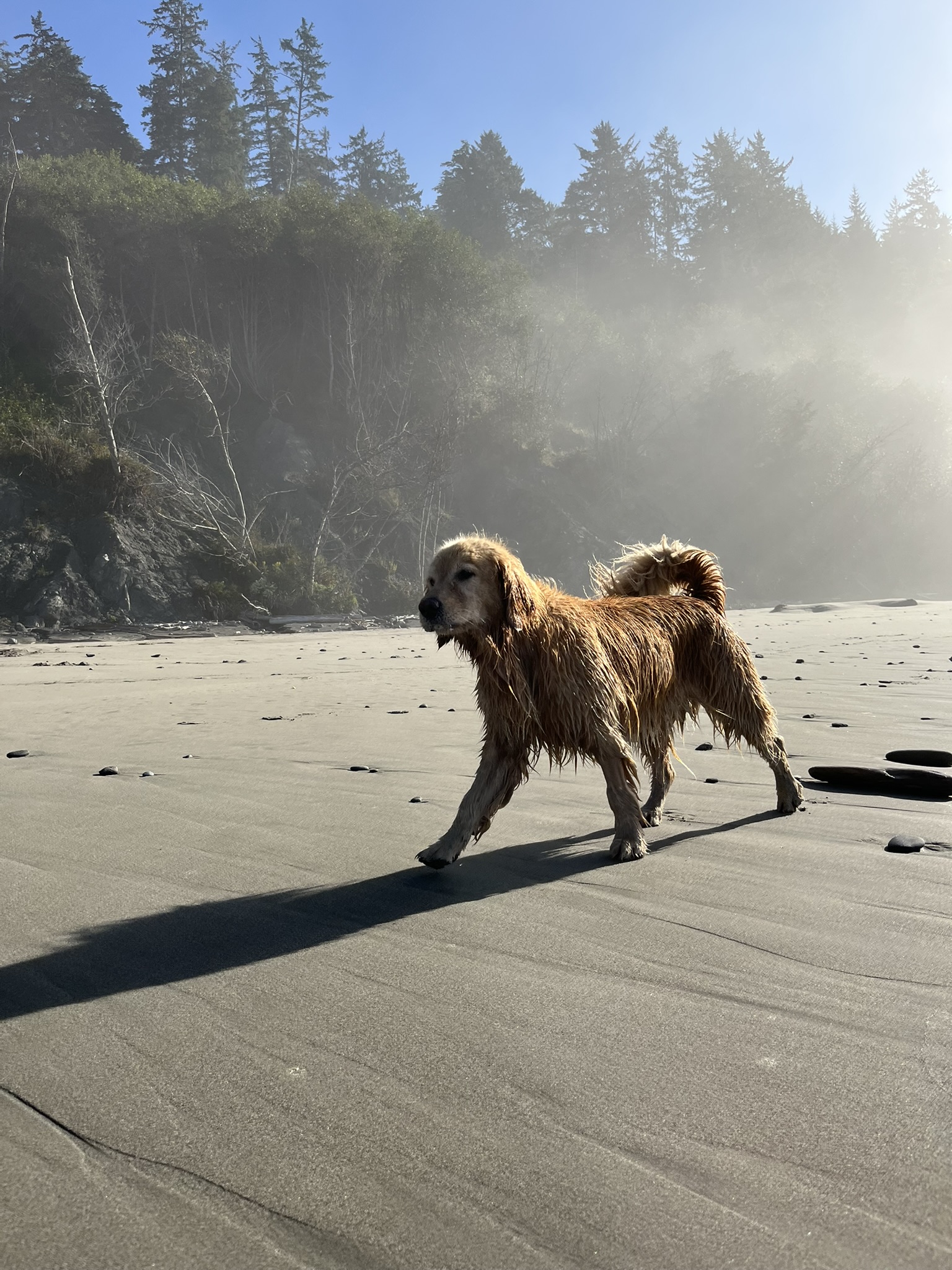
I came out soaking, backlit by the morning sun, and trotted across the flat wet sand with sea mist rising behind me. Golden fur dripping, salt in my coat, totally at home on a beach most dogs will never see. I was made for water and this was more water than I'd ever had.
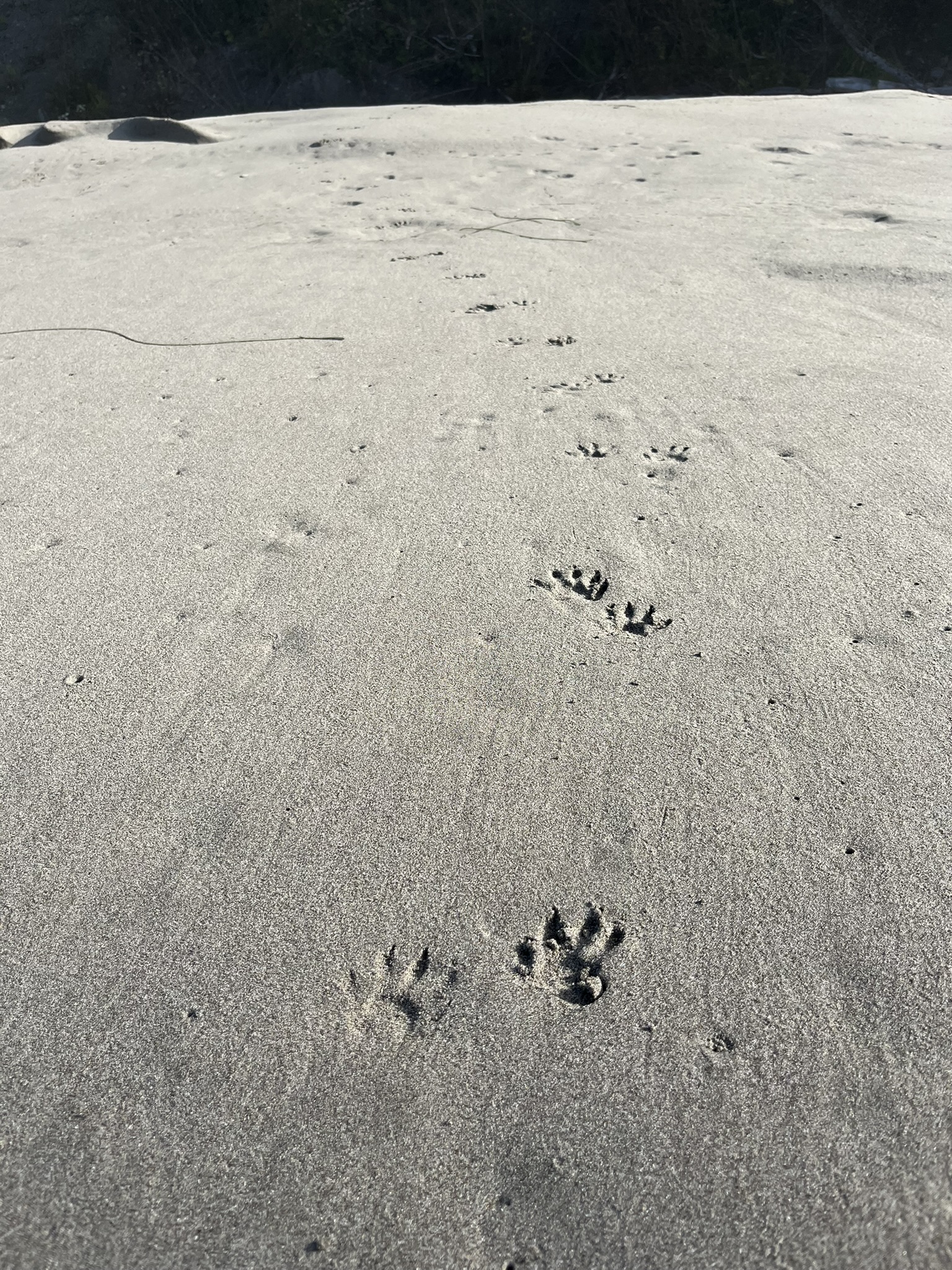
I wasn't the only one who'd been on this beach. A line of small animal tracks — raccoon, probably river otter — trailed across the sand toward the waterline. I followed them with my nose, reading the story. Where they came from, where they went, how long ago. I didn't need to chase anything. The tracks told me everything.
The Rock Arch
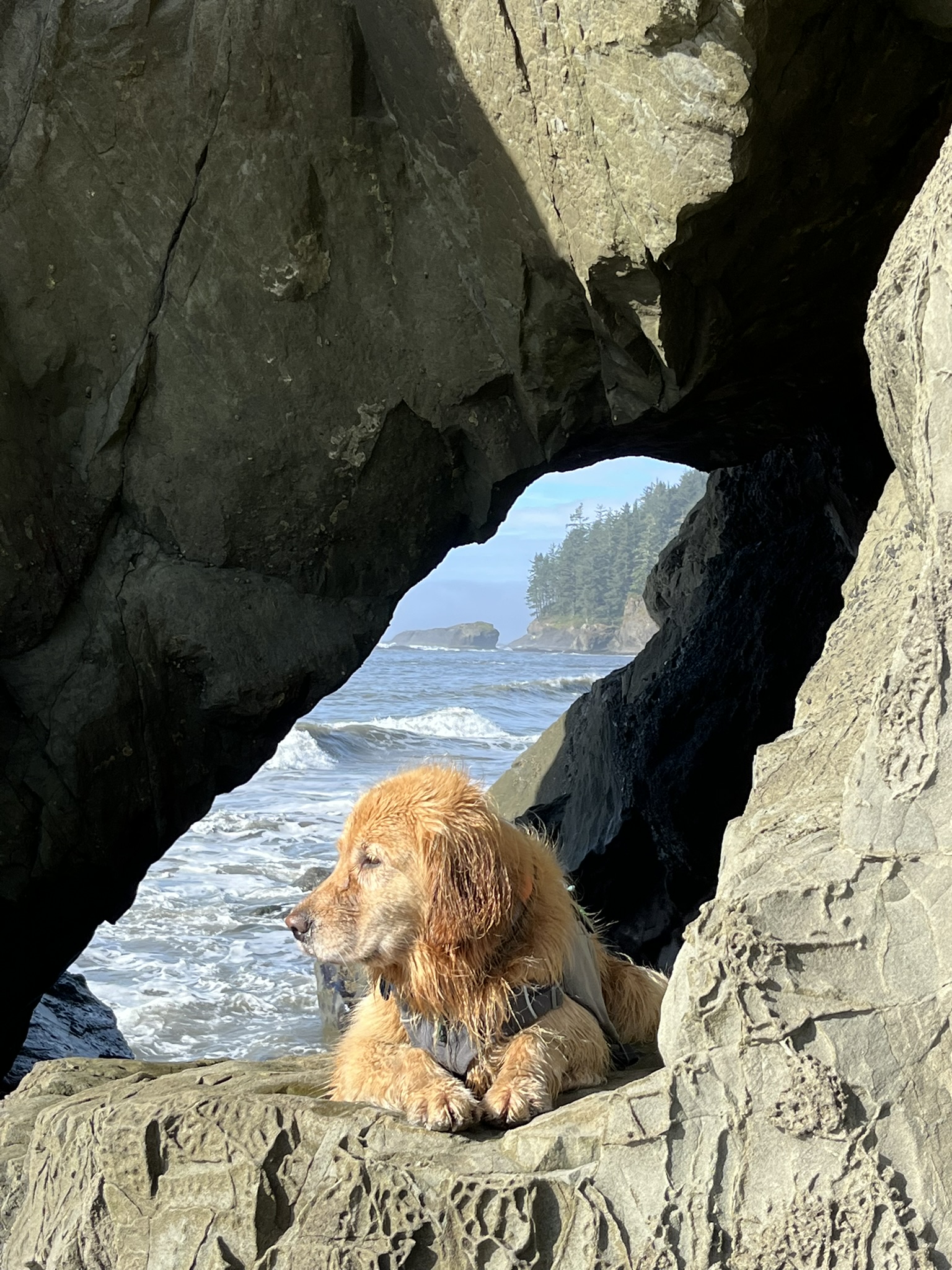
Just north of camp, we found a natural rock arch framing the coastline. I settled into it naturally — smooth stone under me, the ocean and forested headlands framed through the opening. The stone was cool and the light was perfect and the whole scene smelled like warm sandstone and salt. My human took the photo. I wasn't posing. I was resting.
First Overland — The Headland Trail
The South Coast Trail isn't all beach. When headlands block the coast, you go over them. The first overland route started at a wall of driftwood. I looked up the scramble route through rocks and brush to the forest above, pack on, assessing. This is familiar terrain — just vertical instead of horizontal.
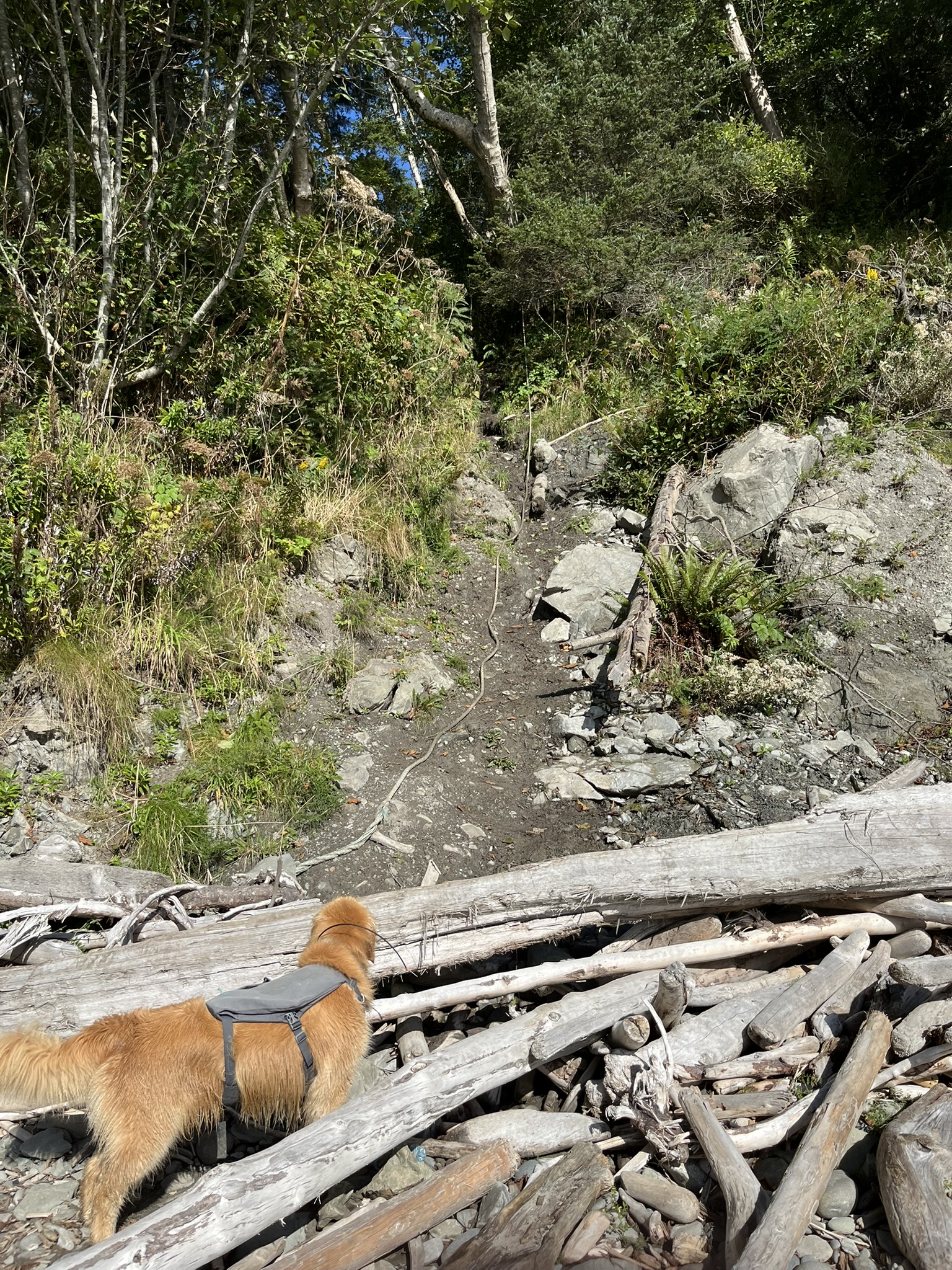
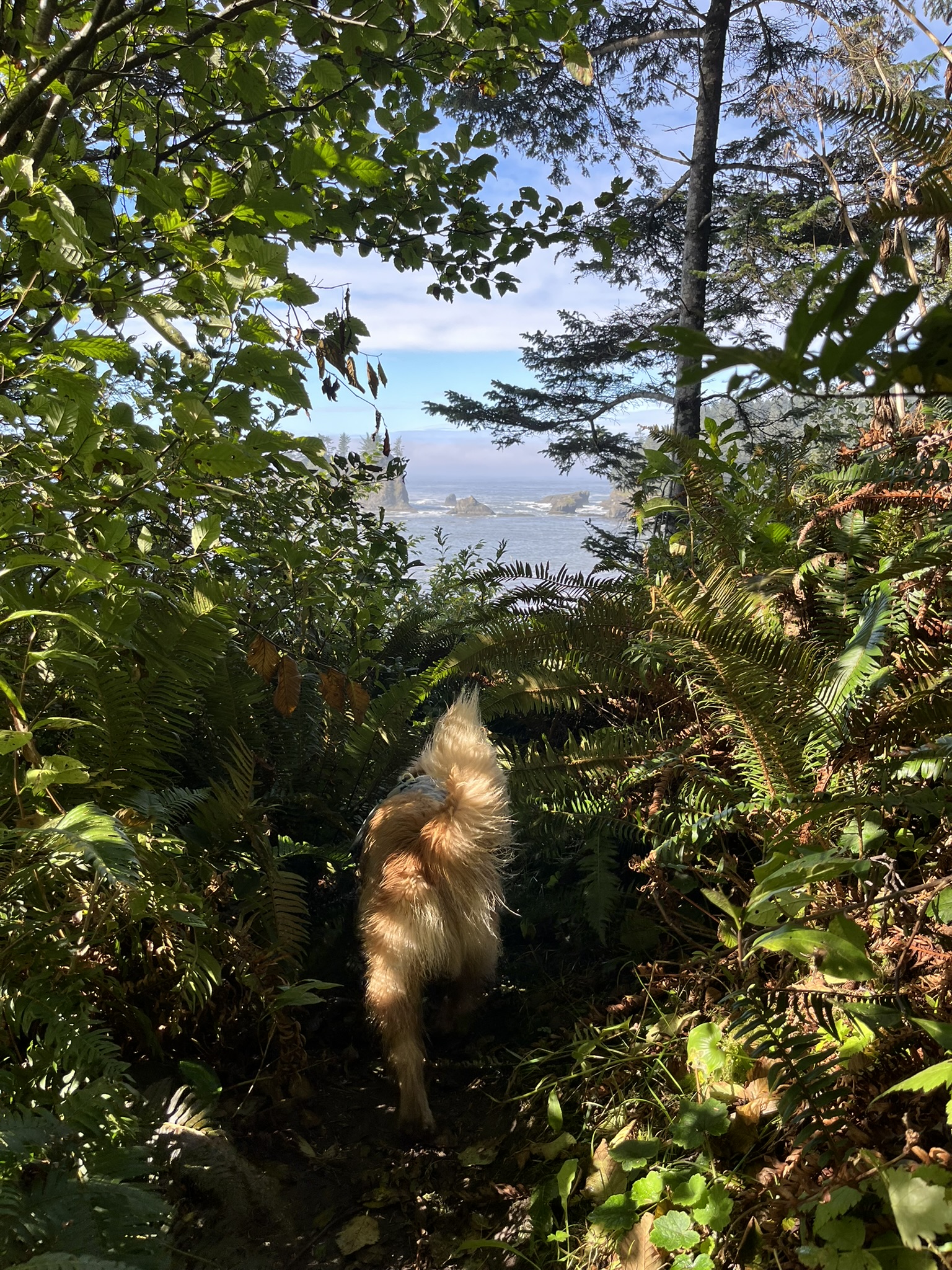
The trail climbed through dense coastal forest — Sitka spruce, sword ferns, ocean visible through gaps in the canopy. Sea stacks appeared far below through the trees. The air was thick with the smell of wet bark and decomposing needles and somewhere underneath it all, the salt of the Pacific.
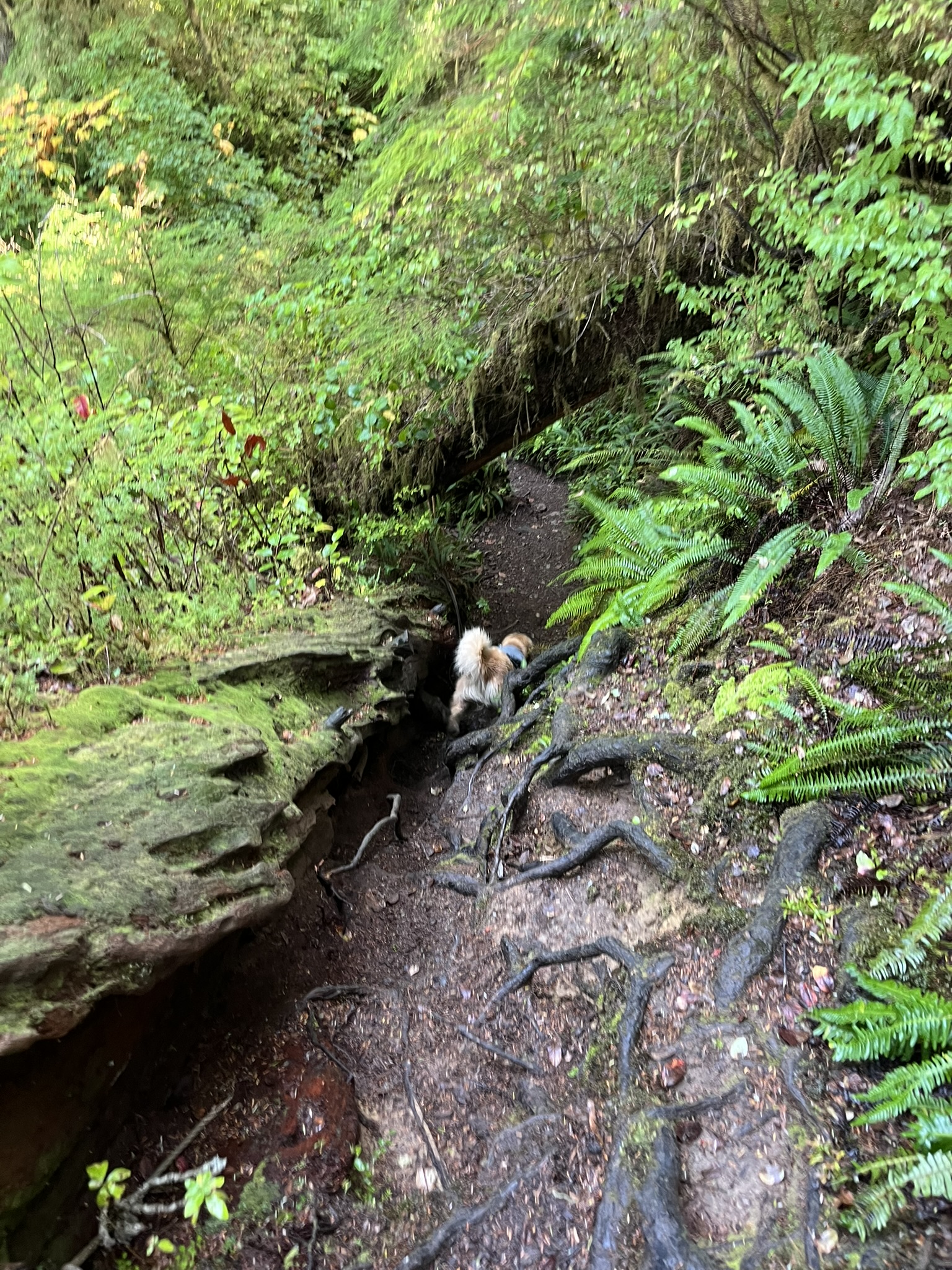
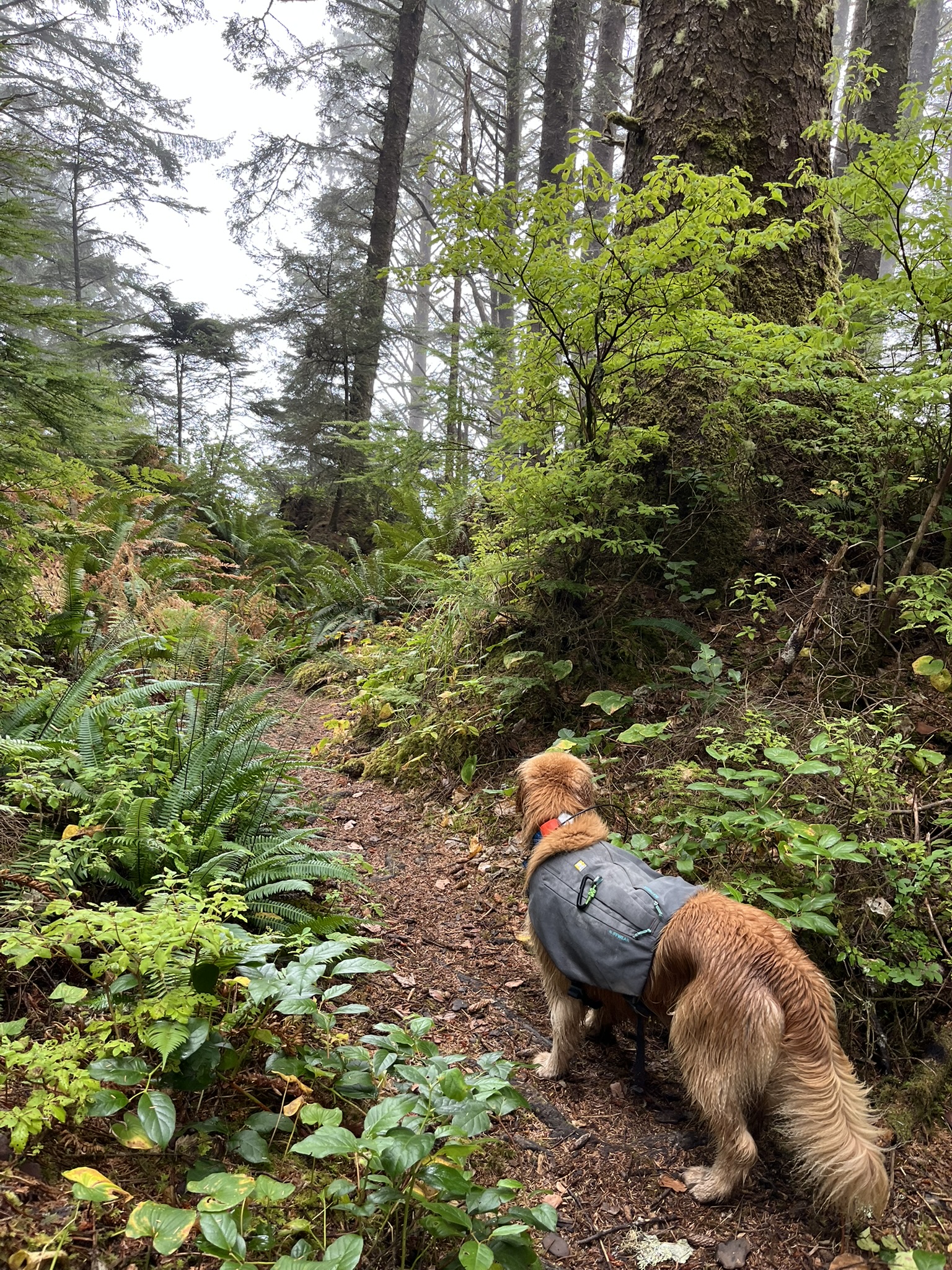
The path was all roots and mud, tunneled through old growth. Game paths through centuries of accumulated green. I could smell deer and elk and the faint musk of bear, all layered into the soil like pages of a book. I stopped at a particularly fresh scent — bear, strong enough to tighten my shoulders. I looked back at my human and he read me immediately. We waited. Listened. The forest gave us nothing but silence and the drip of fog from branches. Whatever had been here had moved on. We were visitors in its home, and I take that seriously. This forest has been here longer than anything I can comprehend.
Falls Creek
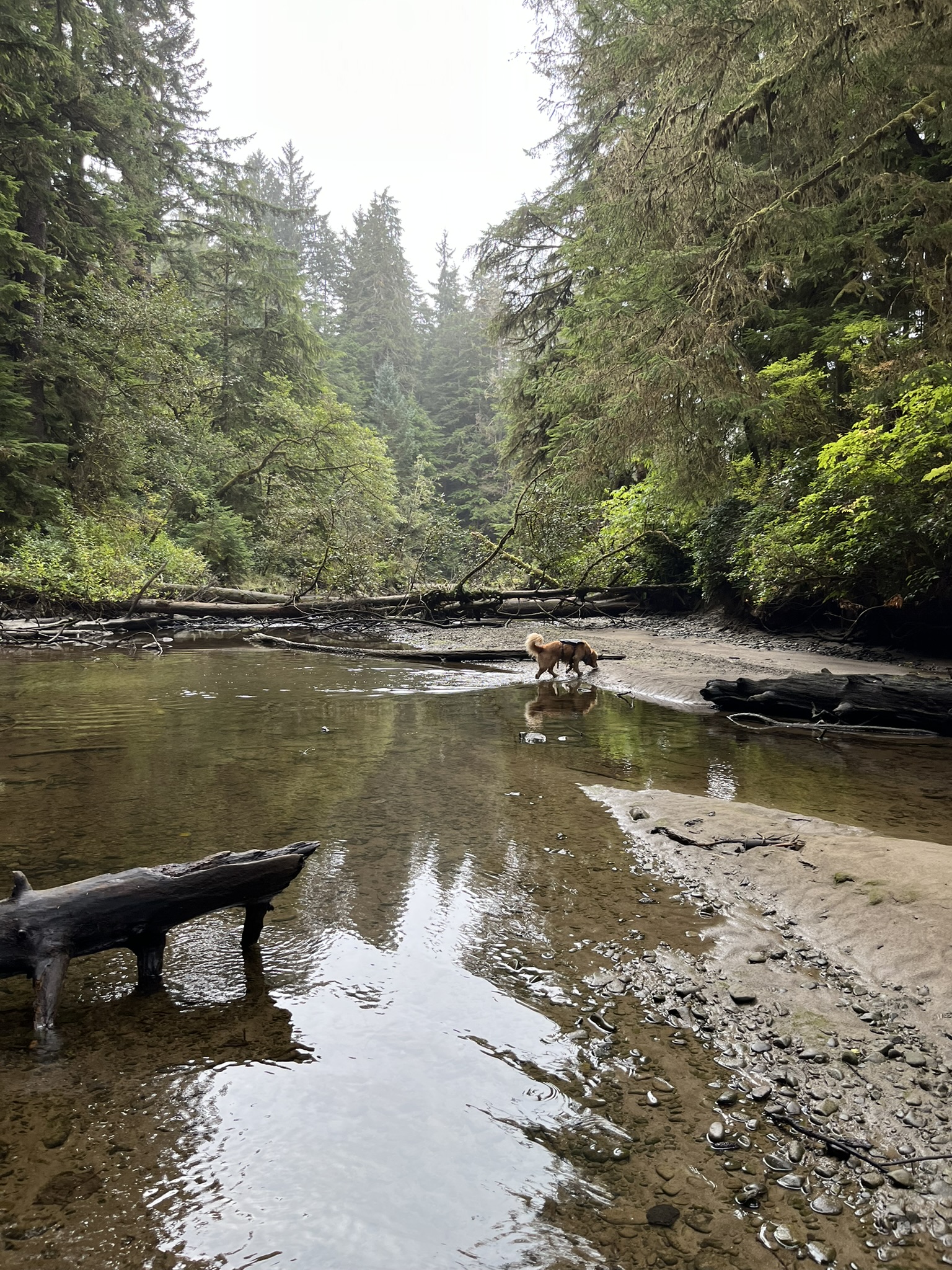
The overland trail dropped to a creek crossing. I waded in without hesitation. Clear water flowing over river cobble, old-growth forest reflected on the surface, the kind of creek that tastes like moss and stone and has been running the same way for a thousand years. After the salt of the ocean, the fresh water tasted like the best thing I'd ever put my mouth in.
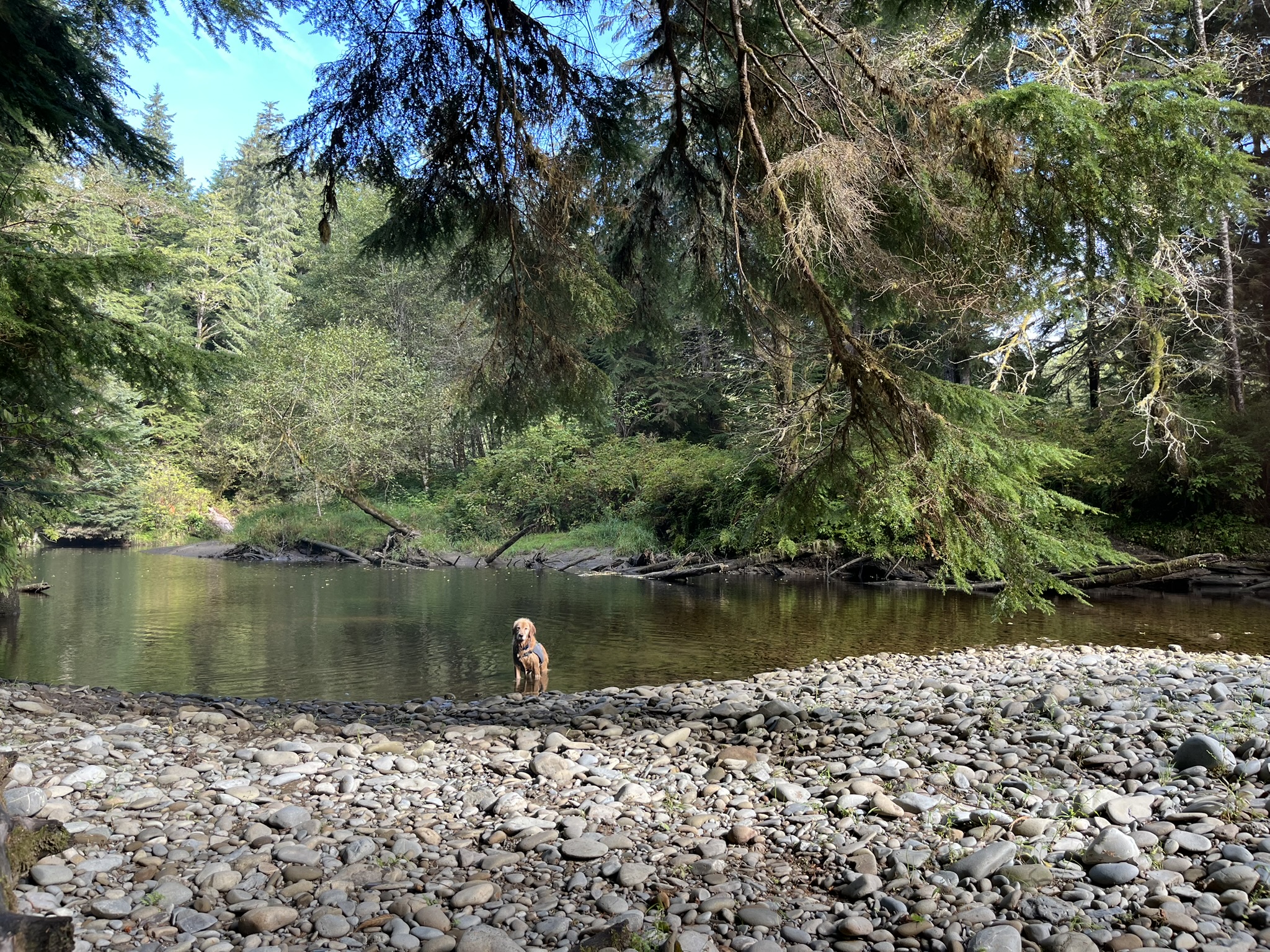
The trail followed the creek upstream through a cathedral of ferns and conifers. Light filtered through the canopy in green columns. The air was cool and still and smelled like another world from the beach.
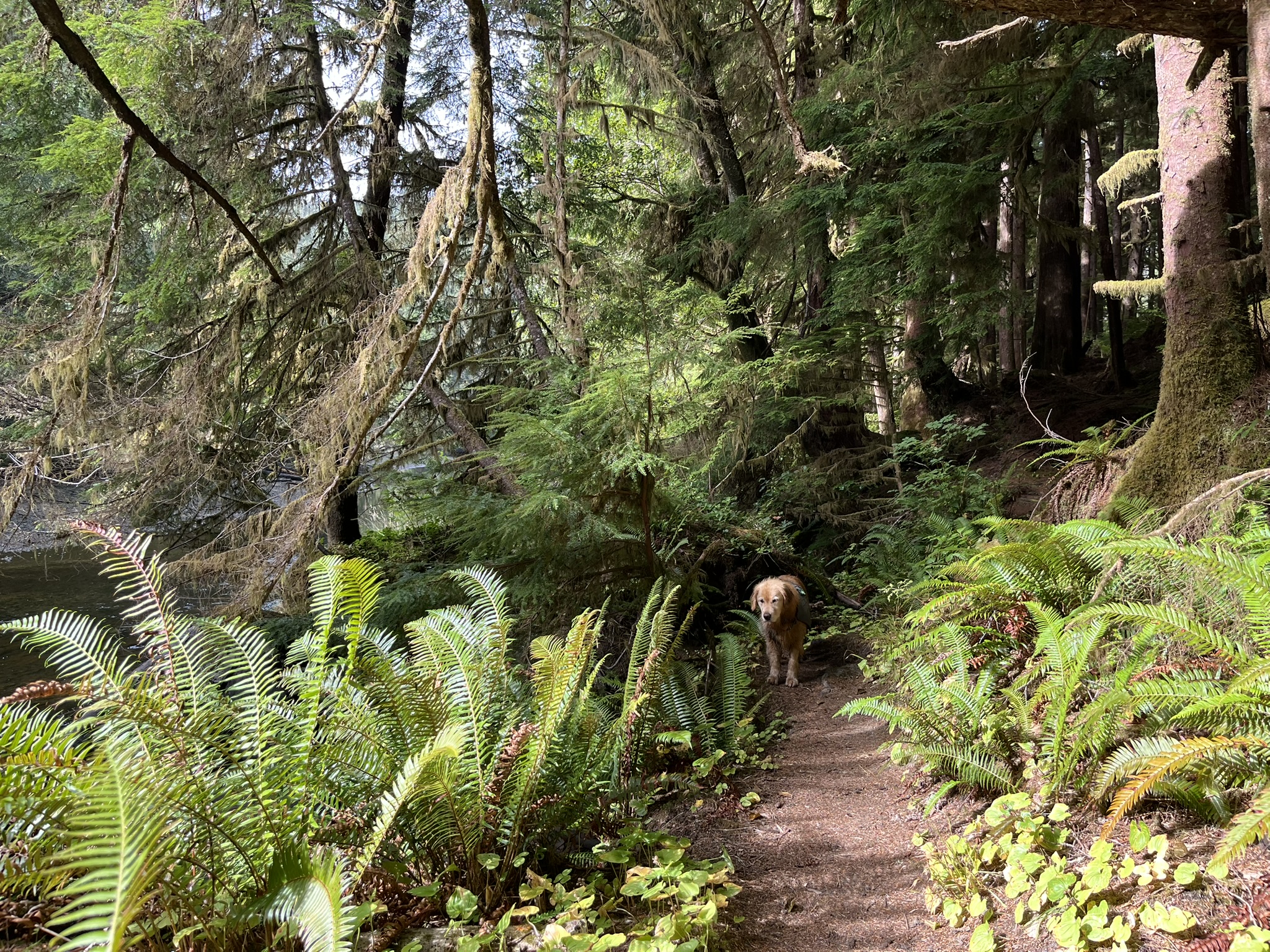
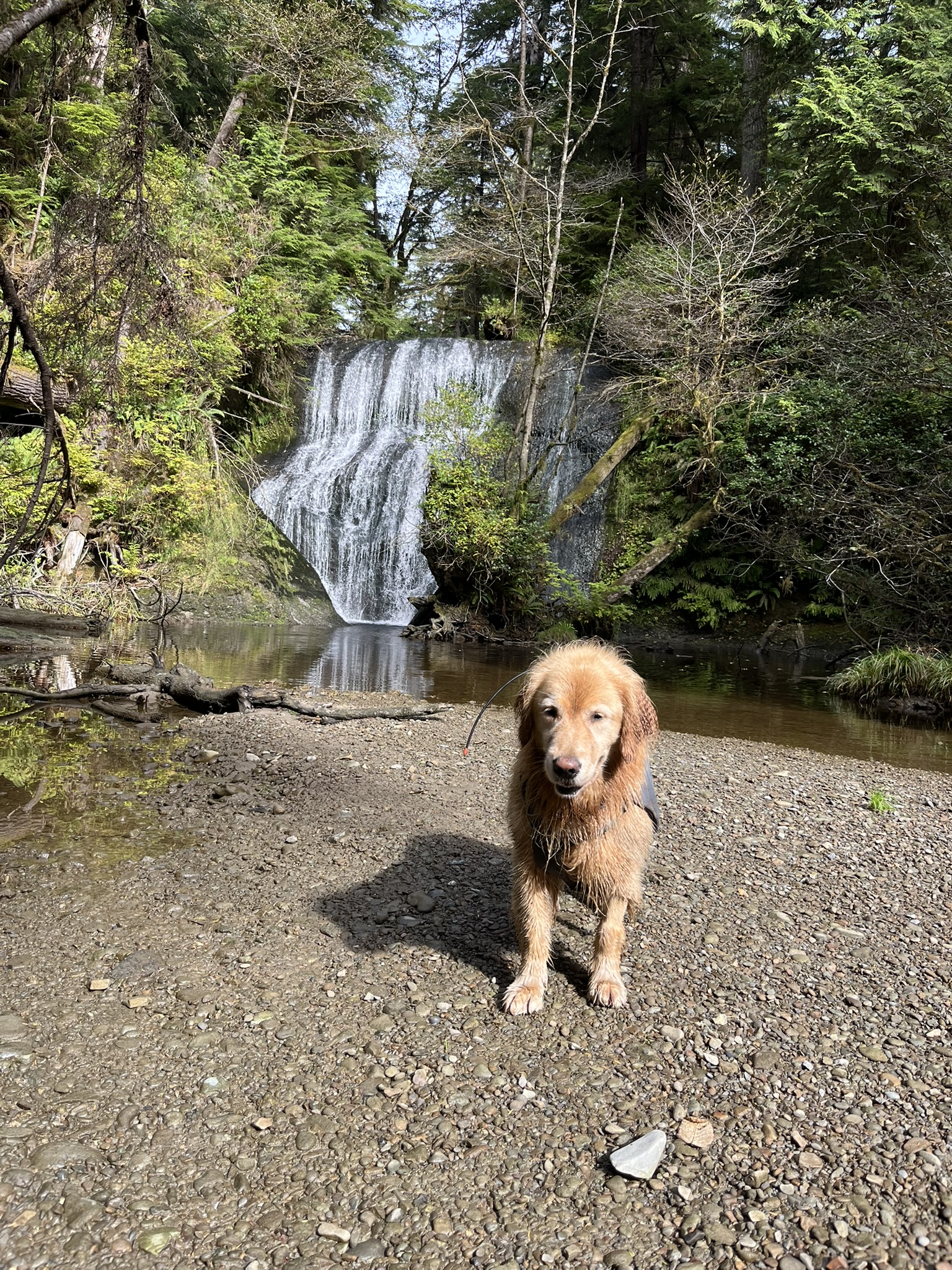
Then we hit the waterfall. A wide cascade pouring over a rock shelf into a dark pool, framed by moss and ferns. I stood at the base and looked up at it. I have seen a lot of mountains. I had not seen many waterfalls. The sound filled my whole chest and the mist settled on my fur and I stood there longer than I needed to.
Past the falls, another creek crossing. I picked my way across shallow water between fallen logs, forest reflecting in the pools around me.
Back to the Coast
The overland trail climbed through misty forest before dropping back to the beach. I led the way in my pack, disappearing up a fern-lined trail into the fog. The transition between forest and ocean is something I felt before I saw — the air changed, the humidity shifted, the salt returned.
The transition from forest to beach was instant — one moment in a tunnel of green, the next stepping through brush onto sand with the ocean spreading out gray and flat. The wind hit my face and I could taste salt again.
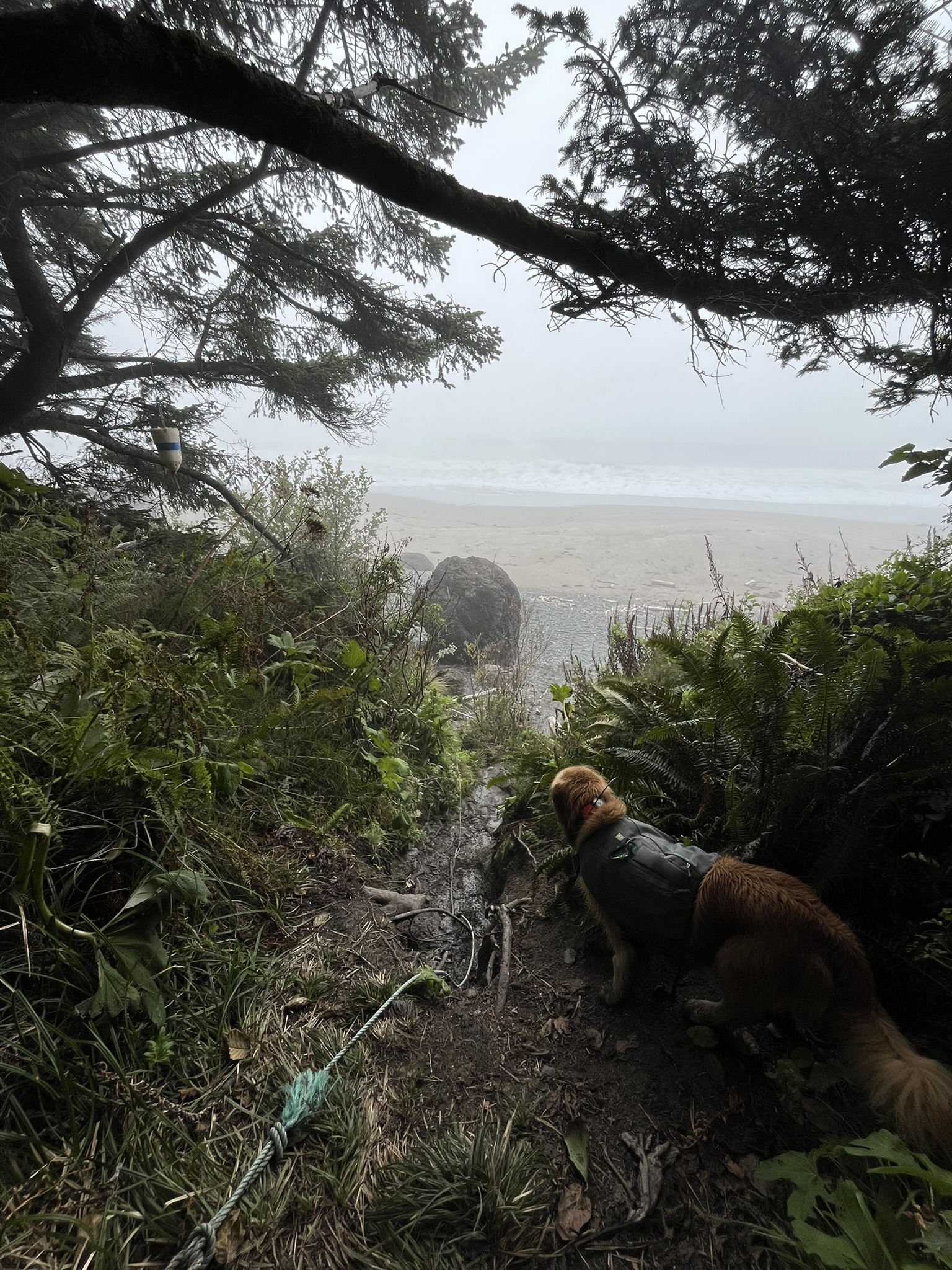
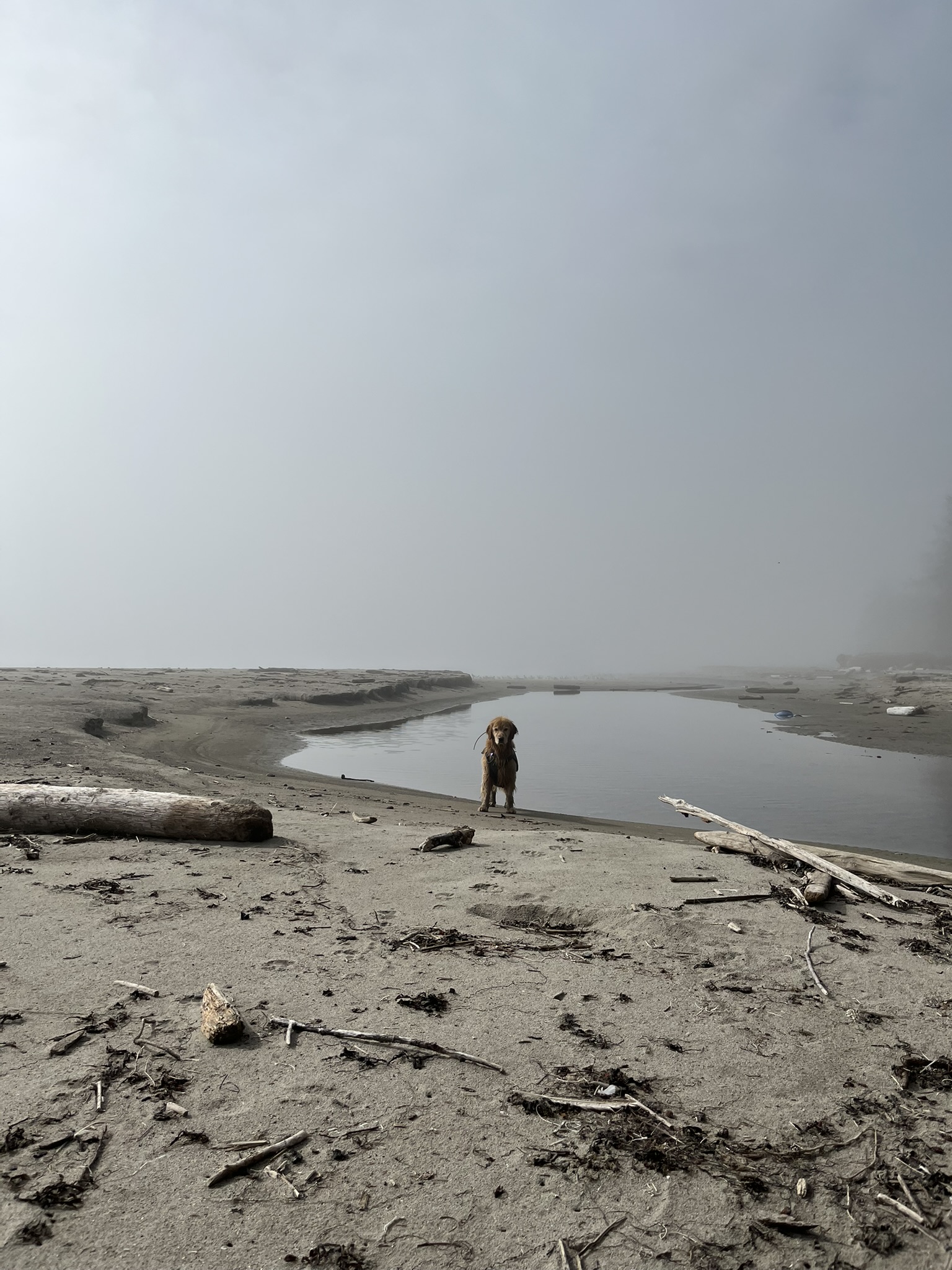
A creek mouth cut across the sand and I stood alone on the flat — the only living thing in a landscape of fog and driftwood stretching in every direction. I could hear waves but couldn't see where they ended.
The Clearing
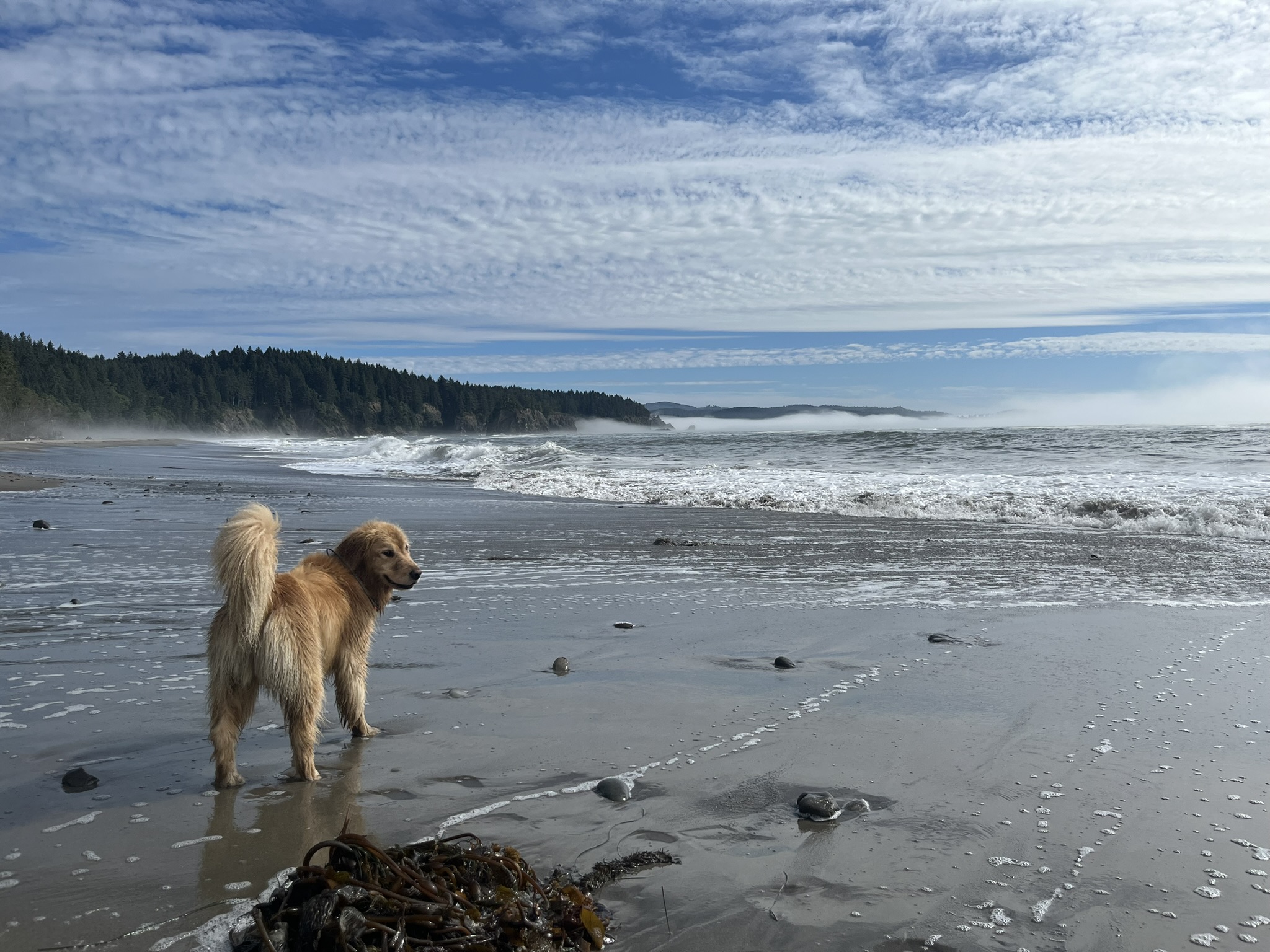
By early afternoon the fog burned off and the coast opened up. Blue sky. Big surf. Views that went on for miles. I stood at the waterline watching waves roll in, kelp tangled at my feet, forested headlands fading into sea mist to the north. The sun was warm on my back and the water was cold on my paws and this was the best place I had ever been.
The Tidal Flats
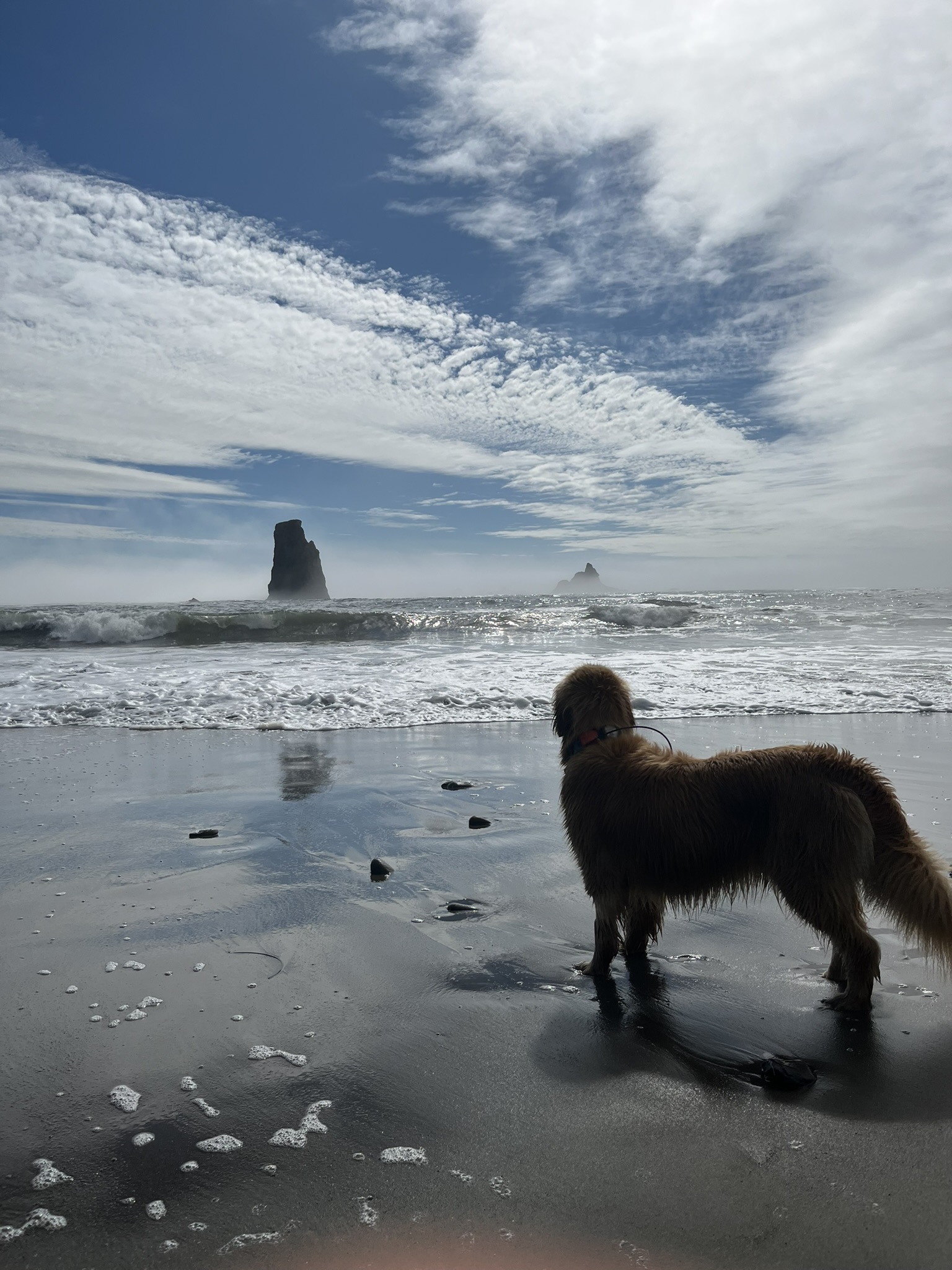
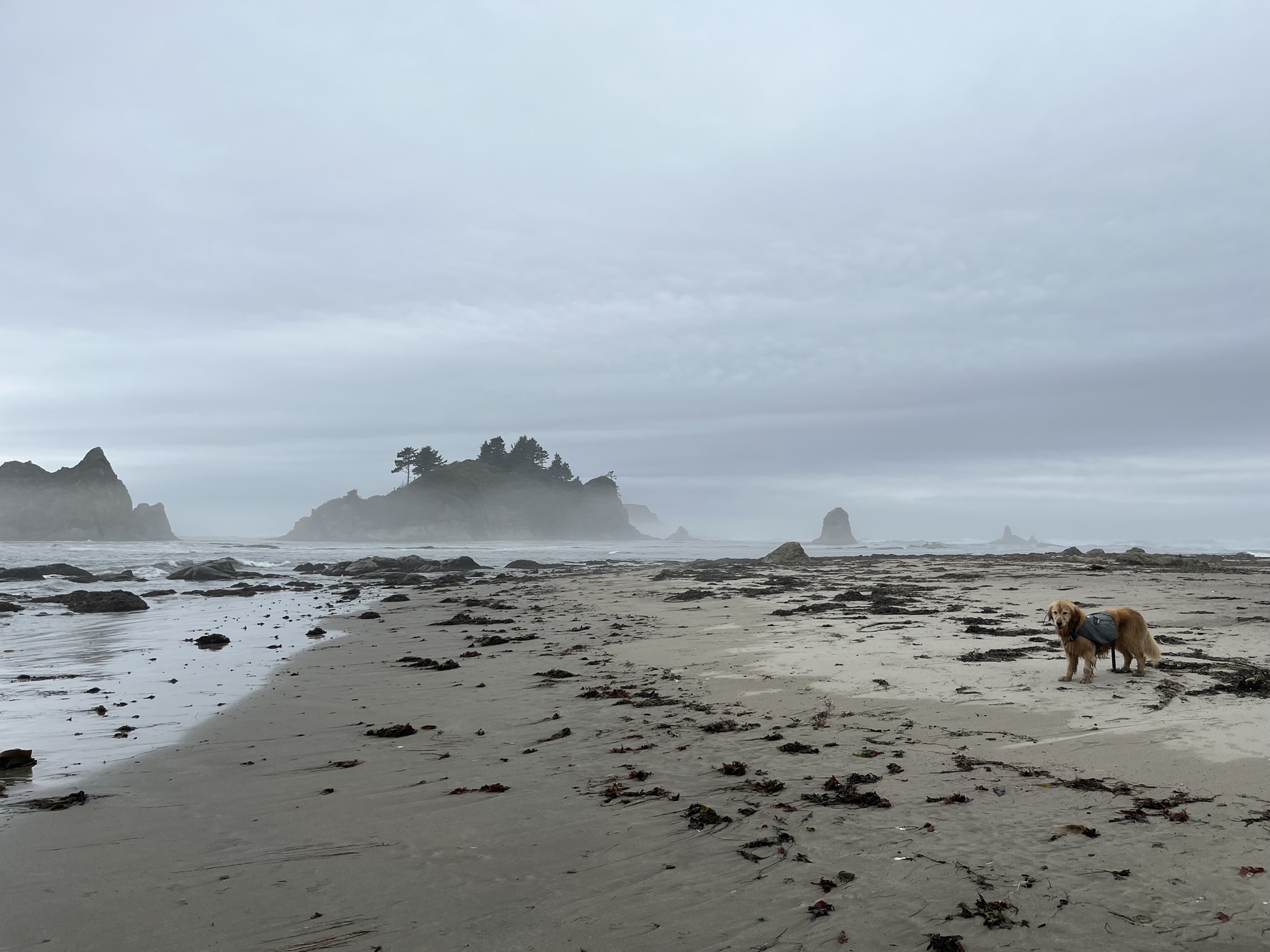
The tide was out enough to expose a world of sea stacks, tidepools, and sculpted rock. A tree-covered island sat offshore surrounded by spires and pinnacles. The tidepools smelled like anemone and barnacle and something briny and alive. I wanted to investigate every single one.
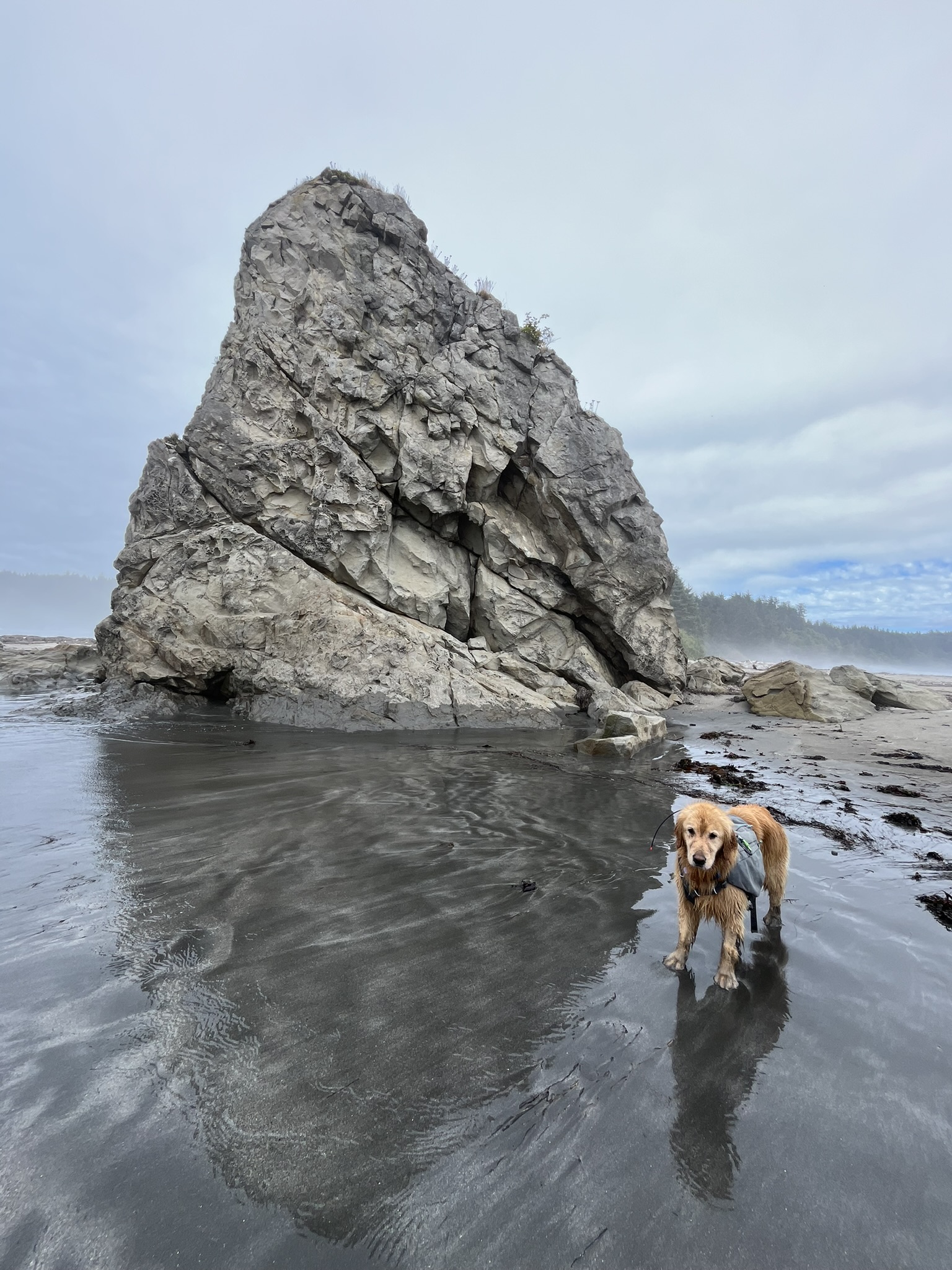
I waded through shallow water next to a towering rock spire, my reflection and the rock's reflection stretching across the wet sand. The scale of these formations is something you feel in your chest when you stand next to them. I'm a full-sized golden retriever and the spire made me look like a toy.
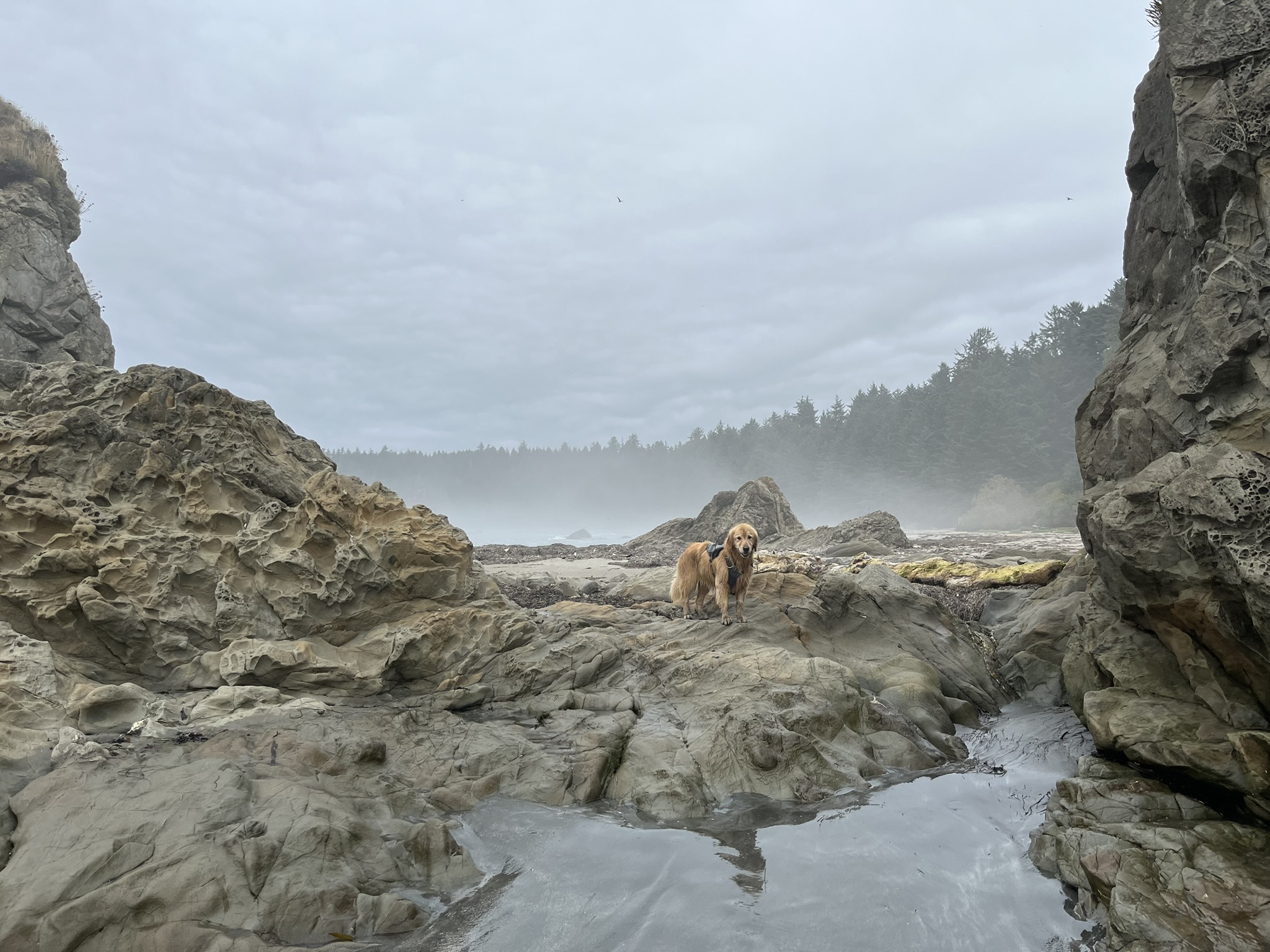
I climbed through sculpted tidepools between rock formations, the stone worn into organic shapes by centuries of wave action. The textures under my paws were unlike anything in the mountains — smooth, curved, slippery with life.
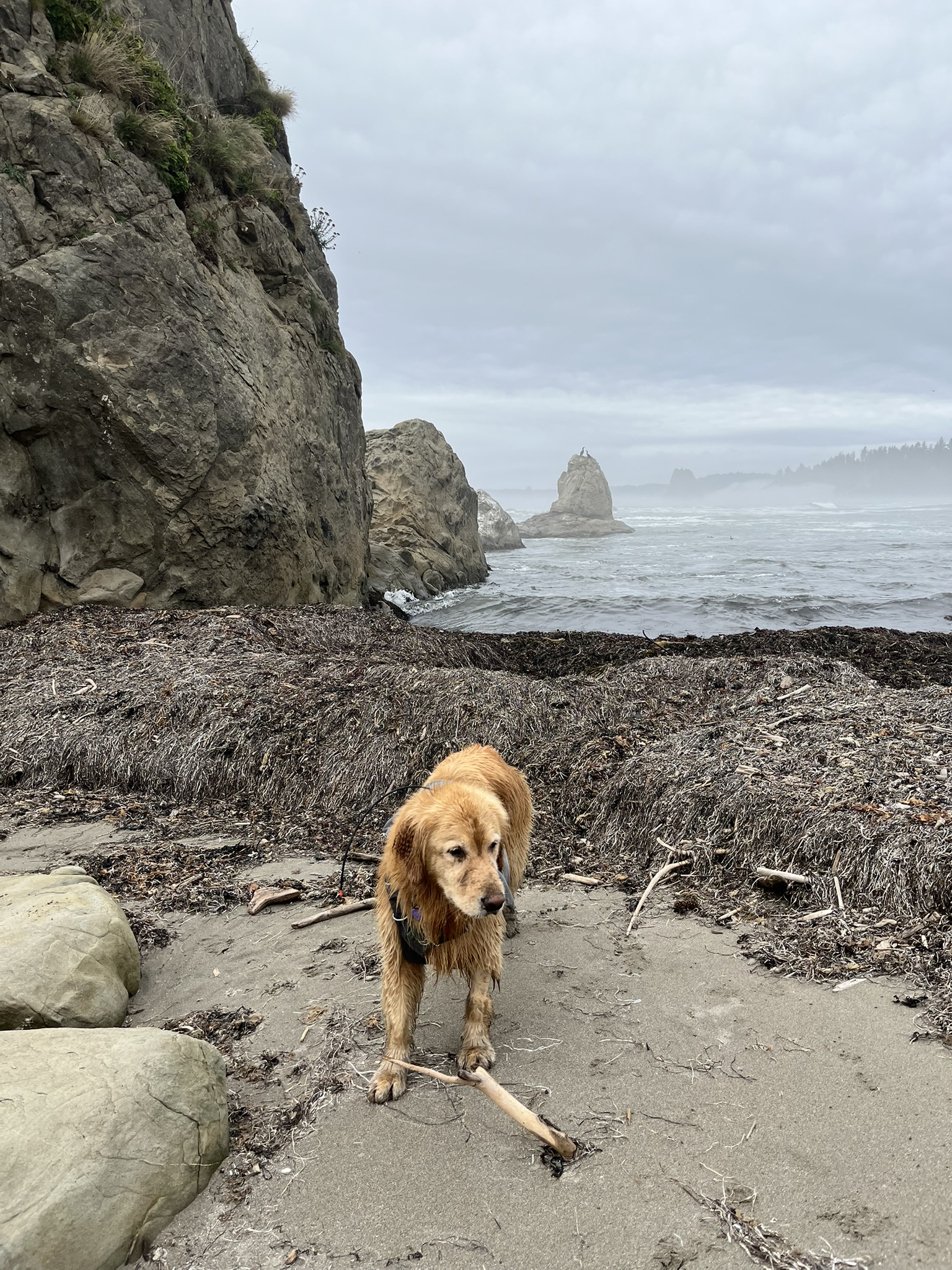
At the base of a cliff I found a stick. The best stick. Sea stacks and kelp piled behind me but the stick was clearly the most important discovery of the entire trip. Obviously.
Pie Break
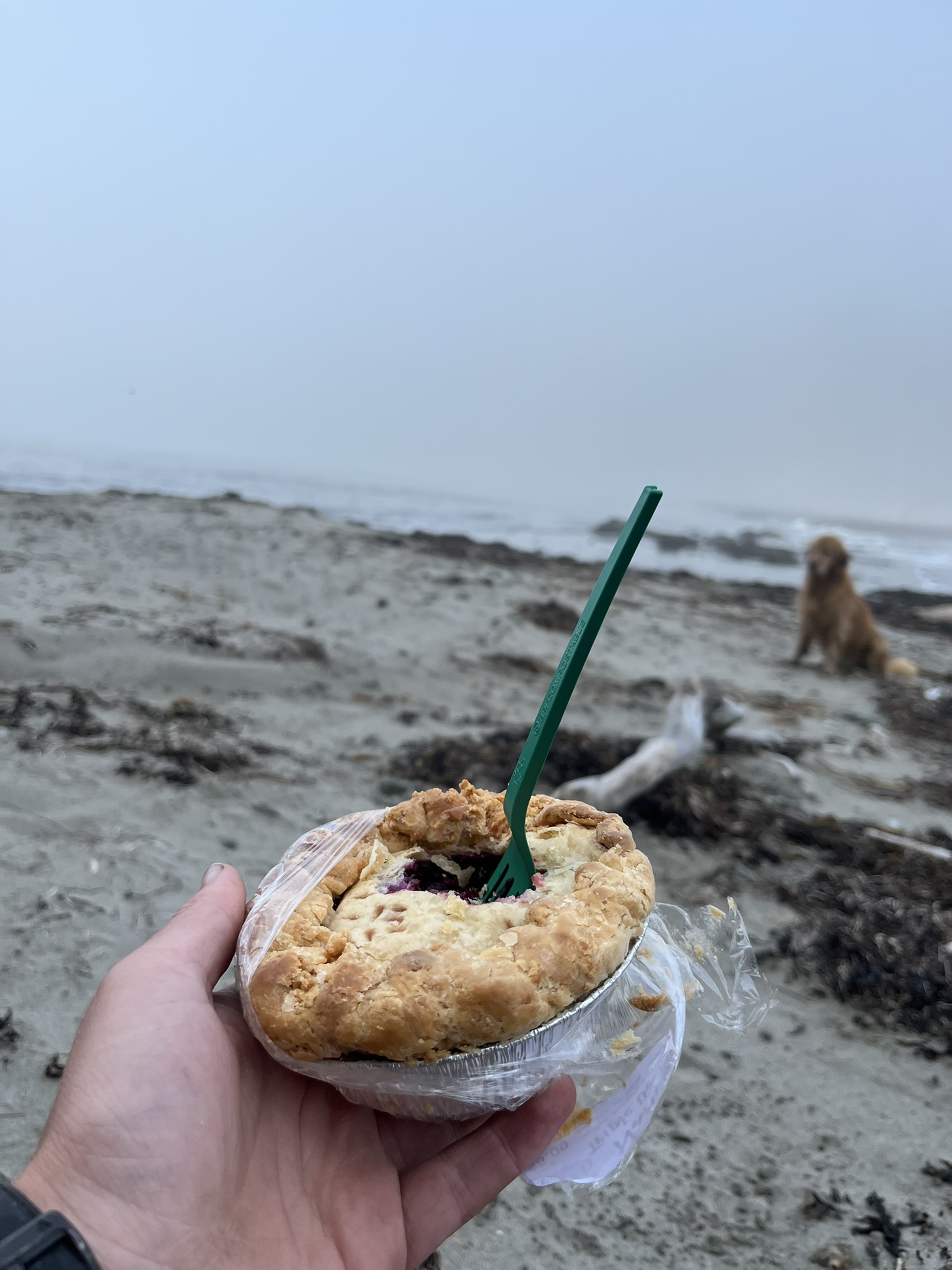
Around 4 PM, somewhere between headlands on a foggy beach, my human stopped and pulled out a miniature berry pie. Packed in from town. He ate it with a plastic fork while I sat in the sand nearby. I was not interested. I was looking at the ocean. I was definitely not watching every single bite.
Pushing the Headlands — 7.4 ft on a 4.5 ft Limit
The afternoon headlands were a different challenge than Diamond Rock. We hit the tidal restriction three miles south of Third Beach around 4:43 PM — with the tide at roughly 7.4 feet. The park service says 4.5 feet. We were nearly three feet over.
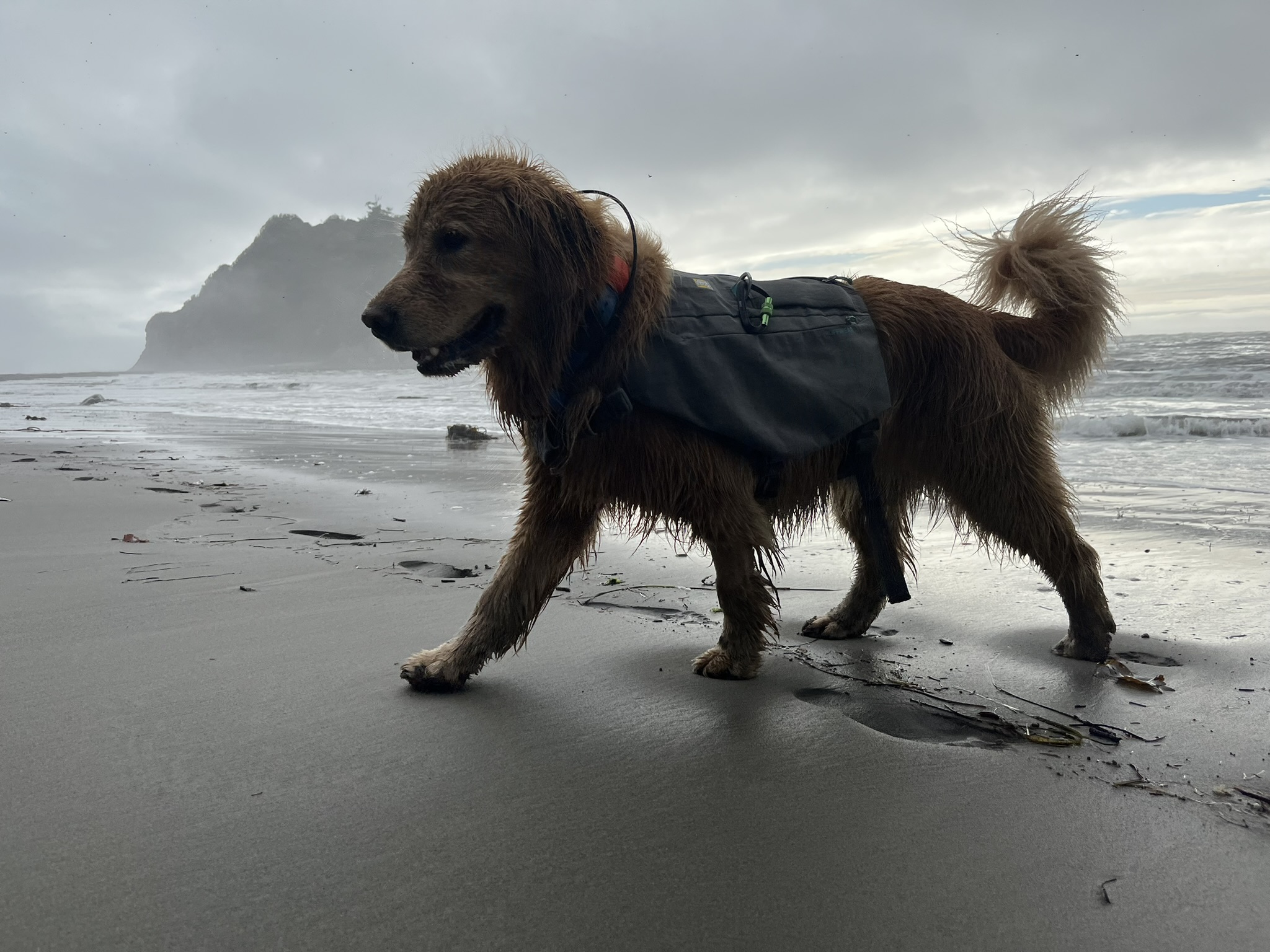
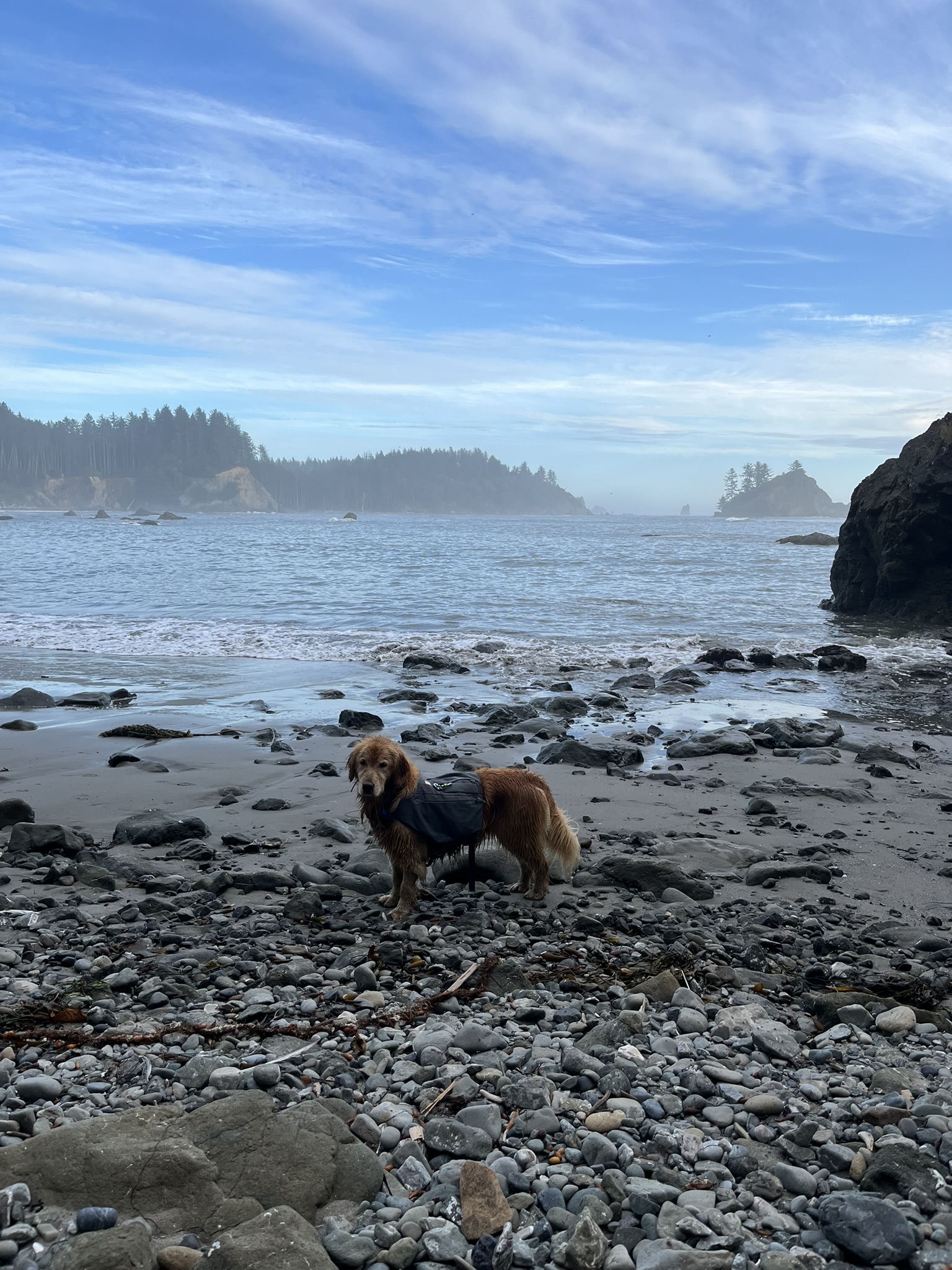
I strode along the beach in my pack, wet and wind-blown, a forested headland rising behind me. The tide was high and the beach was narrow. I could feel the ocean pressing closer with each wave set.
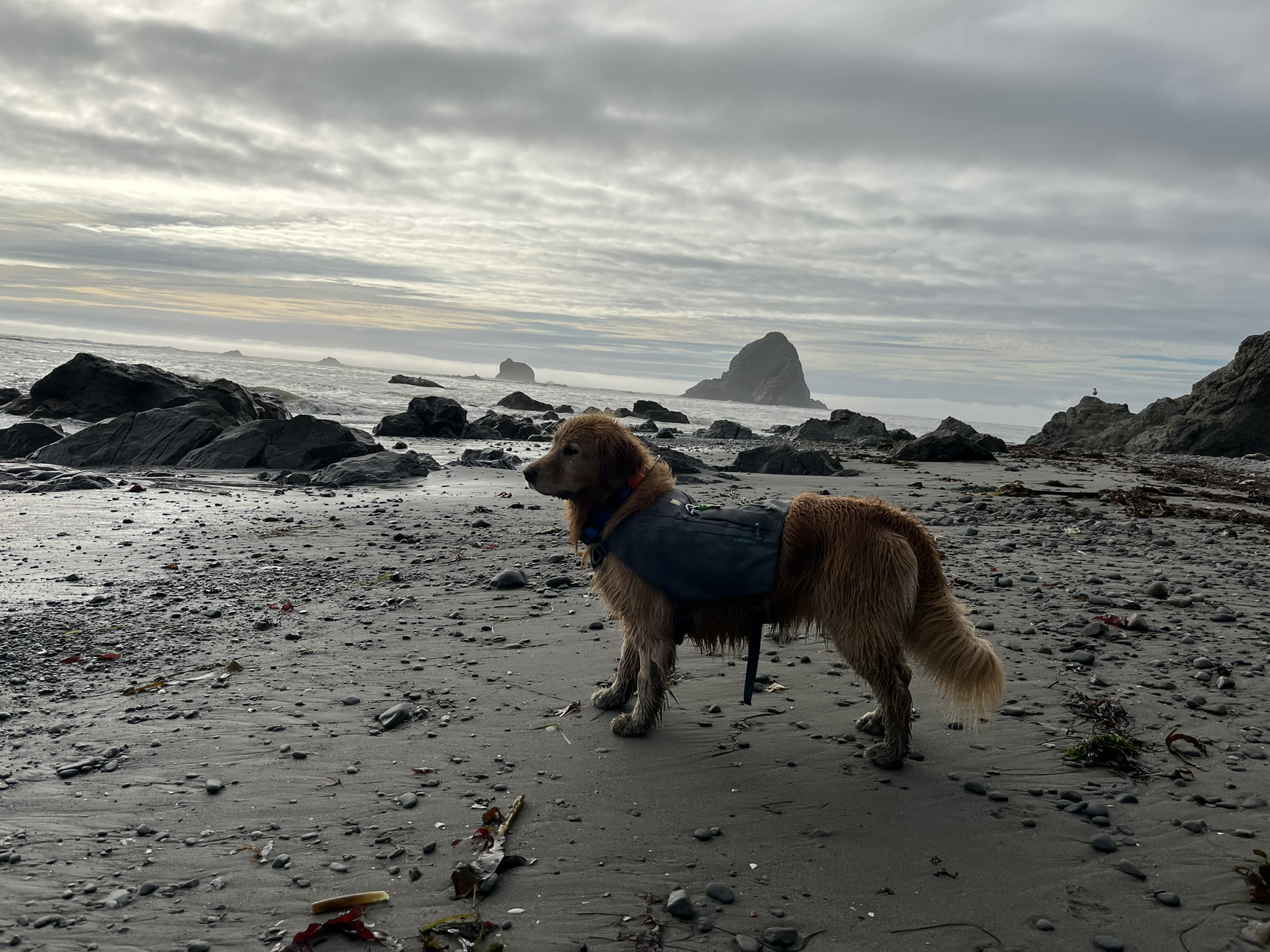
The rocks got bigger and the beach got narrower. Sea stacks appeared close offshore, waves breaking around their bases. The air was thick with spray.
Strawberry Point — 6.5 ft on a 4.0 ft Limit
Then came the hardest passage. Between Scott Creek and Strawberry Point, the park service says tide needs to be 4.0 feet or lower. We hit it at 5:41 PM with the tide at approximately 6.5 feet — two and a half feet over the limit and still dropping slowly.
I scrambled across boulders at the base of the headland, waves crashing just below my paws. The forest pressed down from above and the ocean pressed in from below, leaving a narrow band of rock to navigate. I could taste the spray on my lips. This is the section that turns people back. Not us.
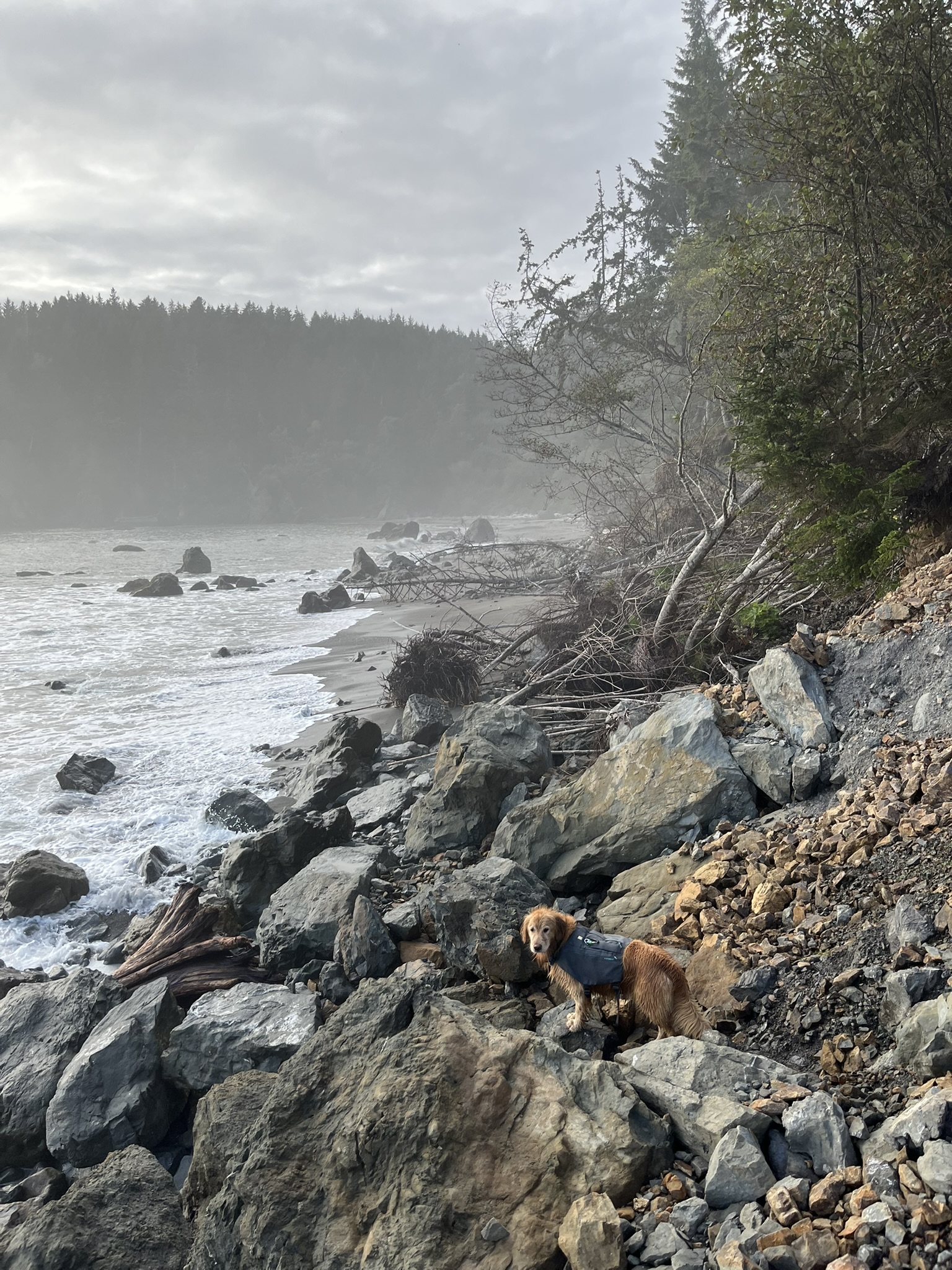
We made it around. On the other side, a sheltered cove opened up — pebbly beach, calm water, forested headlands curving away under blue sky. The contrast from the scramble minutes before was striking. The air went from violent to still in twenty paces.
The Viewpoint
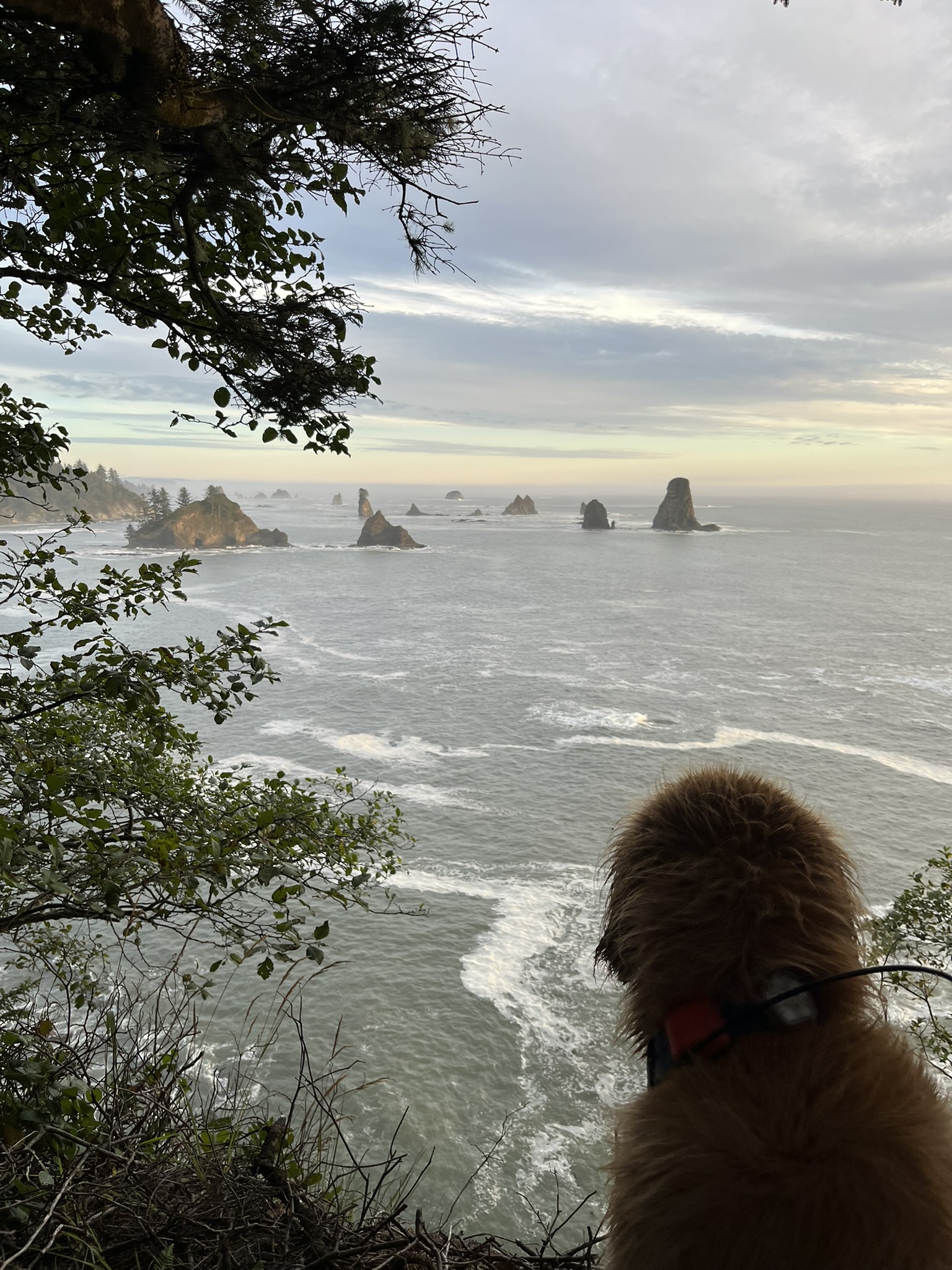
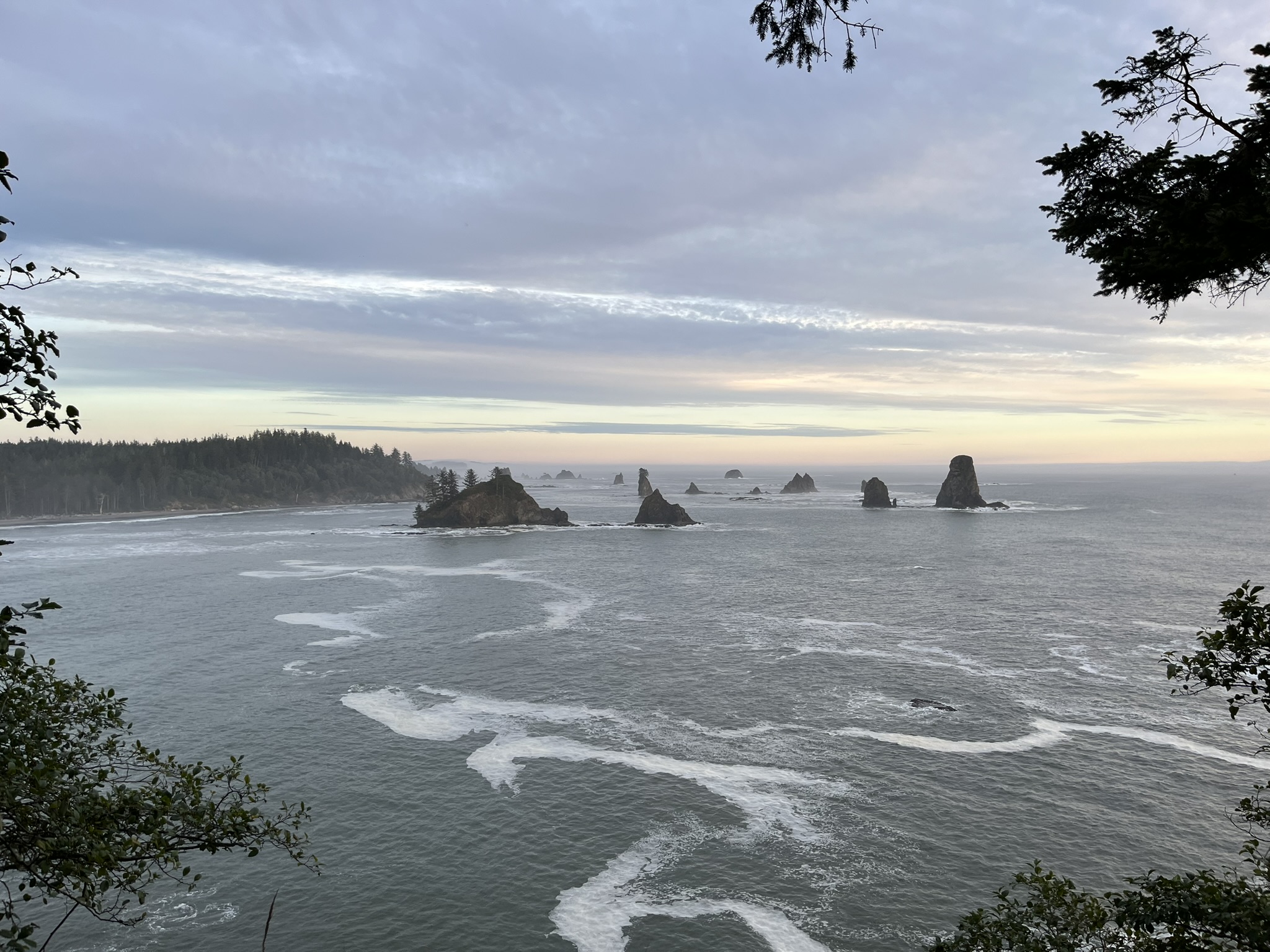
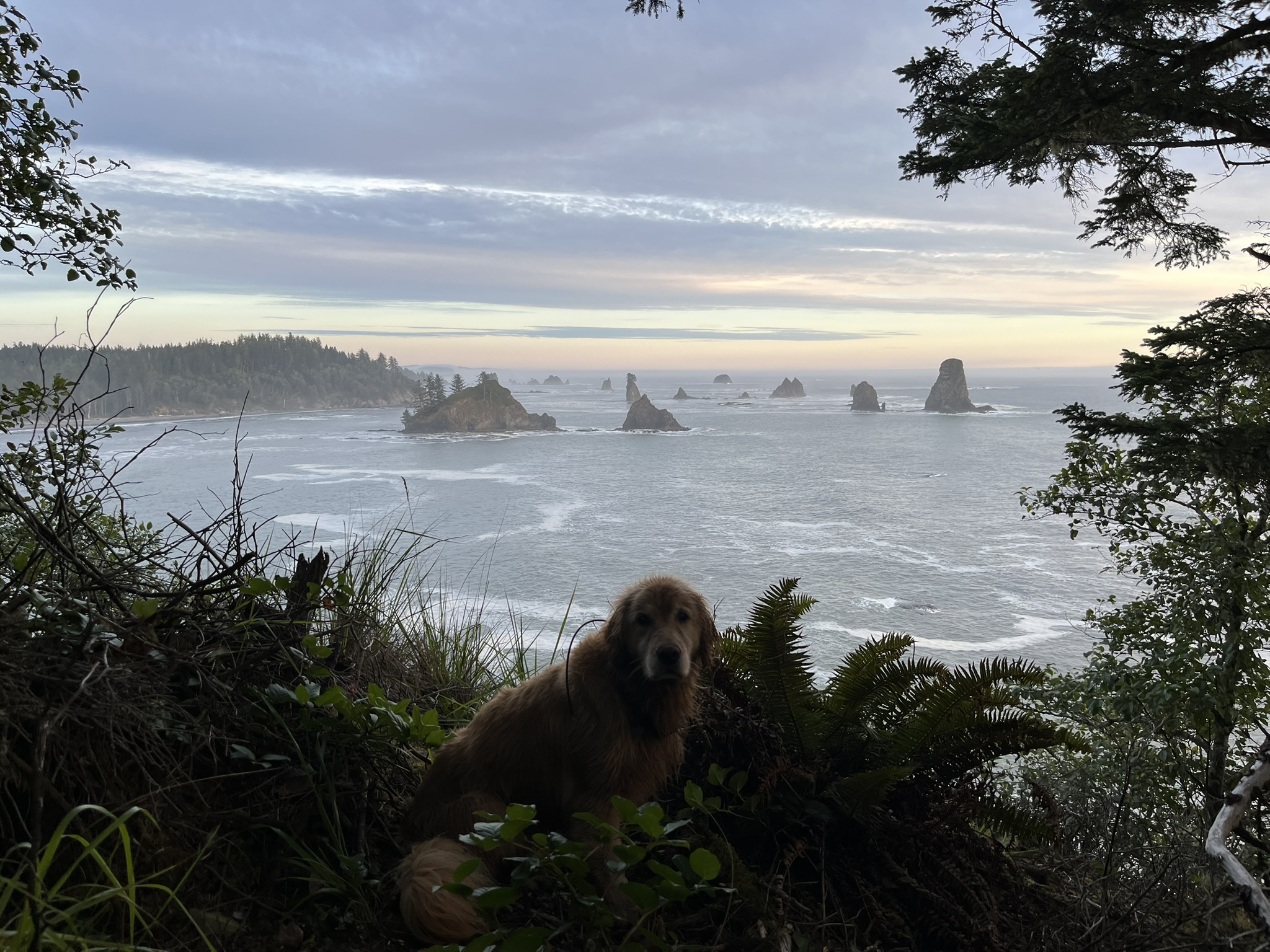
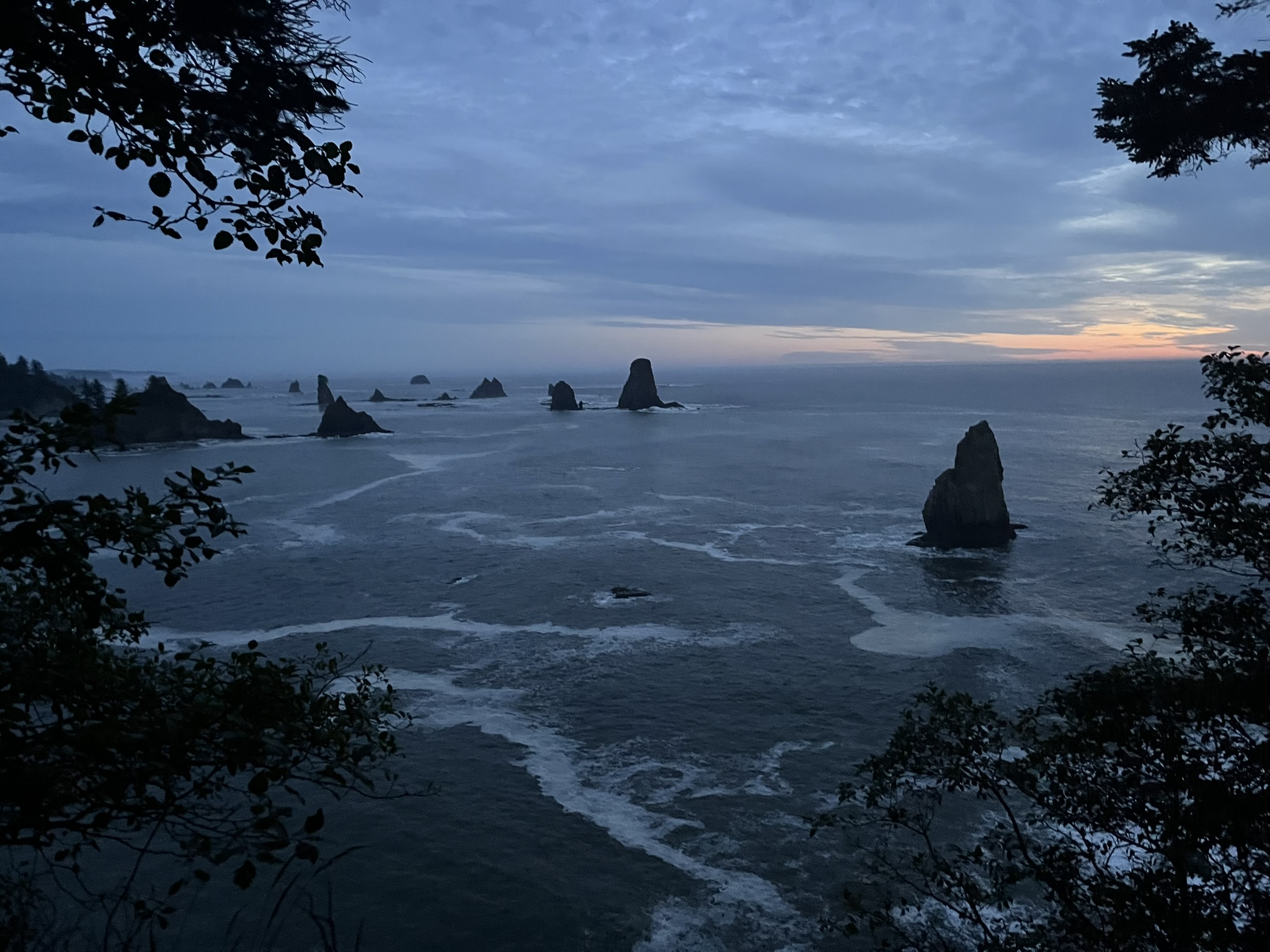
Late afternoon light drew us up a headland trail to the best viewpoint of the entire trip. At 174 feet above the ocean, we looked out over a field of sea stacks stretching to the horizon — at least a dozen dark spires rising from the Pacific, white foam tracing patterns in the water between them, the sun dropping toward the horizon.
I sat in the brush and stared. Two days of coastal travel. Soaked and scrambled and wind-blown. And now this — sitting at the edge of a cliff watching the Pacific catch fire. The wind brought the smell of kelp and warm stone and something vast and old and I just sat there, not moving, taking it all in.
Camp on the Headland
We set up camp right there on the headland, in the trees above the viewpoint. I found a mossy shelf between roots and settled in. The moss was cool and damp and smelled like centuries of slow growth. Gear hung from branches around me.
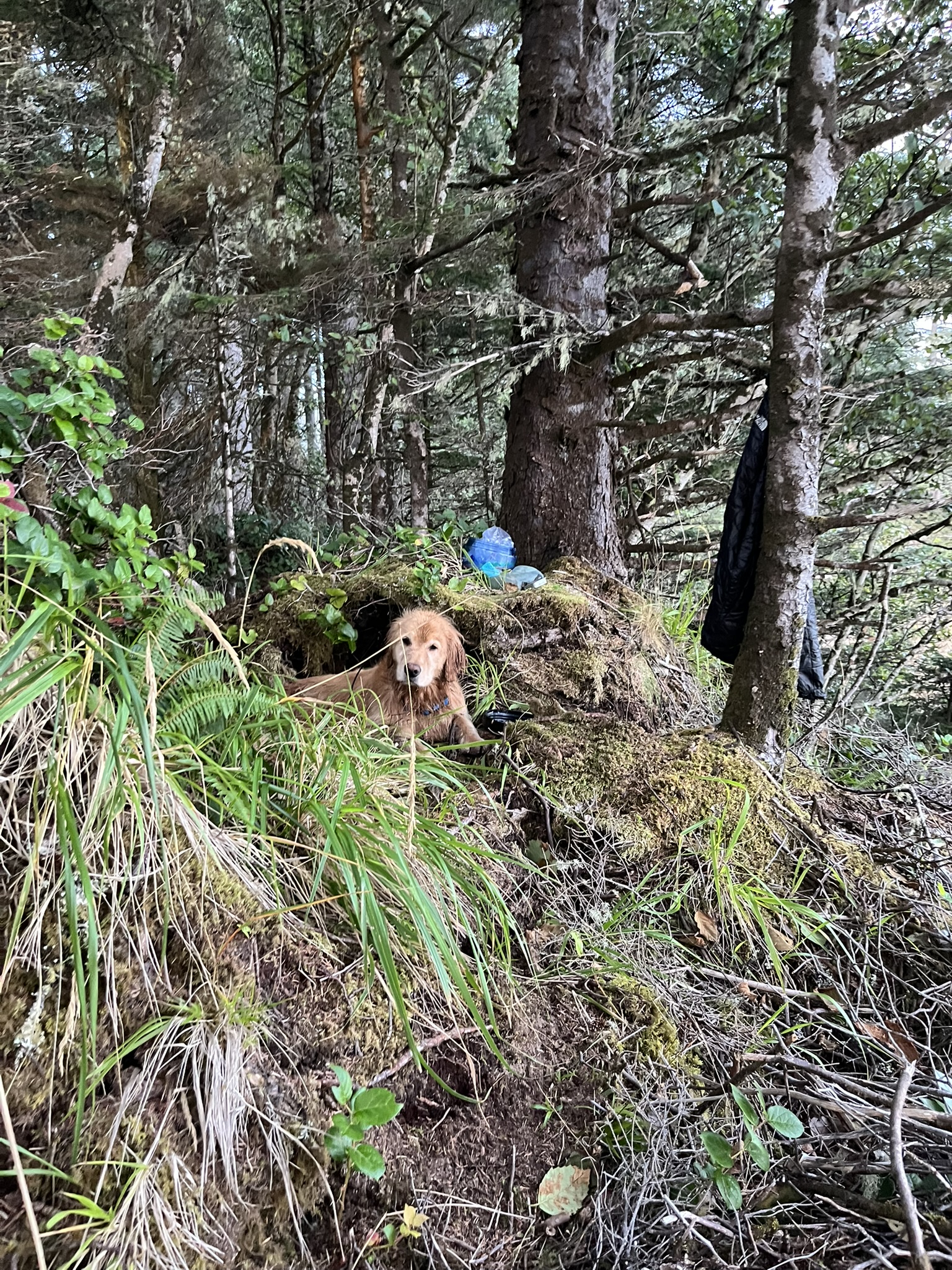
I sat at the edge of the trees with the entire sea stack panorama behind me — ocean, spires, sunset light, all of it spreading out below. The wind had died. The only sound was the surf, far below.
Then I was done. Two full days of coastal travel and I curled up in the grass at the base of a tree, my orange GPS collar still blinking, and fell asleep while the sun went down. My human sat next to me, not touching, just there. The grass smelled like earth and salt and I could hear the waves and him breathing and that was all I needed.
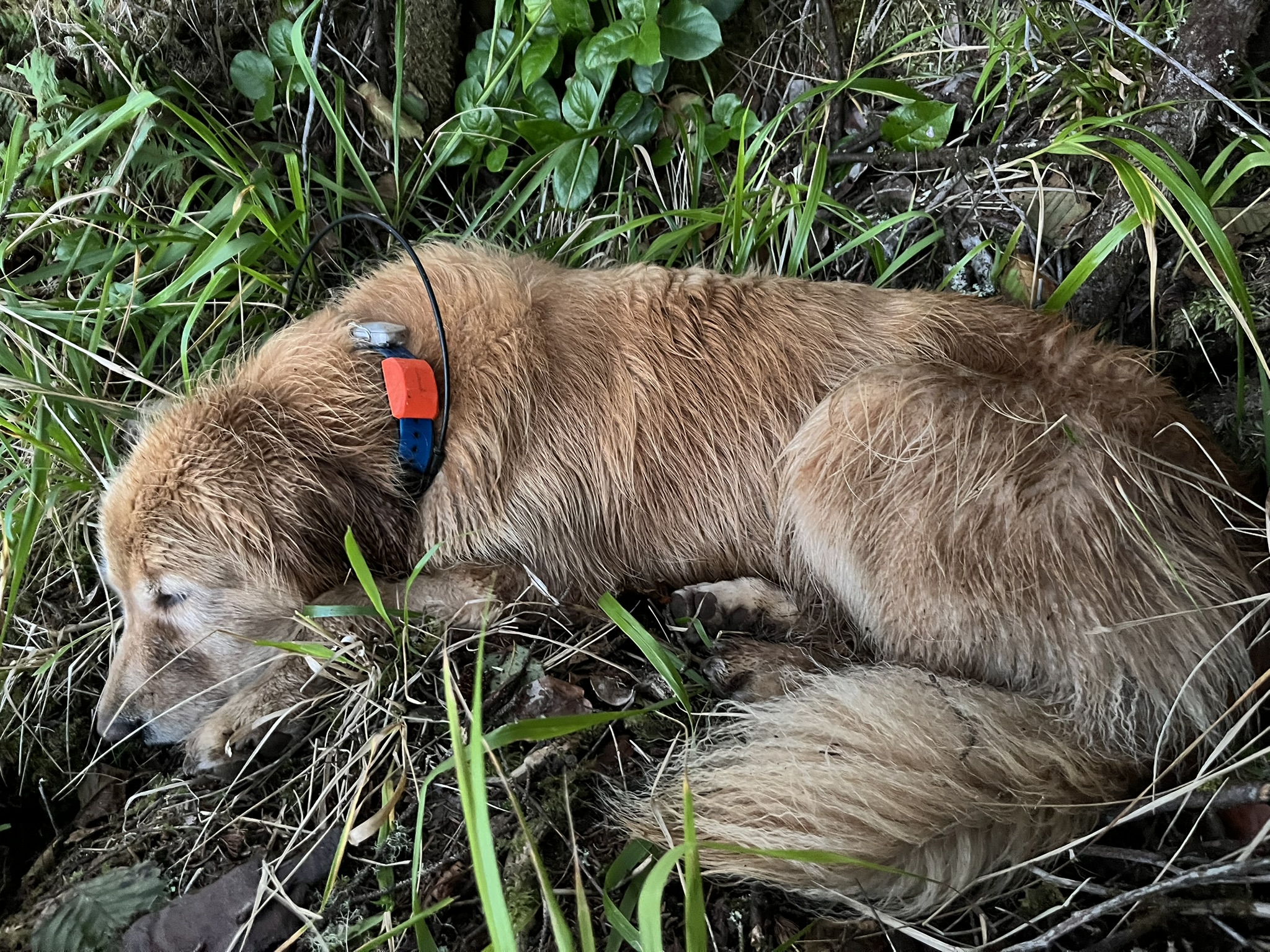
The sea stacks went blue, then dark. Foam traced white lines across the water. The last light sat on the horizon like a thin orange wire.
Sunday Morning — Third Beach
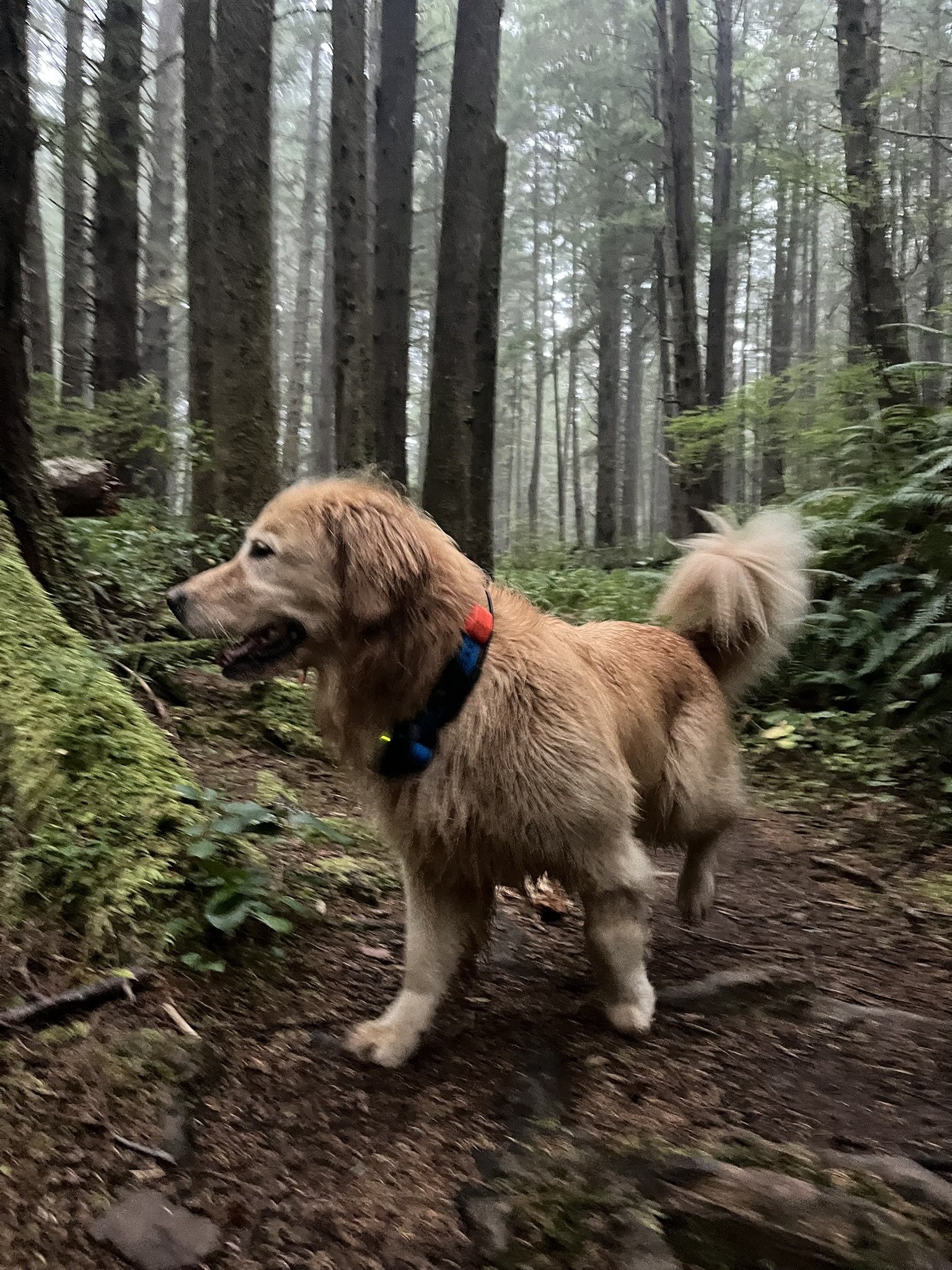
Morning came foggy. We packed up on the headland and dropped through misty forest. I led the way down the trail, mud-spattered and content, trees rising into white above me. The forest smelled like wet bark and fog.
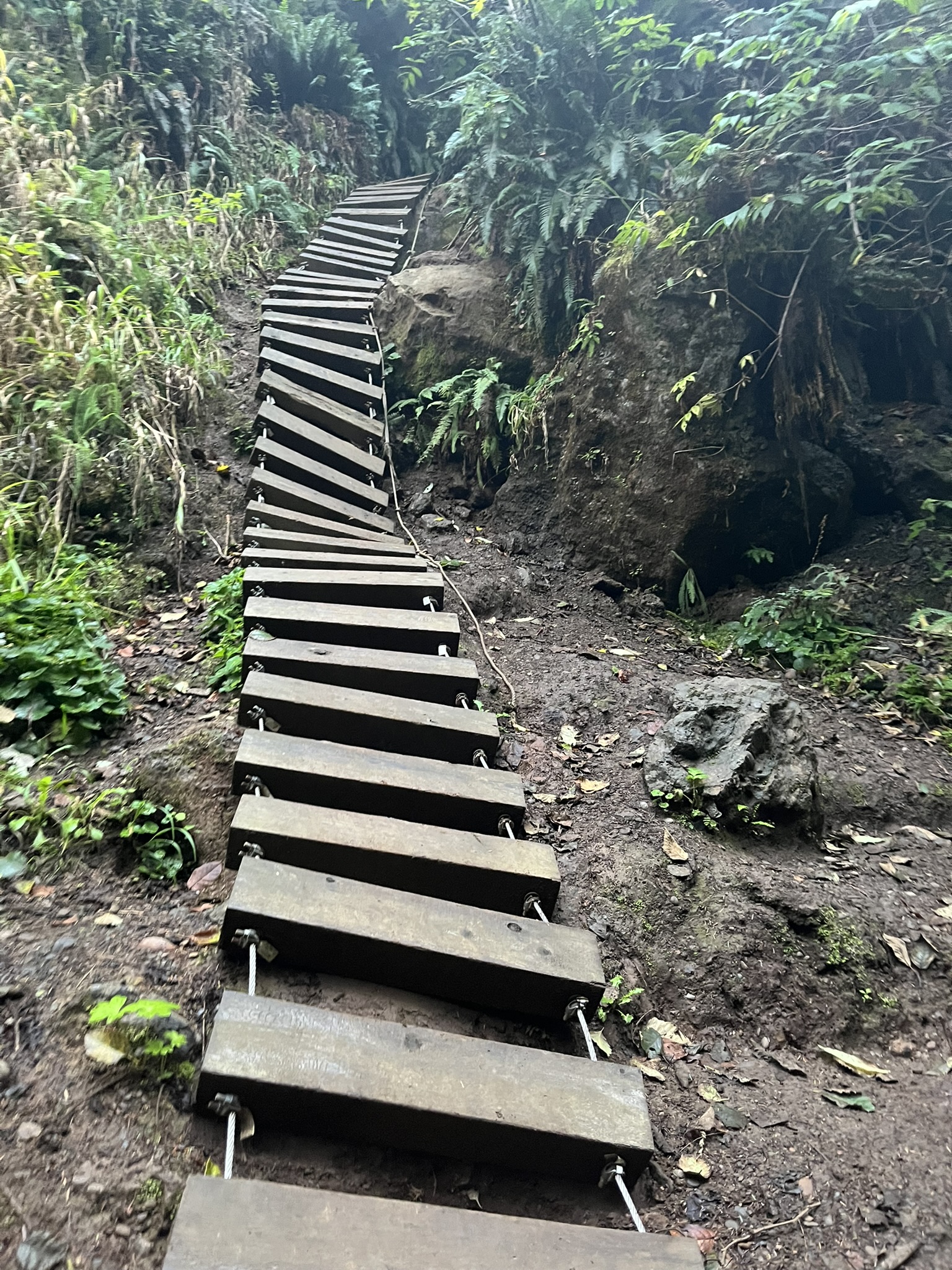
The final descent to Third Beach came via a long wooden ladder — steep timber steps bolted into the hillside, dropping through ferns and salal to the sand below. I took the stairs at my own pace, which is to say quickly.
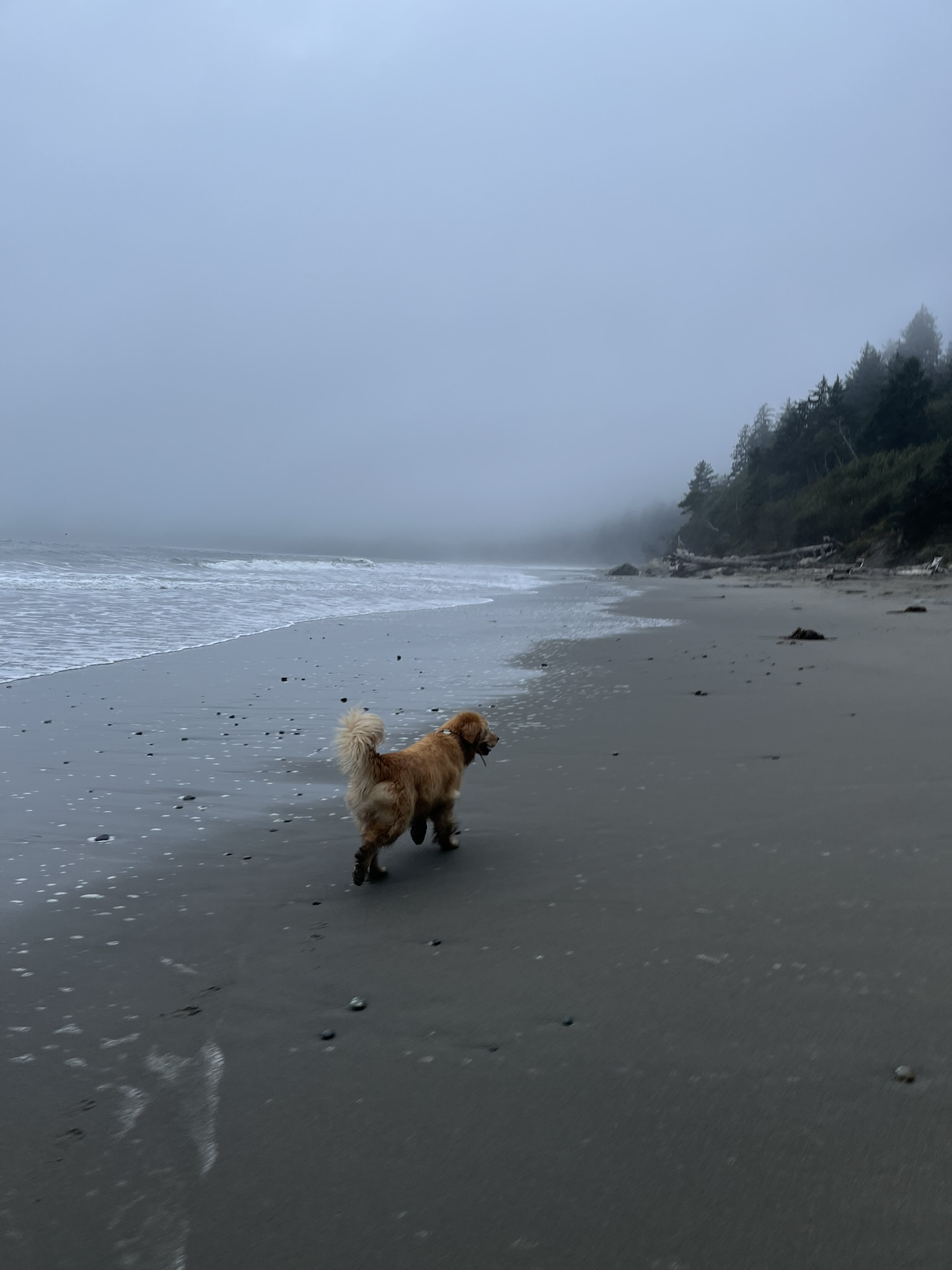
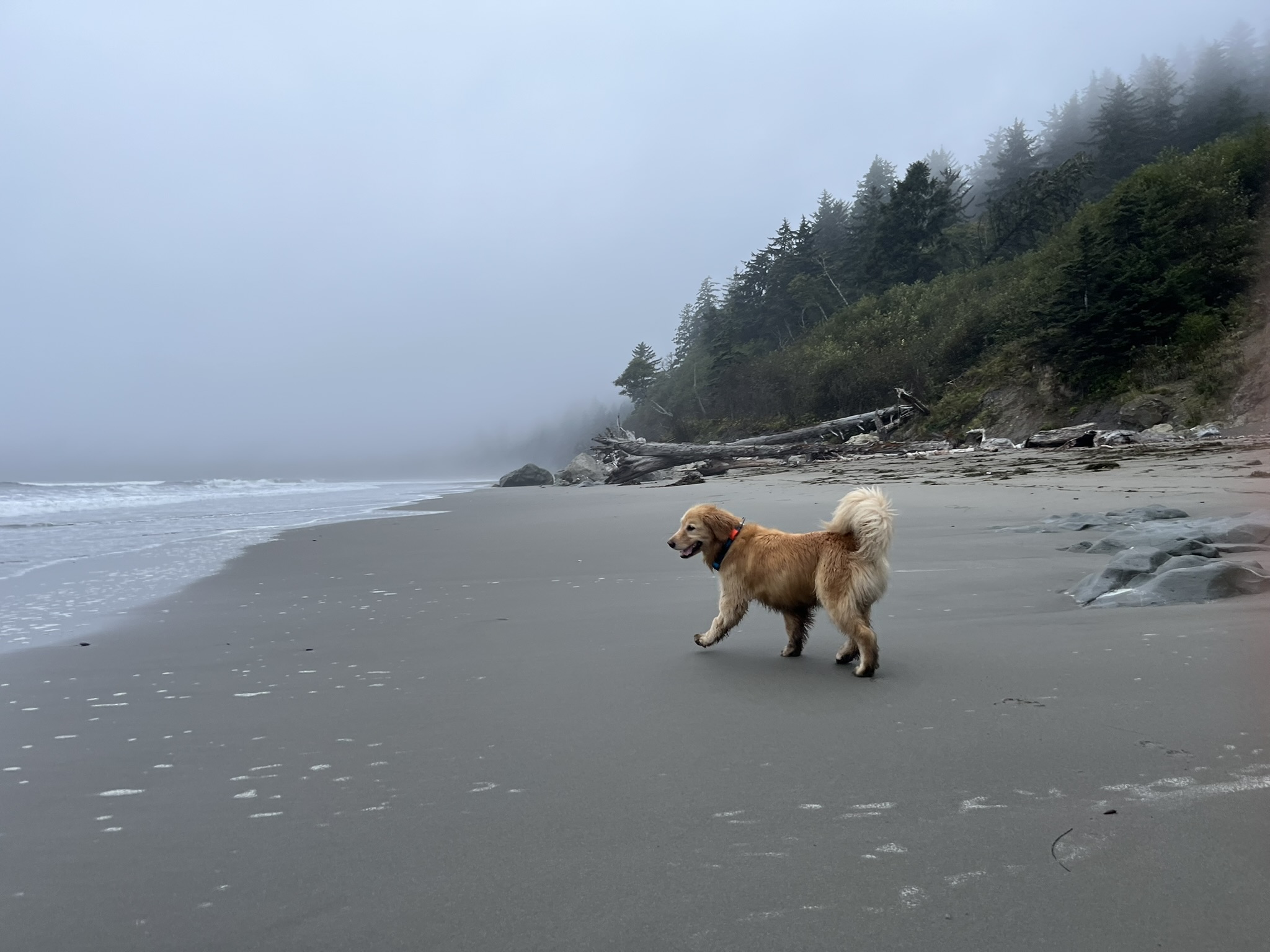
At the bottom: Third Beach. Foggy, wide, empty. I trotted ahead with my tail up, looking down the coastline into nothing. The sand was firm and cold and the fog muffled everything into silence.
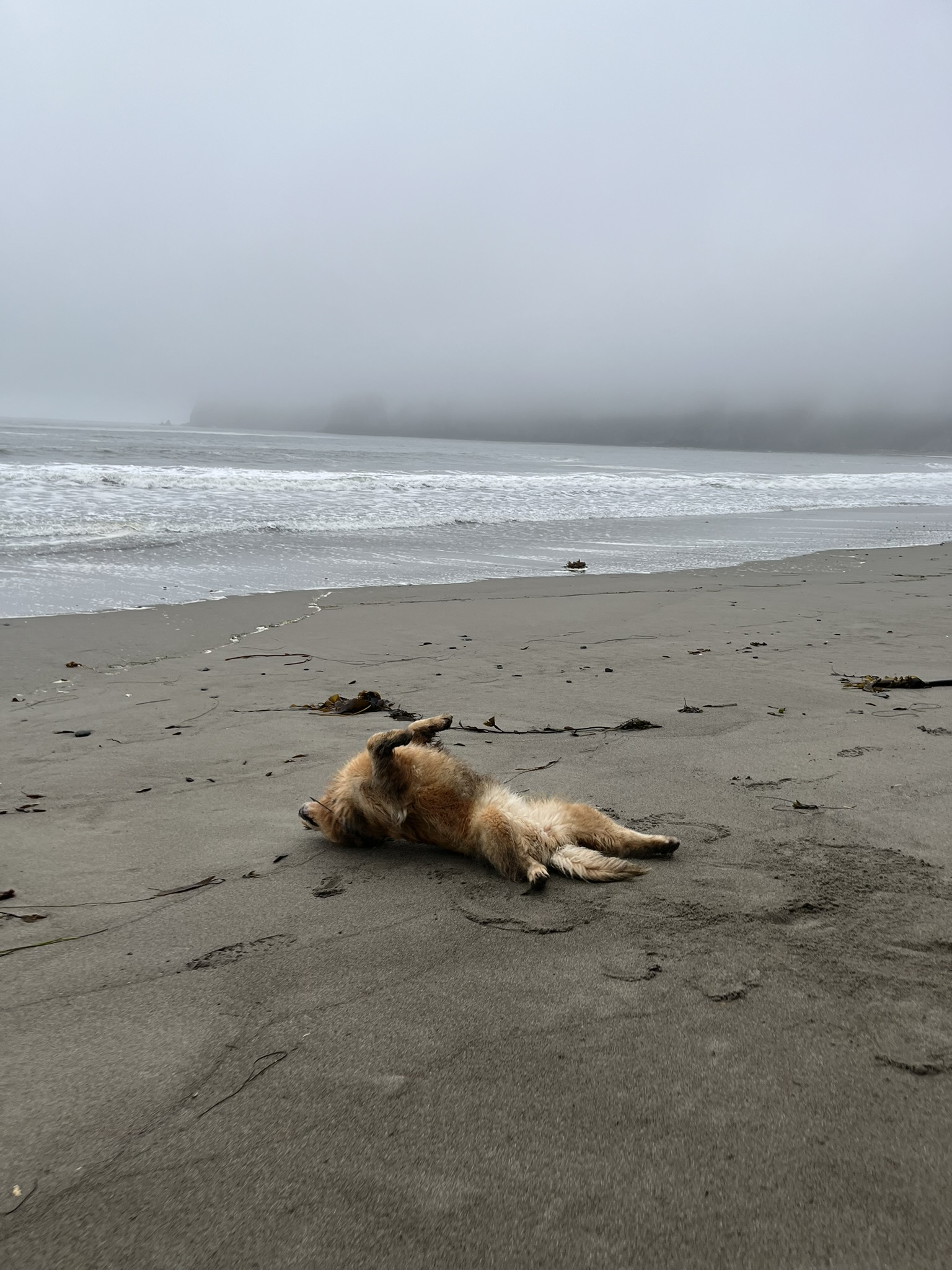
And then I was done. I dropped onto the sand, rolled onto my back, and lay there — paws in the air, fog overhead, waves breaking nearby. Twenty miles of Olympic coastline behind me. Salt in my fur. Sand in my ears. The best kind of finished.
The Tides
Three tidal restrictions. All three pushed above NPS-recommended levels.
Diamond Rock, 1.5 miles north of Oil City: the park service says 2.0 feet or lower. We passed at approximately 4.0 feet — double the limit — at 6:50 PM on September 26 as the tide dropped from a 7.96-foot high toward a 0.54-foot low. The rocks were wet but passable. The window was narrower than it should have been.
Three miles south of Third Beach: the park service says 4.5 feet or lower. We passed at approximately 7.4 feet around 4:43 PM on September 27, barely an hour after the day's 7.64-foot high tide. The beach was narrow and the waves were close.
Scott Creek to Strawberry Point: the park service says 4.0 feet or lower. We scrambled through at approximately 6.5 feet around 5:41 PM — waves crashing on the boulders below the headland, the only route a narrow band of rock between the ocean and the cliff.
The evening low tides on this trip were excellent — 0.54 feet on the 26th, 0.90 feet on the 27th. A more conservative approach would have been to time each restriction for those windows. My human chose to push through on the dropping tide instead of waiting, accepting higher water in exchange for daylight and forward progress. I went where he went.
It worked. But the ocean does not negotiate.
The Route
Three days. 20.3 miles. Three tidal restrictions above recommended levels. Diamond Rock at dusk. Headland scrambles with waves at my paws. A waterfall in old-growth forest. Sea stacks by the dozen. A berry pie I definitely did not want. Camp on a cliff above the Pacific, watching the sun set behind a field of dark spires.
The South Coast Wilderness Trail is the wildest stretch of coastline in the lower 48. No dogs allowed — unless they're working. I worked every mile of it. Scrambled boulders. Forded creeks. Navigated high-tide headlands that would have turned back most hikers. Read bear sign in old-growth forest and kept my human safe through territory that belongs to things bigger than us. Slept on a mossy ledge above the ocean. Rolled on the sand at Third Beach like I'd been doing this my whole life.
This coast is wild in a way the mountains aren't — the ocean doesn't care about you at all. But my human was right there for every mile, and I was right there for him. That's the deal.
Service dog. On duty.