Friday Evening — Into the Rain
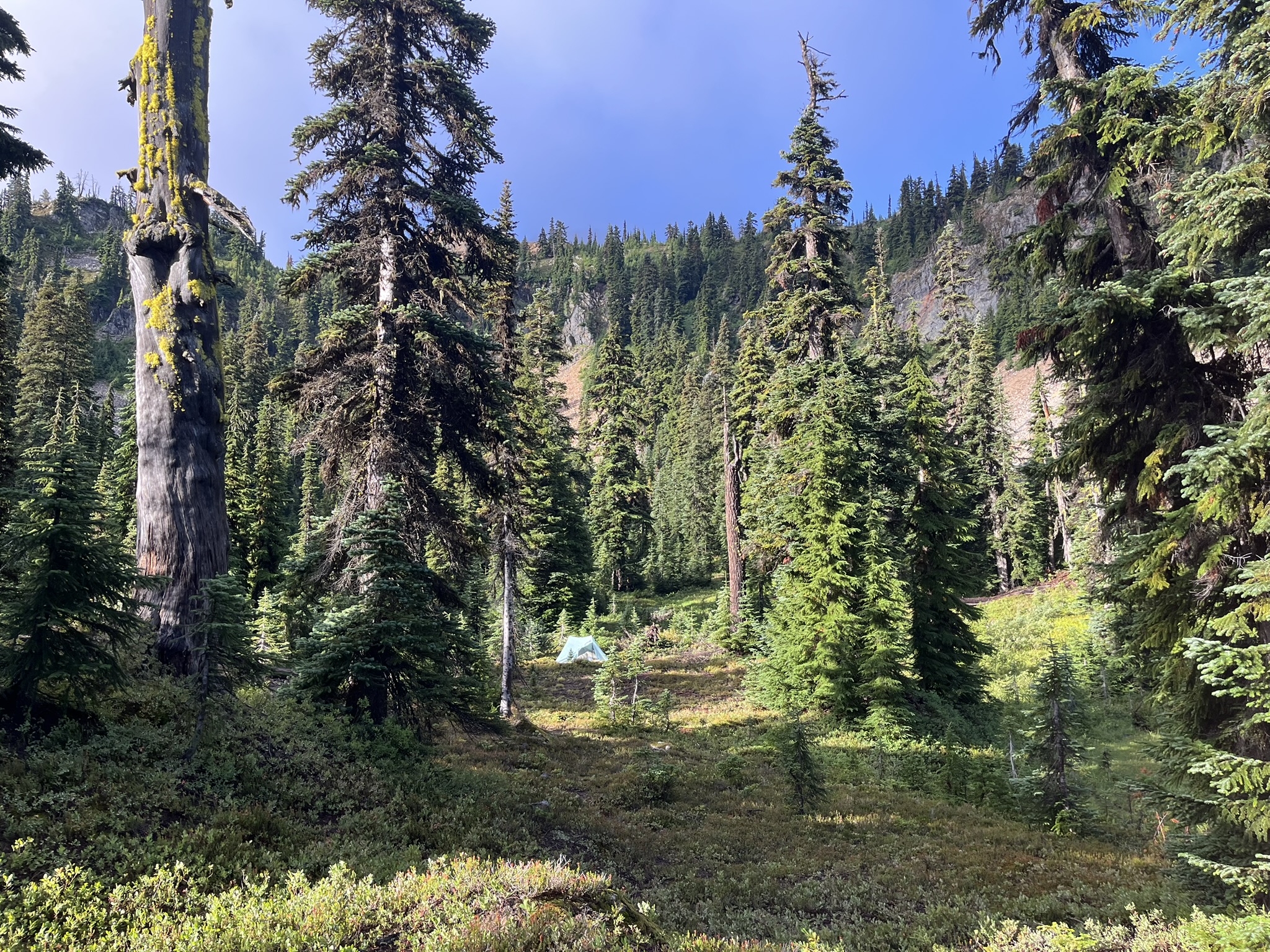
My human left work on a Friday in mid-August and we hit Scatter Creek Trailhead with a few hours of daylight. The plan was ambitious, even by our standards: a combination high route linking Paddy-Go-Easy Pass to Klonaqua Lakes to Robin Lakes. A route that's probably only been done a handful of times. Likely never with a dog. Certainly never with a full-sized golden retriever carrying a blue pack.
We climbed to the Paddy-Go-Easy ridge and that's when the sky opened. Torrential downpour. The kind of rain where pulling out a phone means drowning it. No photos. I put my head down and moved. Rain was hammering my pack, running off my ears, soaking through everything. I loved it. We pushed through the storm until we found a clearing to camp in the subalpine forest at around 5,400 feet. The whole forest smelled like wet granite and bruised fir needles.
Saturday — Down to the Creek
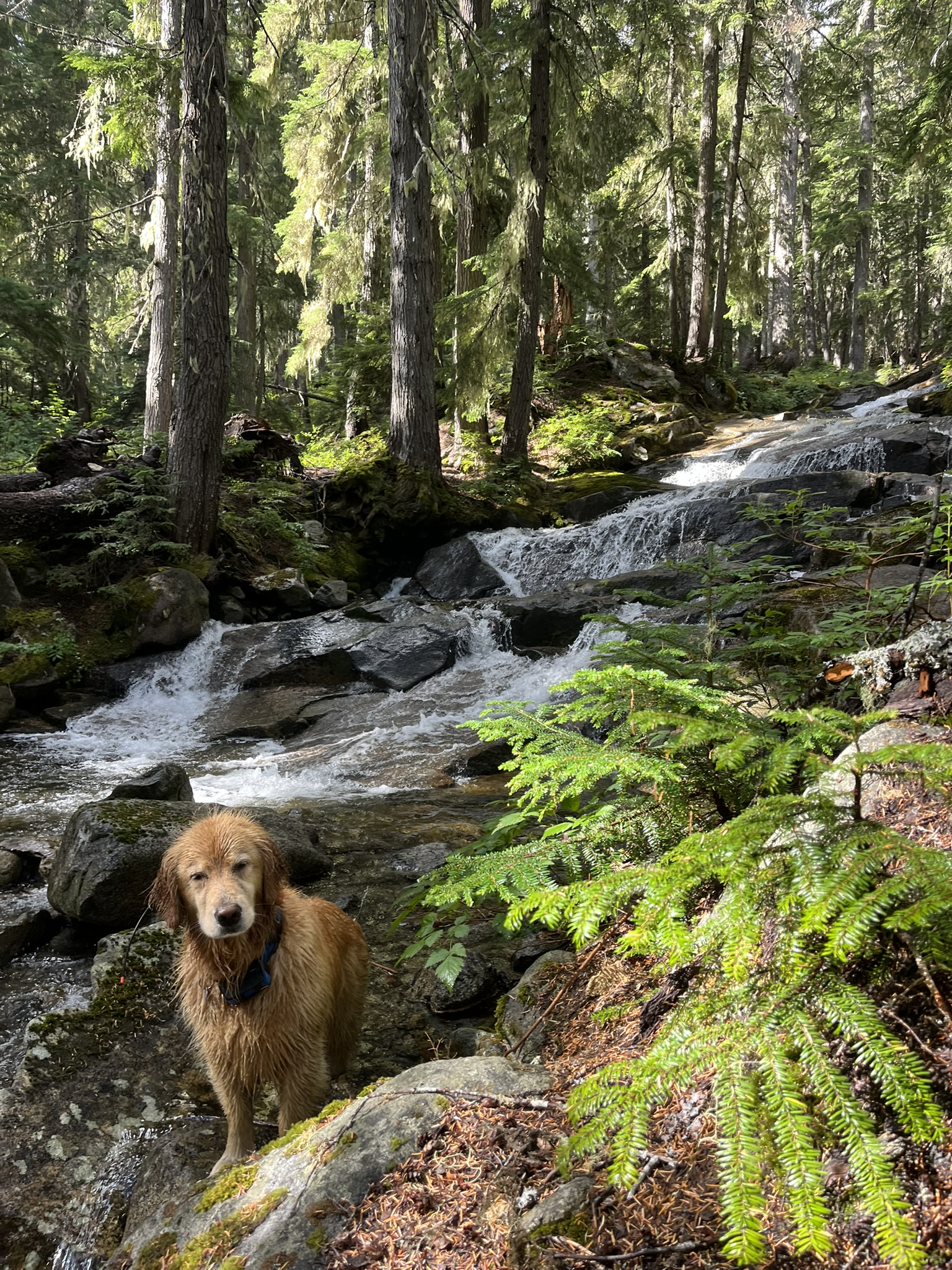
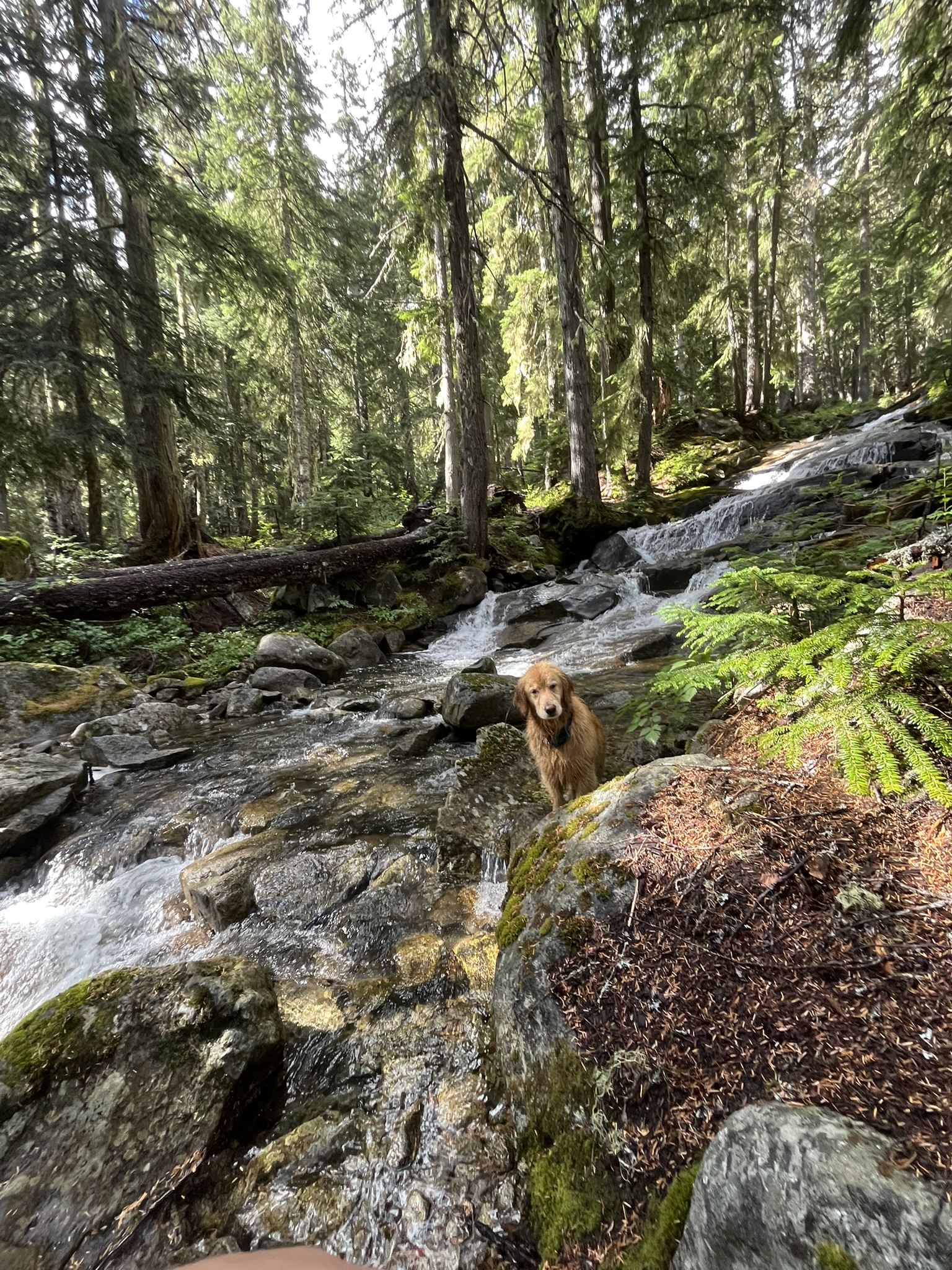
Saturday morning started with a descent. The rain was gone, replaced by overcast skies and a damp forest that smelled like it had been turned inside out. We dropped nearly 1,500 feet to a cascading creek at around 4,000 feet. I planted myself in the middle of it. Water rushing around my legs, cold enough to make my paws ache, ferns and old-growth forest framing every direction. I stood there until my human called me three times.
Klonaqua Lakes
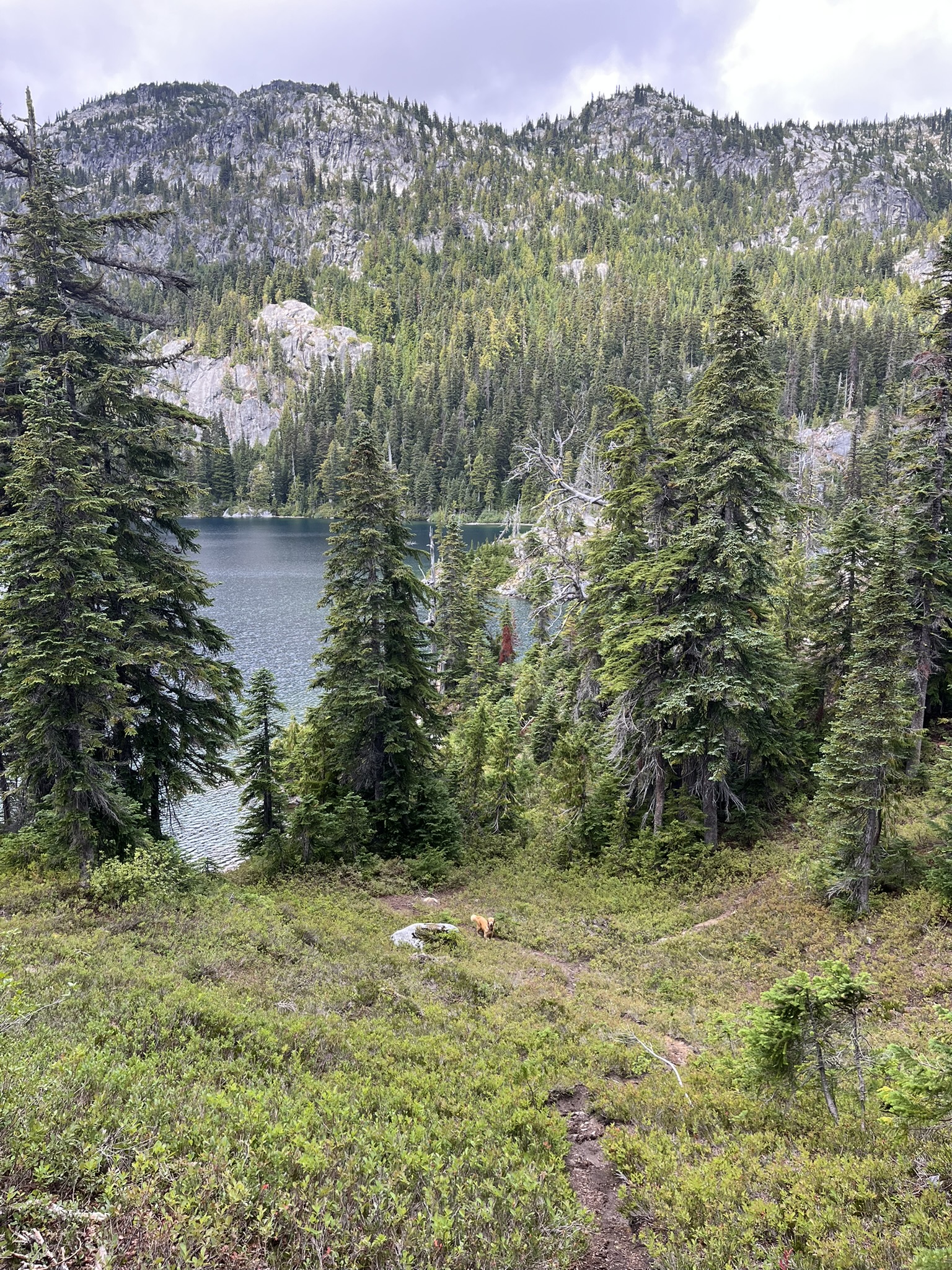
From the creek we climbed back up, gaining over a thousand feet to reach the first of the Klonaqua Lakes. I stood at the shore — green-tinged water, ringed by conifers, quiet and still. No scent of humans anywhere. We hadn't seen another person since the trailhead. We wouldn't see one for two more days. Just us. That's how I like it.
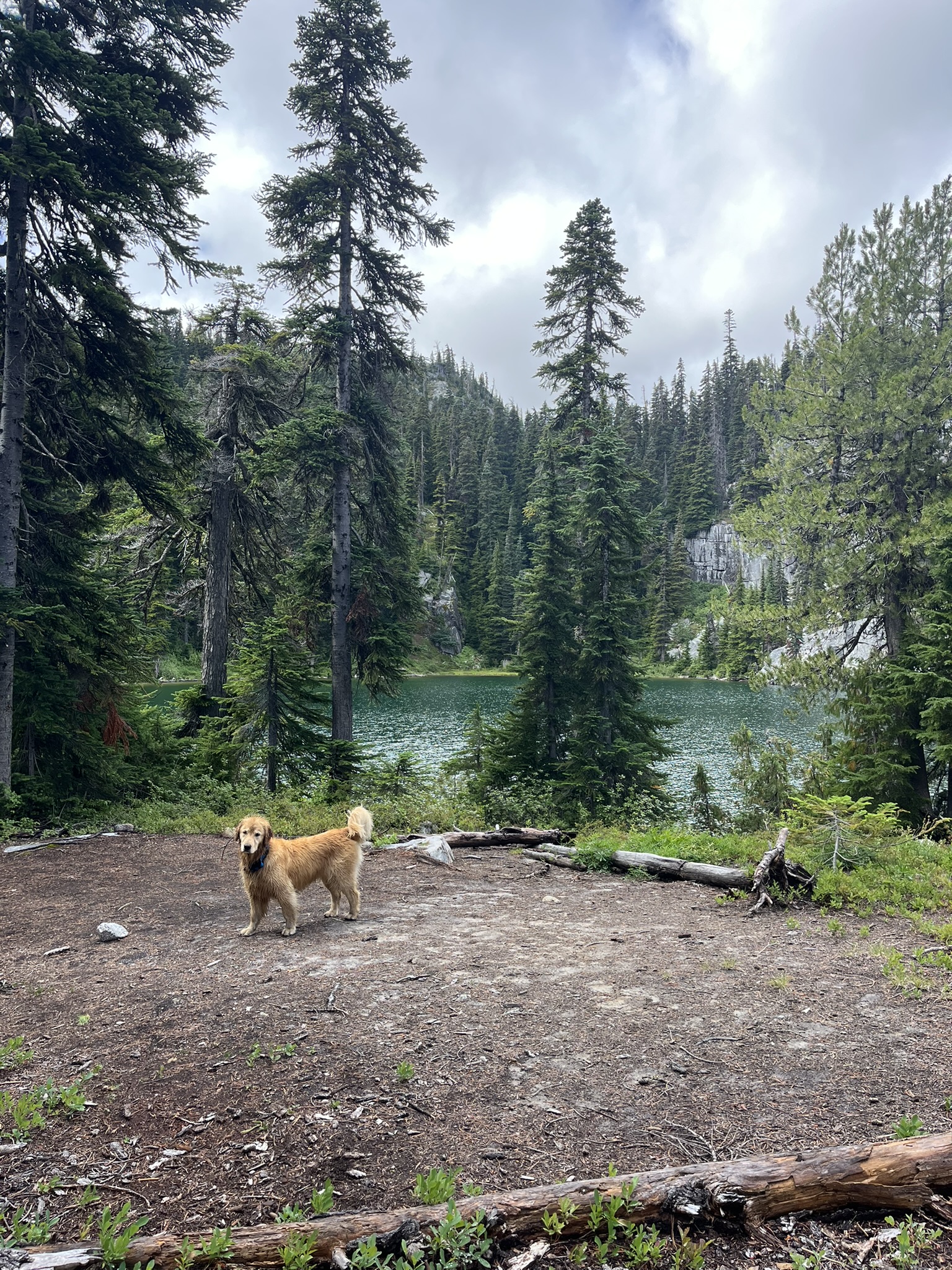

We pushed on, contouring through forest to a second, larger lake. Blue-green water backed by a forested granite ridge. I was already down in the meadow below, a tiny gold dot against all that green, finding my own route.
The Overlook
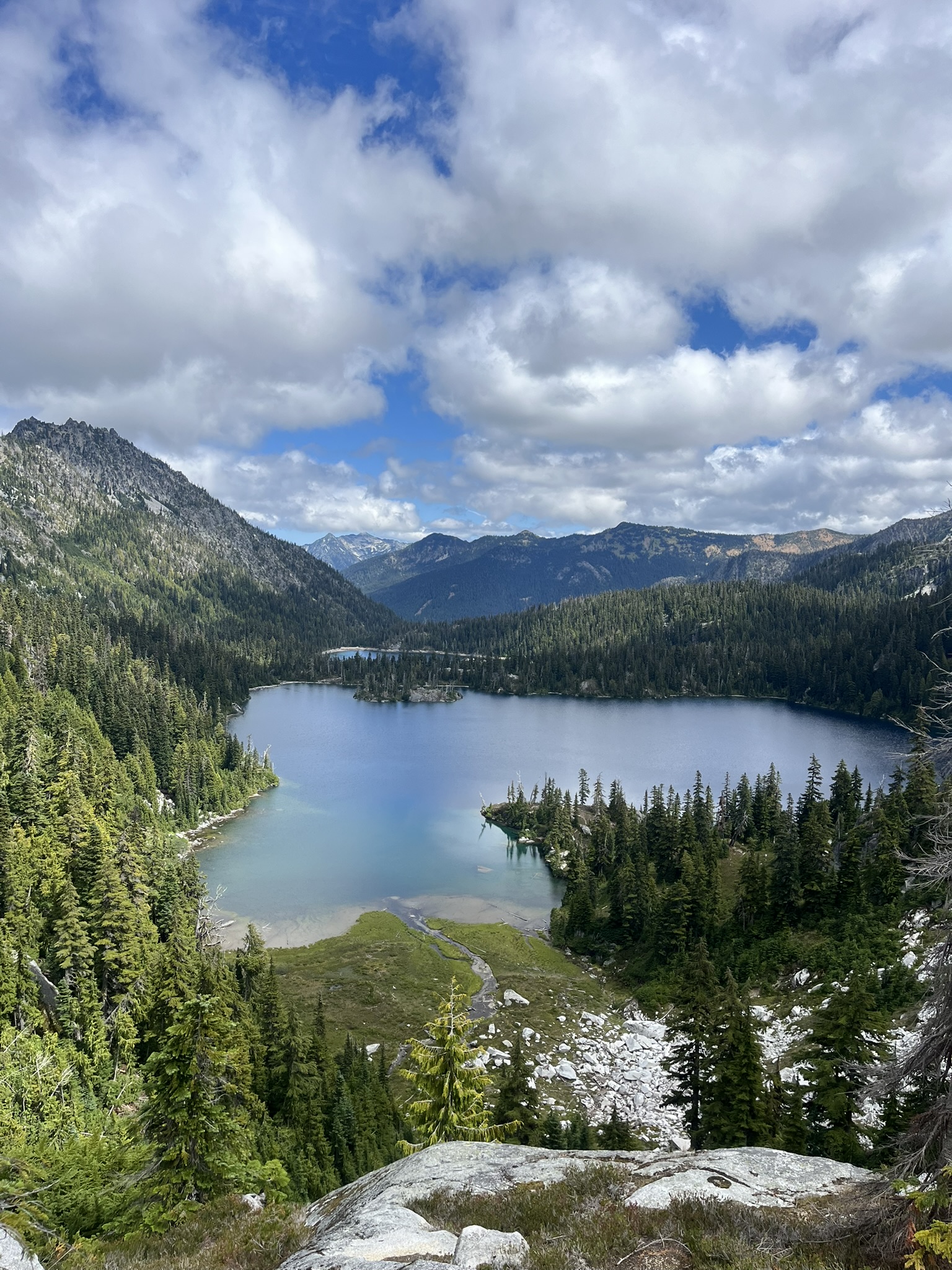
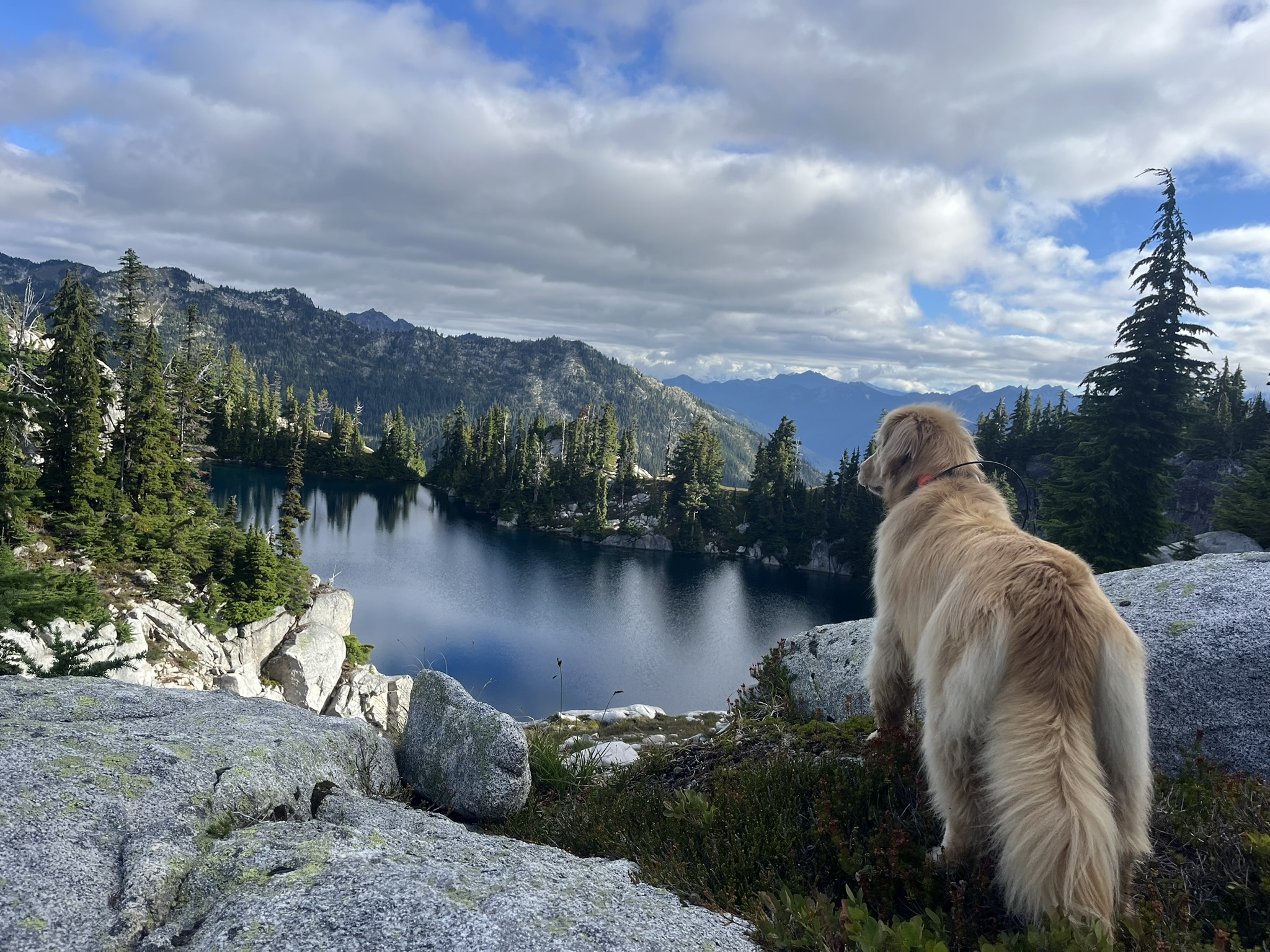
The route climbed above the lakes and everything opened up. From a granite ledge at 5,500 feet, we looked straight down at a massive turquoise alpine lake — the kind of aerial view you rarely get on foot. Forested ridges and Cascade peaks faded into the distance under building clouds. The wind carried the smell of warm rock and cold water from a thousand feet below.
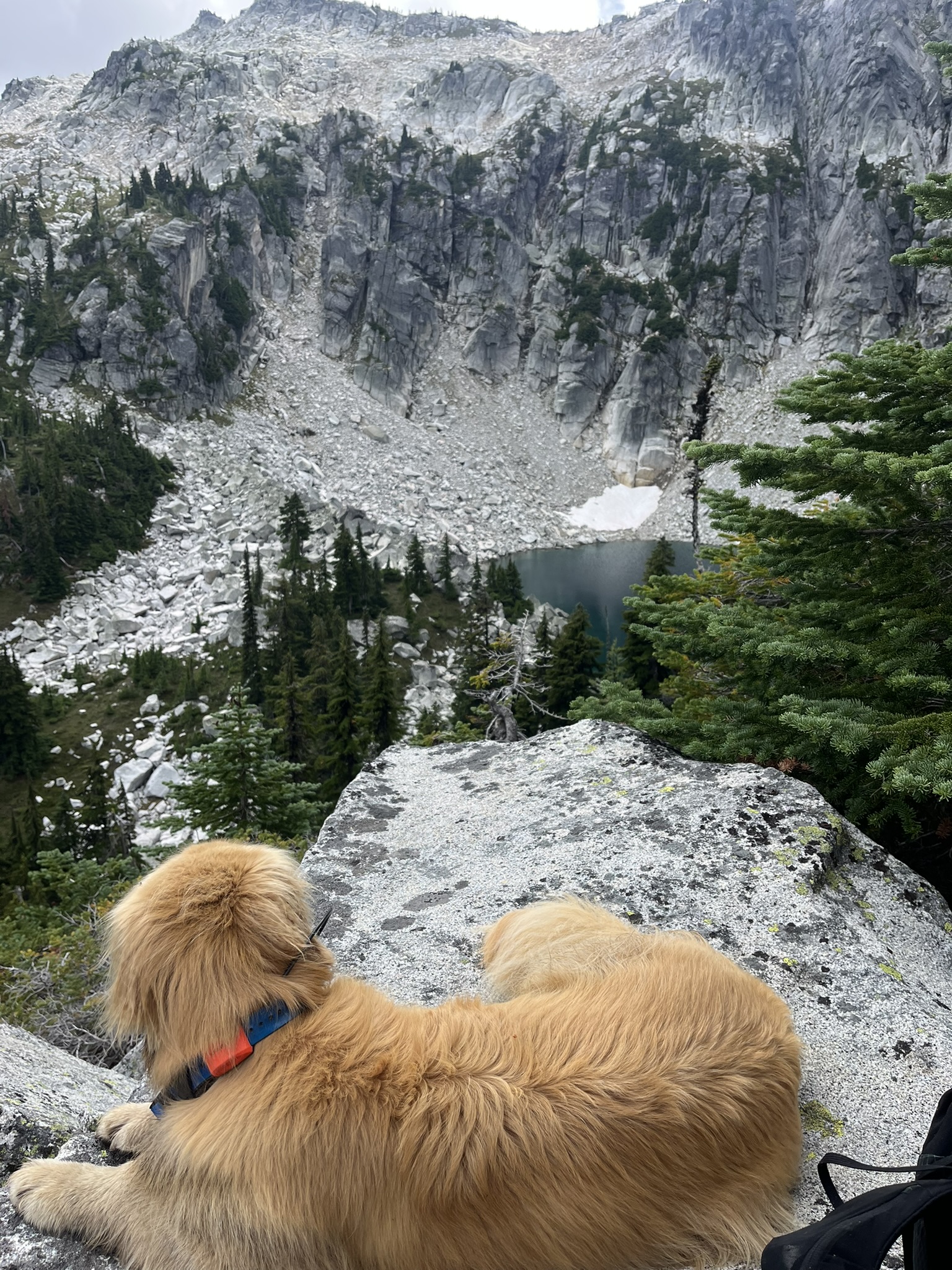
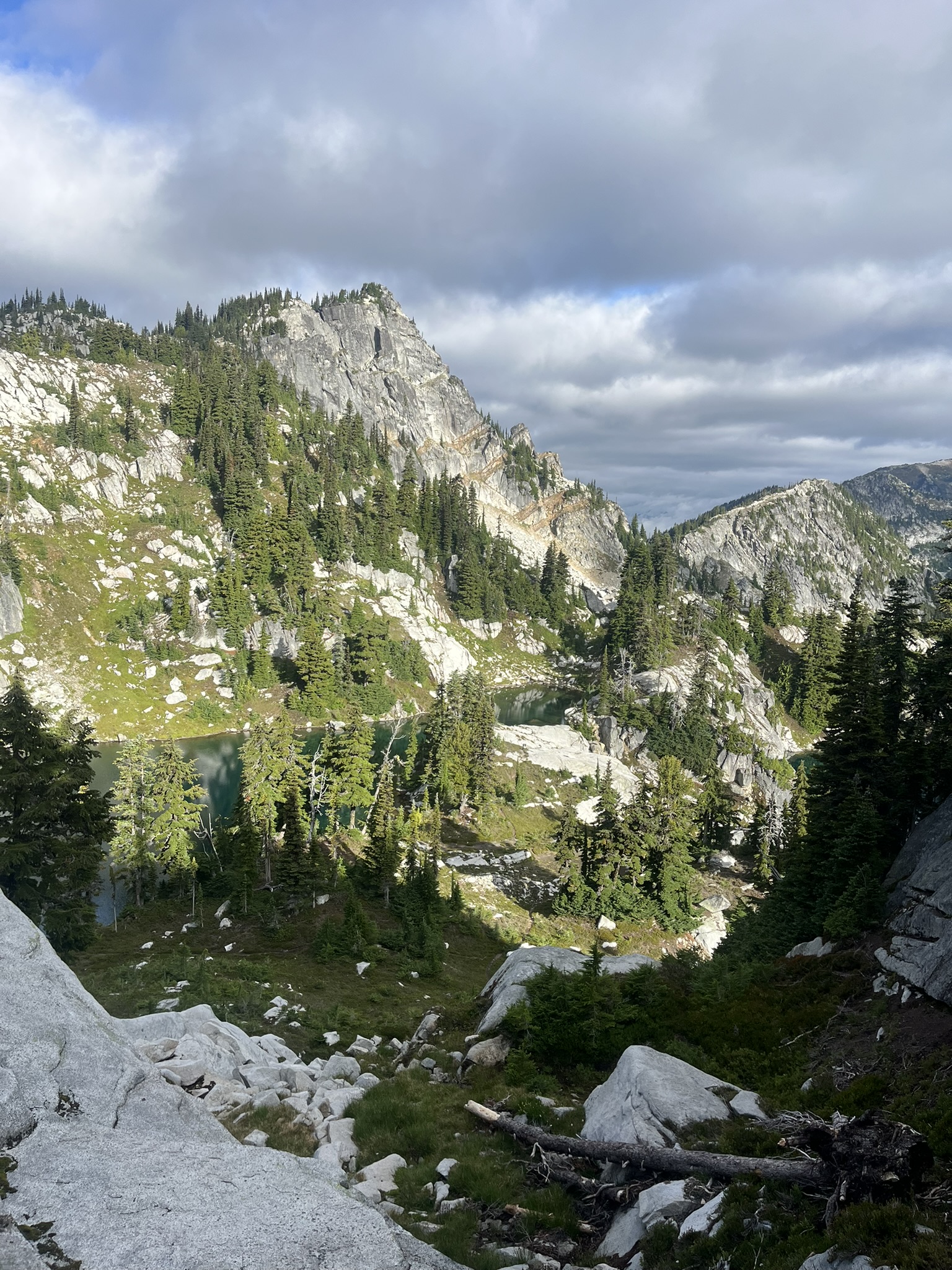
Higher still, I perched on a granite slab and looked down at a lake cupped in a steep-walled cirque hundreds of feet below. I studied the route ahead. The terrain between here and there was a vertical puzzle of brush and granite, and even from up here I could smell the challenge of it. Something in me leaned forward.
The Scramble
This is where it got serious. The cliff between Klonaqua Lakes and Lakes Swede is a gnarly entanglement of thick brush on near-vertical terrain. You can't see where to climb. Exposed granite slabs hidden behind walls of vegetation, nothing below but air and rock. The kind of terrain most humans would turn around on — especially with a dog.
I handled it. A full-sized golden retriever, picking my way through brush-choked cliffs, figuring out moves through exposure that would give experienced scramblers pause. I found my own line. Four paws on vertical brush-covered granite, pack shifting on my back, nose reading the route where eyes couldn't. I made it look easy because I'm good at this. Not bragging. Stating facts.
Lakes Swede
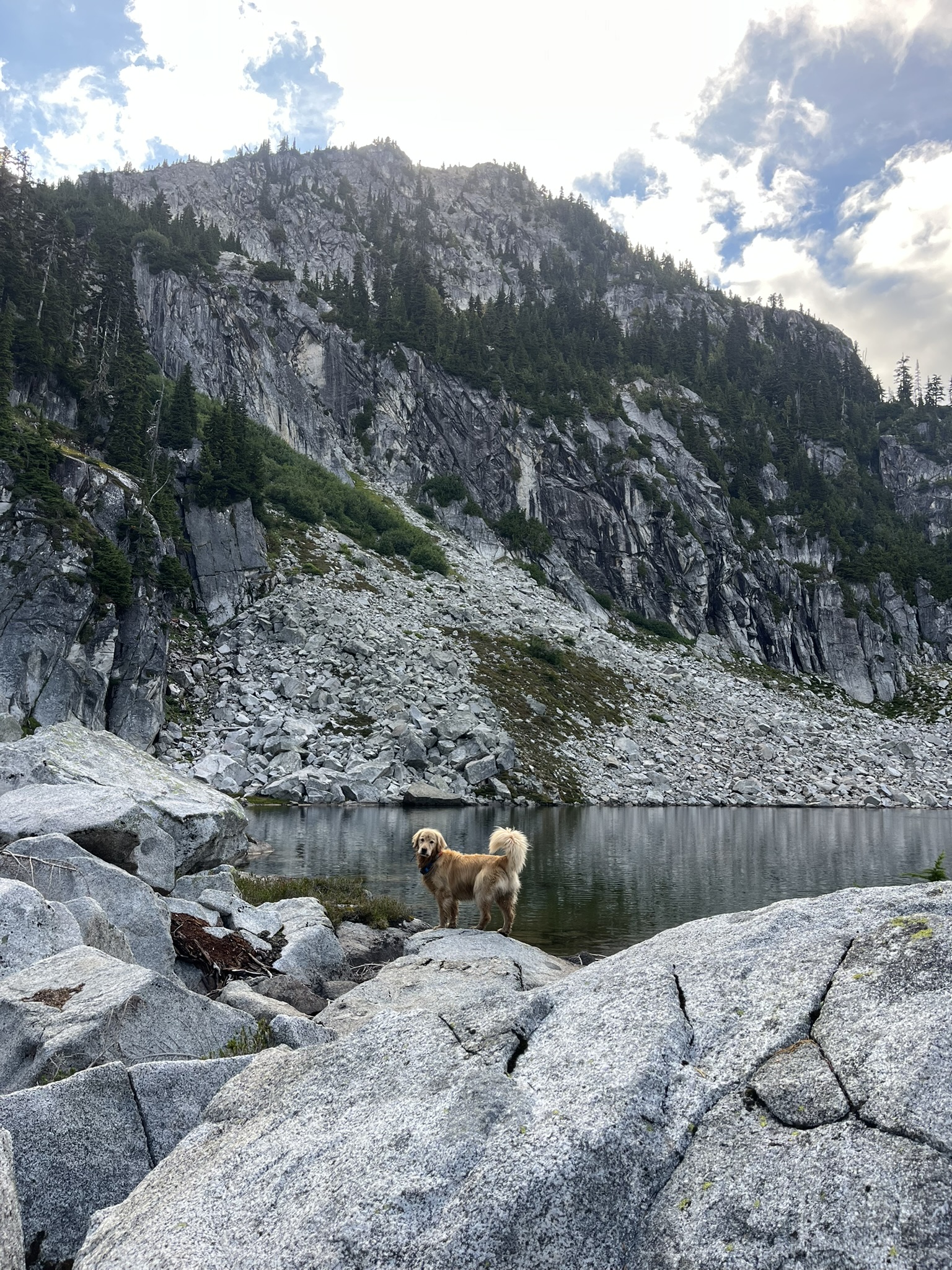
We dropped into the Lakes Swede basin in late afternoon. I scrambled down through granite boulders to the water's edge — deep blue-green water backed by steep granite walls. Remote, wild, and completely empty of any scent but stone and snowmelt and the faint musk of pika in the talus. My kind of place.
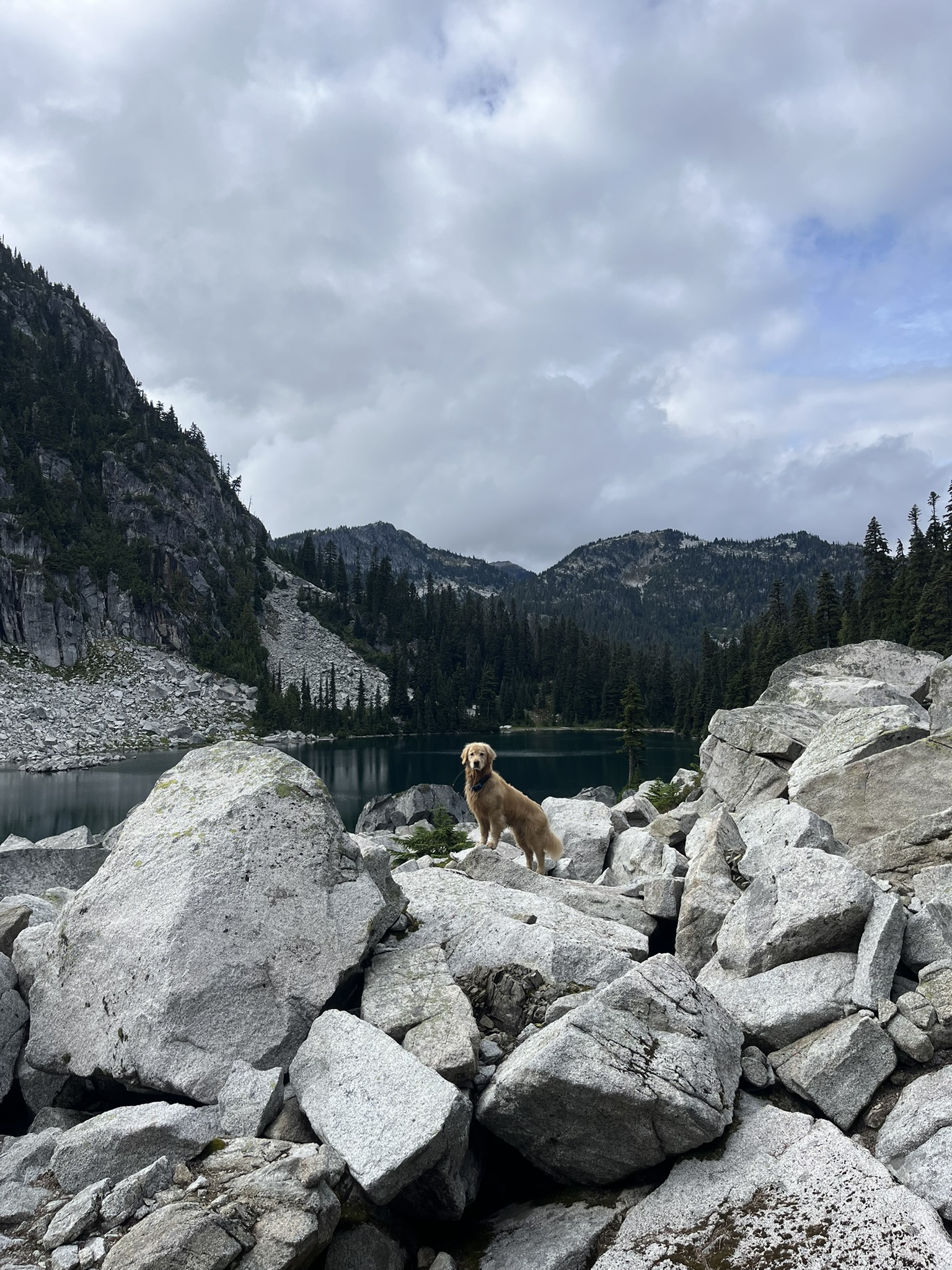
The granite here is massive. Sheer walls rising straight from the lake, hundreds of feet of clean rock catching the evening light. I stood on a slab at the water's edge, dwarfed by the cirque behind me. The scale doesn't bother me. I belong in places like this.
Cross-Country to Lake Phoebe
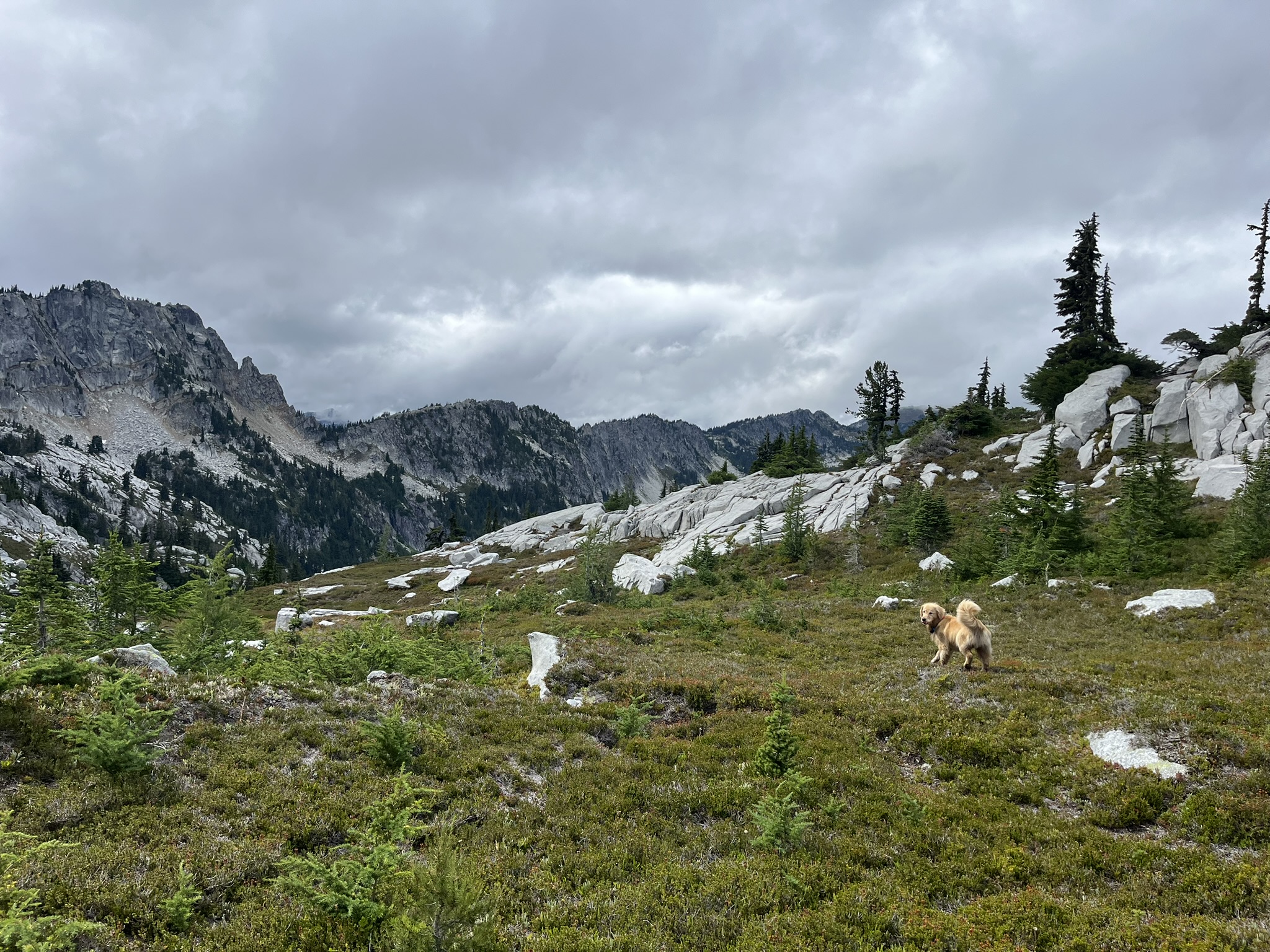
From Lakes Swede we pushed cross-country toward Lake Phoebe, picking through talus and boulder fields. Between the two lakes, the terrain opened into one spectacular alpine meadow — granite slabs, heather, jagged peaks emerging from the clouds. The heather was warm under my paws and the granite radiated stored heat from the afternoon. I trotted through it with my nose up, reading the wind.
Camp at Lake Phoebe
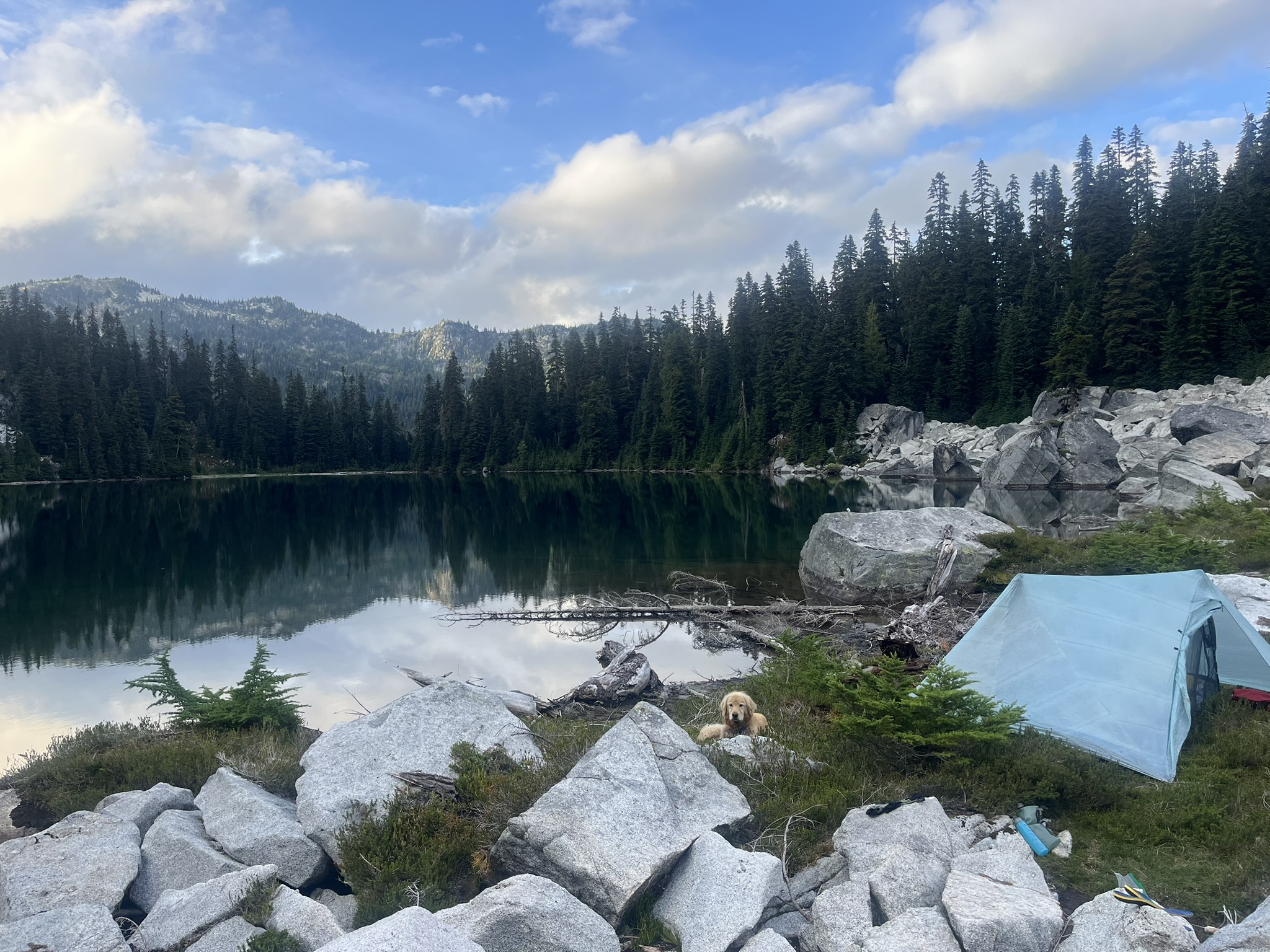
We set up the tent on a rocky bench at the lakeshore. I stationed myself between the tent and the water. This is my job — guard the camp, keep an eye on the lake, listen to the talus for movement. Twice that evening I lifted my head and stared into the boulder field. Something large had passed through recently. I could smell it — musky and warm, layered over the stone. Bear. Not close, but not far. My human noticed me stiffen and followed my gaze. He trusts what I tell him. I held still until the scent faded downwind, then settled back onto the granite. The rock was still warm from the day and I could hear fish rising in the shallows.
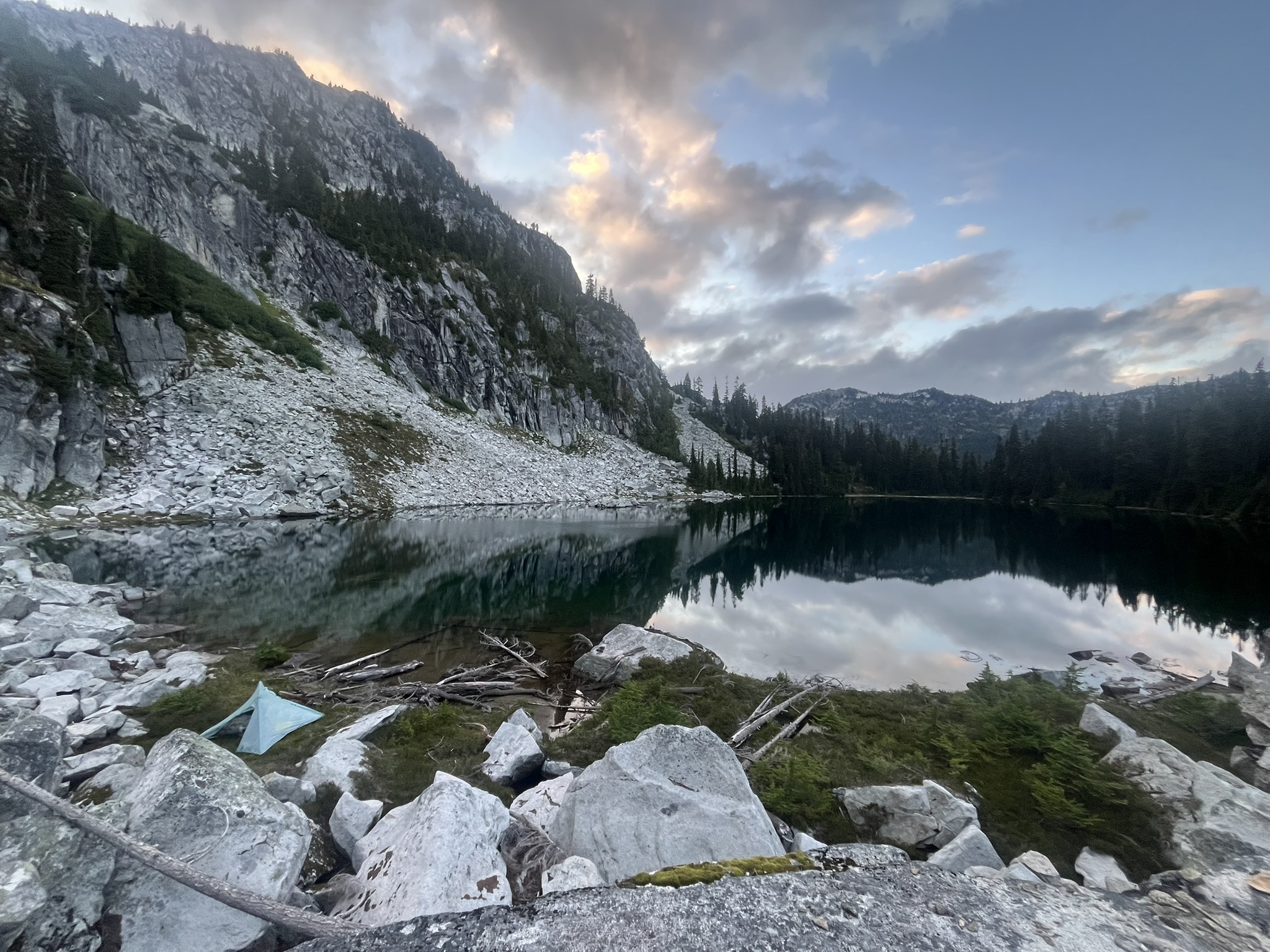
As sunset came, the clouds broke just enough to light up in orange and pink. The granite walls reflected in perfectly still water. Not a breath of wind. The only sound was the lake touching the shore. I lay on the warm rock and watched the light change. Some camps you just know. This was one.
Sunday Morning — Climbing Out
Morning broke clear and cold. The first real blue sky of the trip. Frost on the tent, frost on my pack, my breath visible. We climbed out of the lake basin through a boulder field with lingering snow patches. I navigated between snow and talus, granite towers looming above us. The snow was firm and cold under my paws and the whole basin smelled like ice and clean stone.
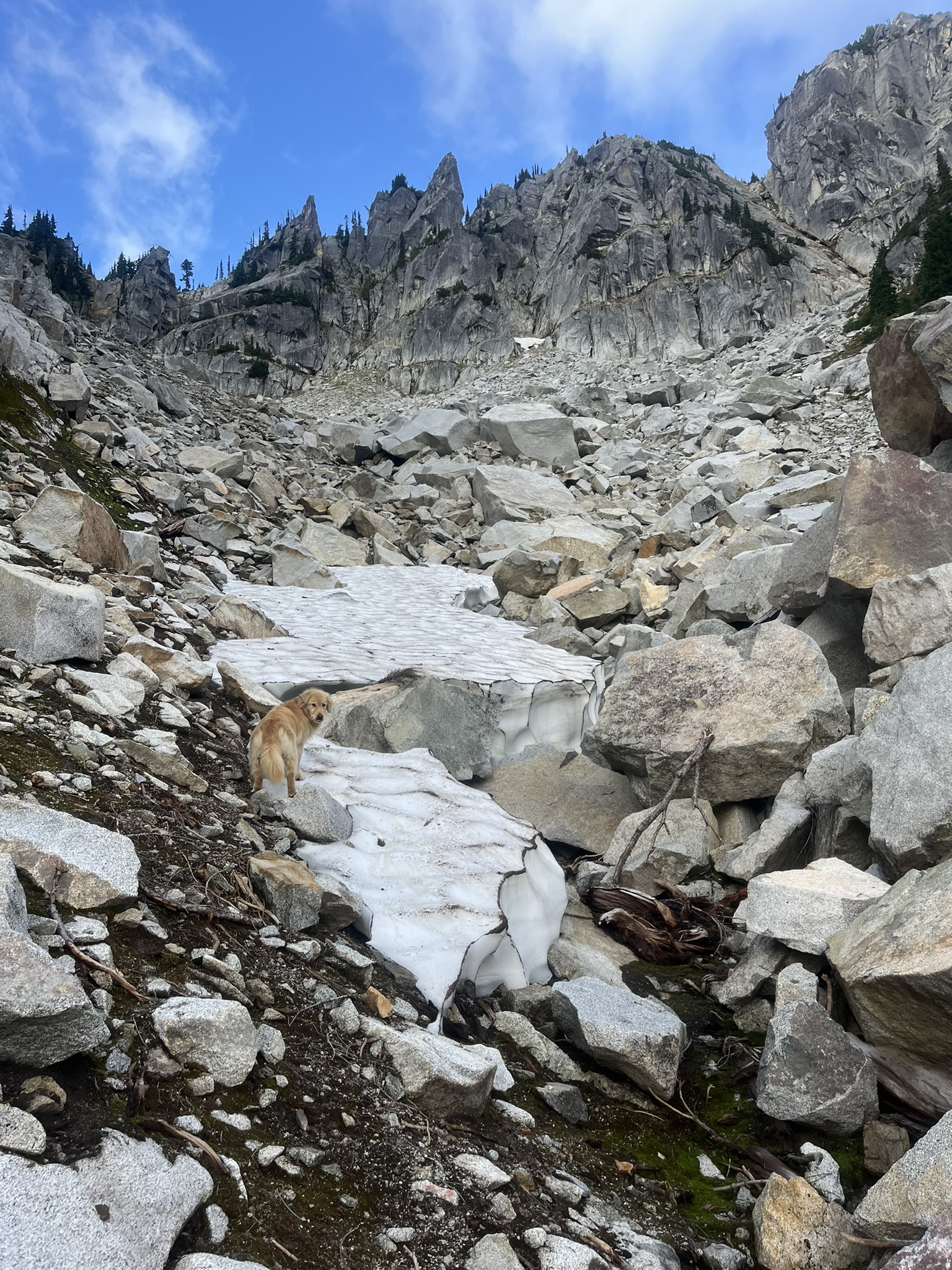
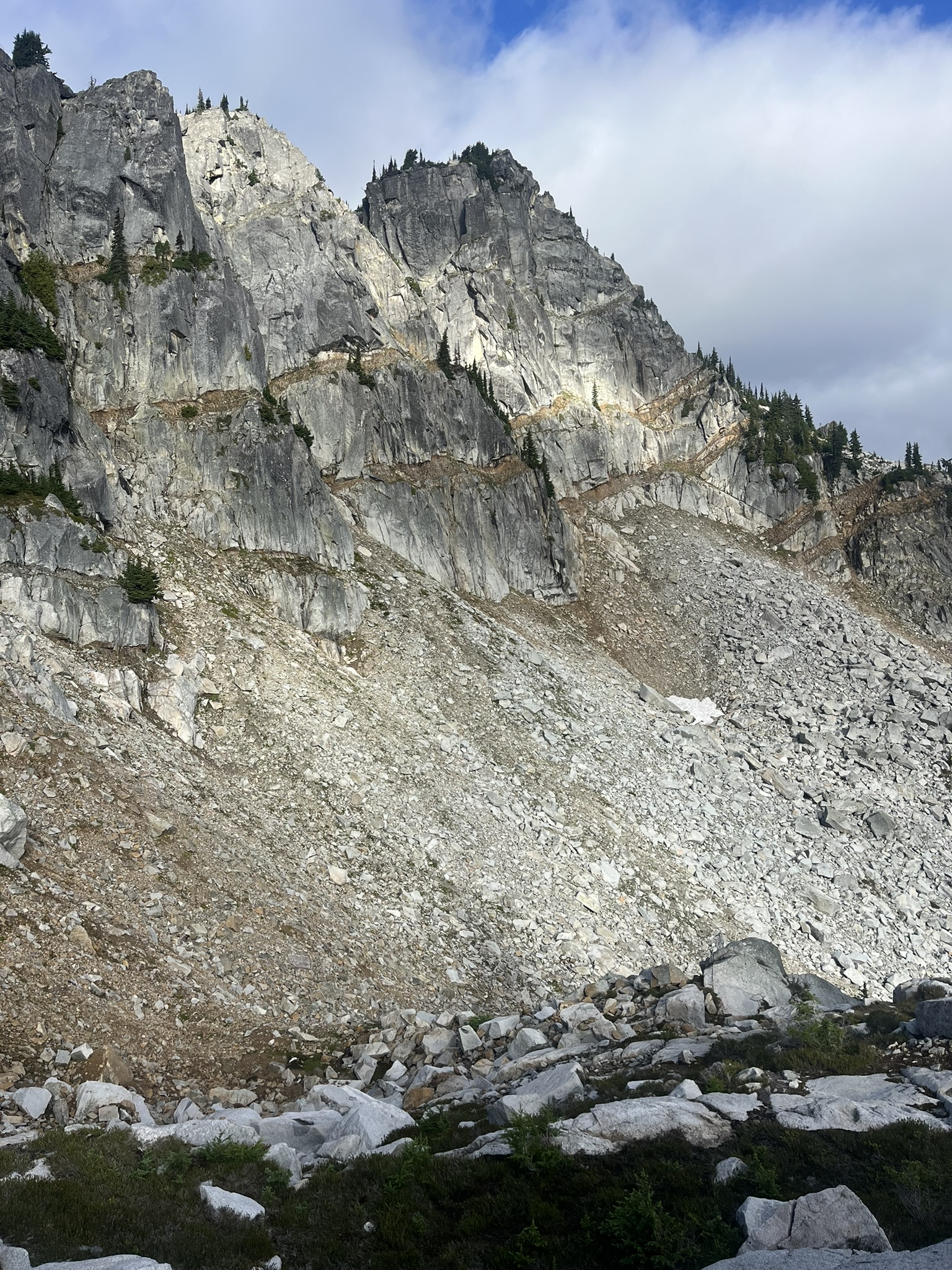
The granite walls above Lake Phoebe are immense. Vertical faces of clean white rock stacked hundreds of feet high, catching the morning light. I stopped and looked up at them. The scale of this country is something I feel in my chest.
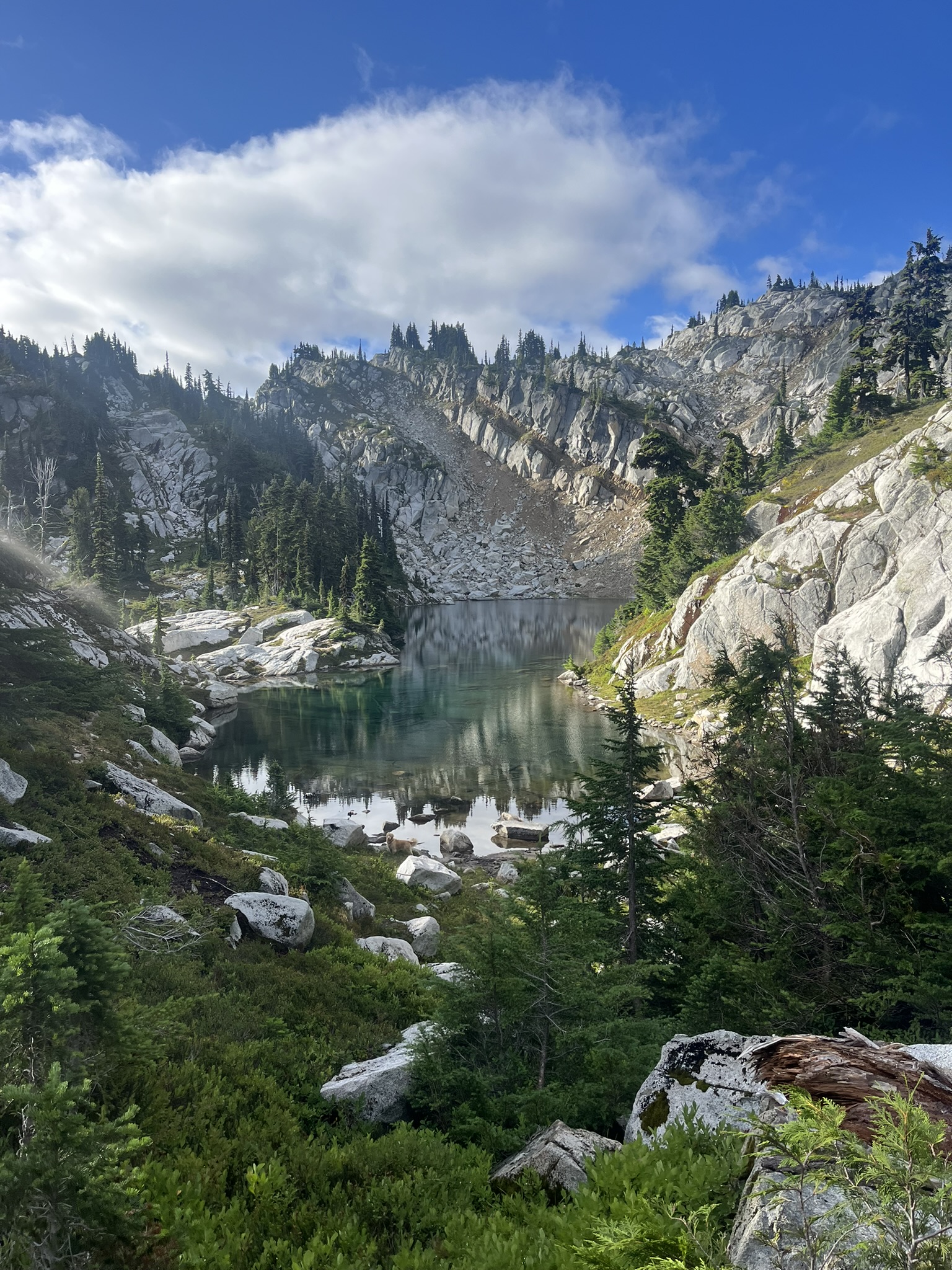
Looking back down, the lake sat perfectly in its granite cirque — steep white walls on every side, deep green water. Hard to believe we'd been down there an hour earlier. I could still smell our camp.
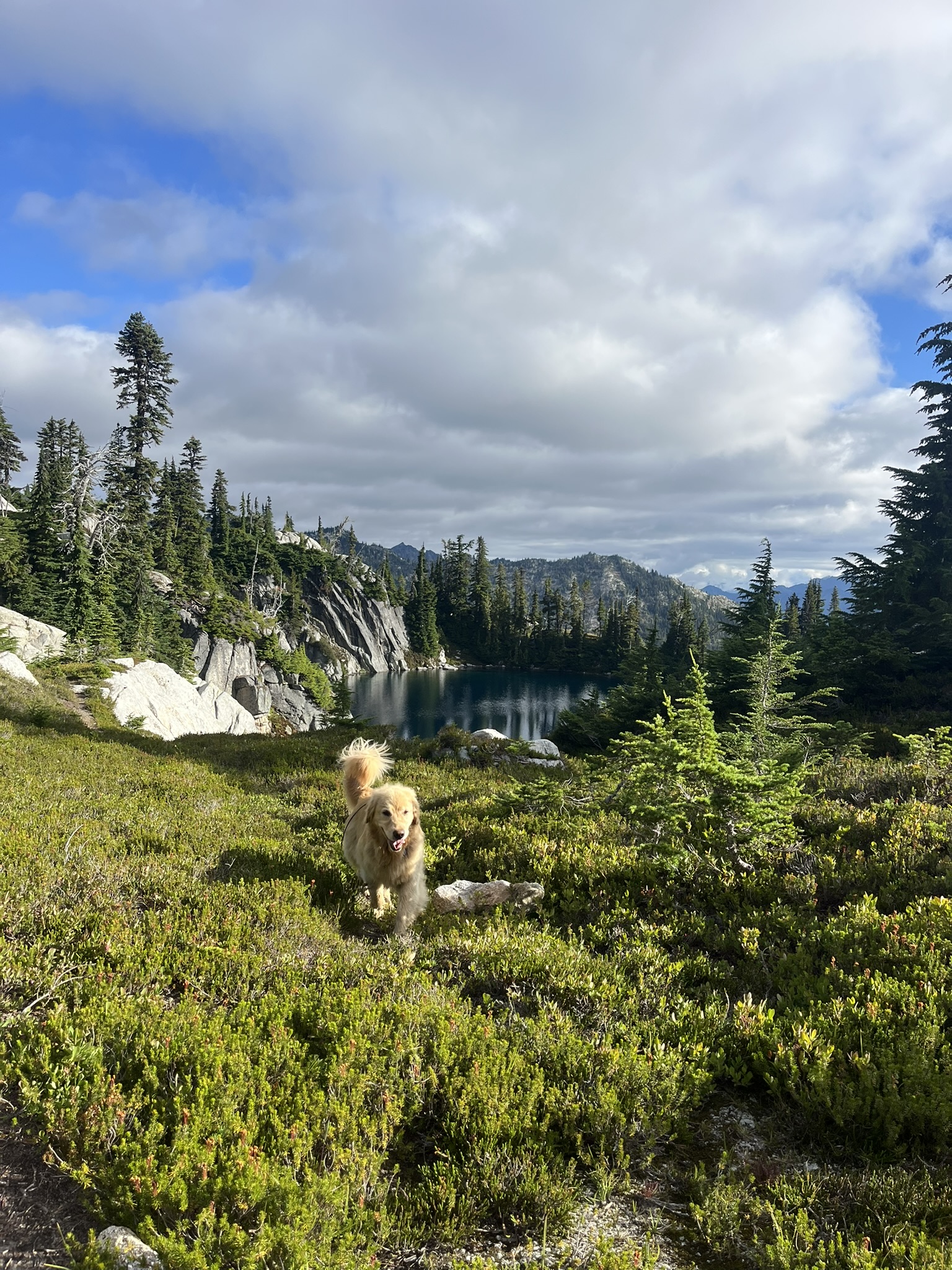
Above the lake, I bounded through alpine heather, the lake and granite peaks framed behind me. Two days in and I was still charging. The heather was warm and soft and the sky was finally blue and I had energy to burn.
I paused on a granite slab and sat looking out — the lake below, forested ridges rolling to the horizon, Mount Daniel somewhere behind the clouds. The wind came up the basin and pressed my ears back and I just sat there, taking it in. Two days of rain and vertical scrambles and now this. Noted.
Robin Lakes
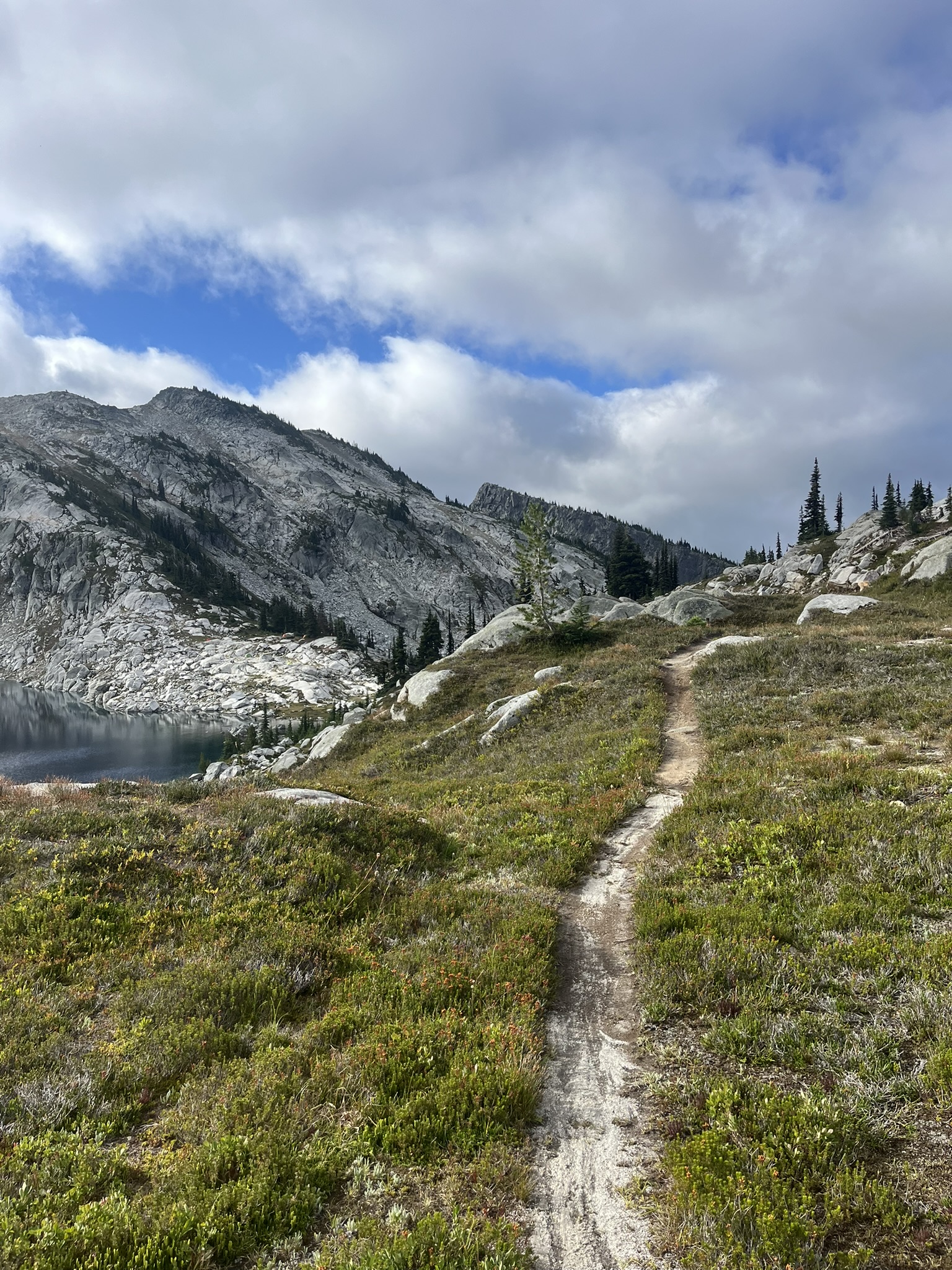
We climbed from Lake Phoebe up to Robin Lakes. A small lake appeared below a pointed granite peak, nestled in the rock. The water was dark and cold-looking and I wanted to swim in it immediately.
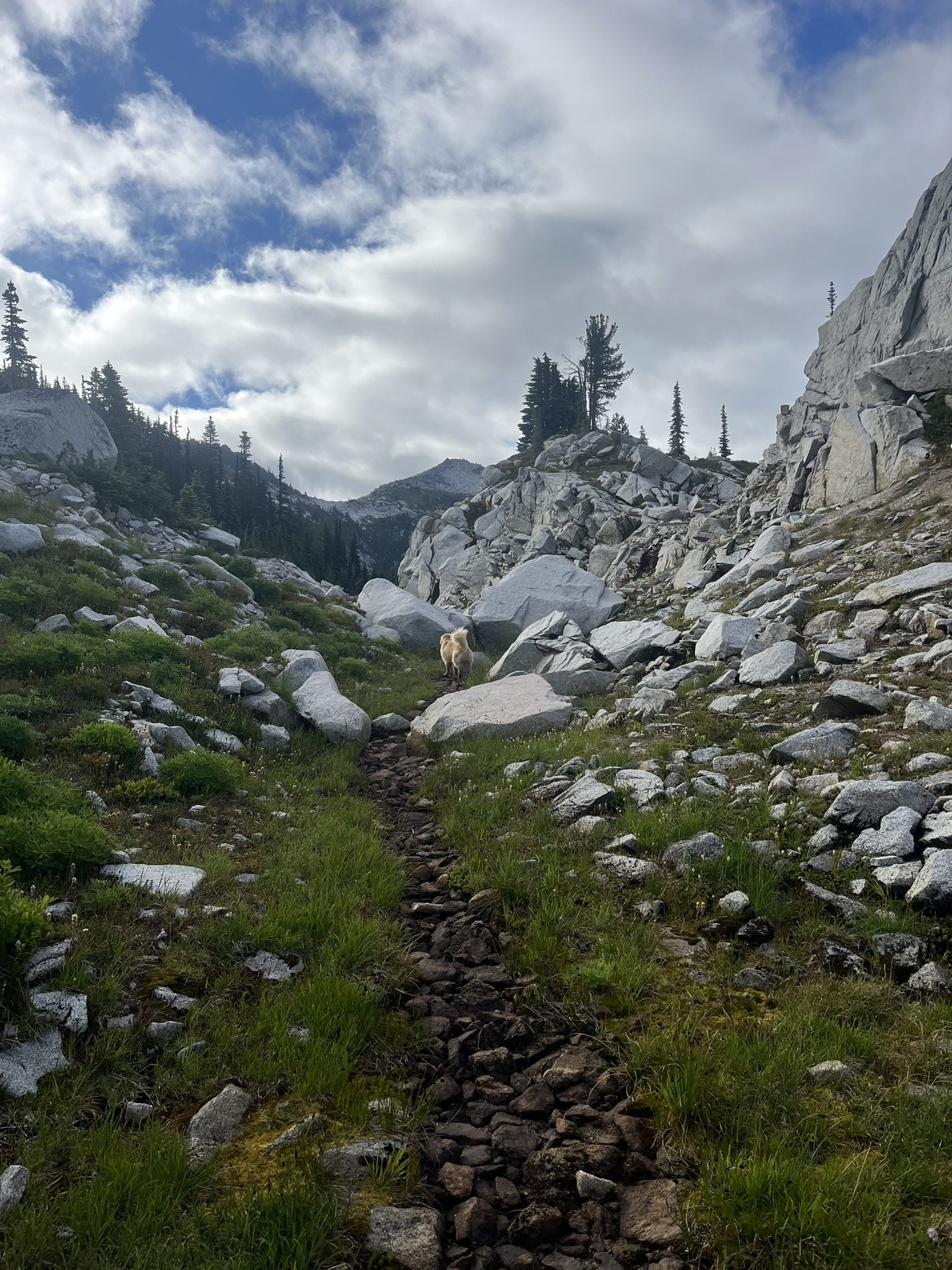
I led the way along a rocky path through the alpine zone — granite boulders, scattered subalpine trees, the terrain opening up in every direction. The air was thin and dry and every smell was sharper up here.
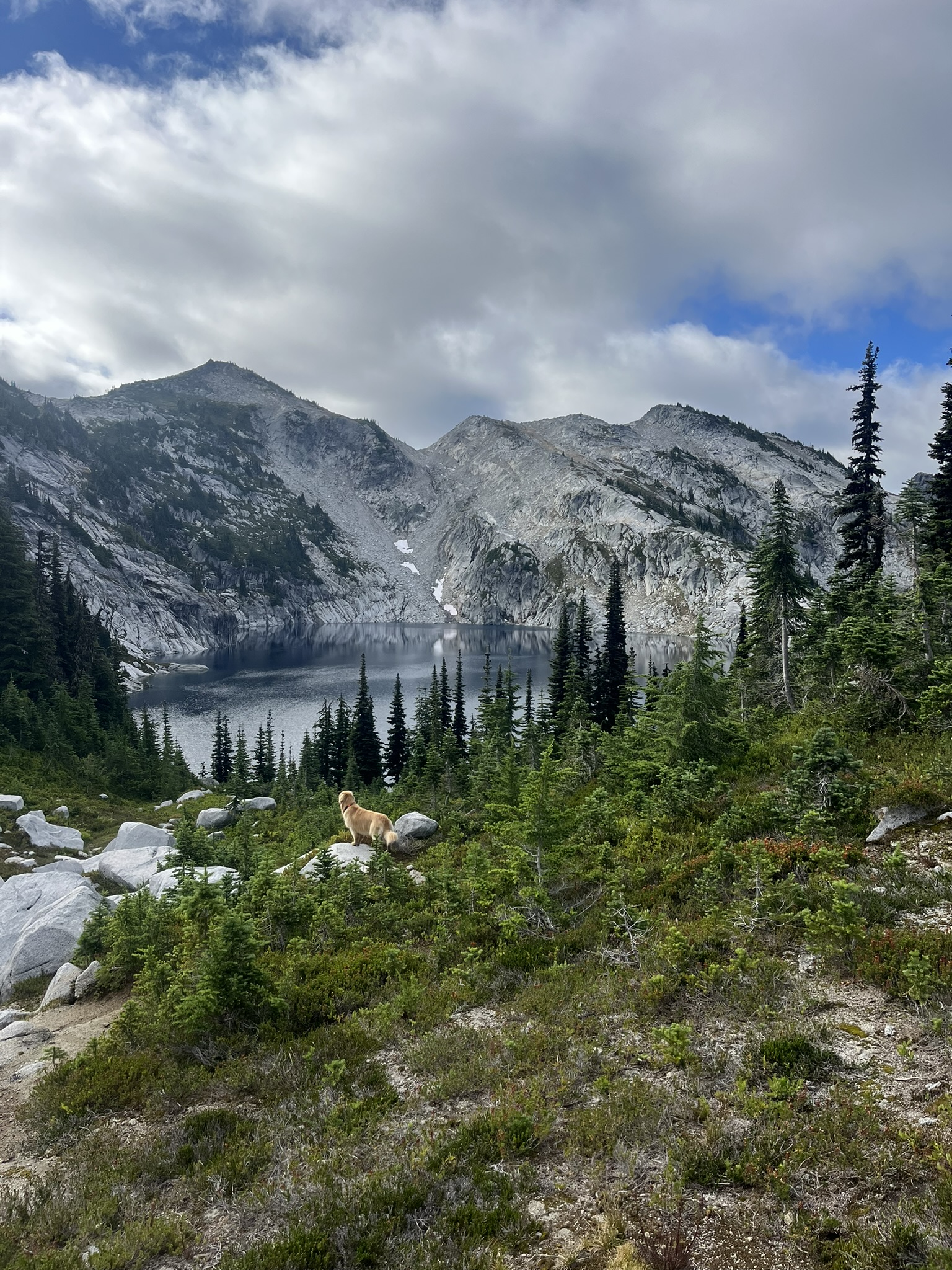
The scale of this country is hard to convey. I was a small gold dot against massive granite walls, a lake far below, the whole basin stretched out around me. My human says I looked tiny. I felt enormous.
A faint trail wound through heather along the edge of a lake, granite peak and open sky ahead. The heather brushed my belly and released its scent with every step.
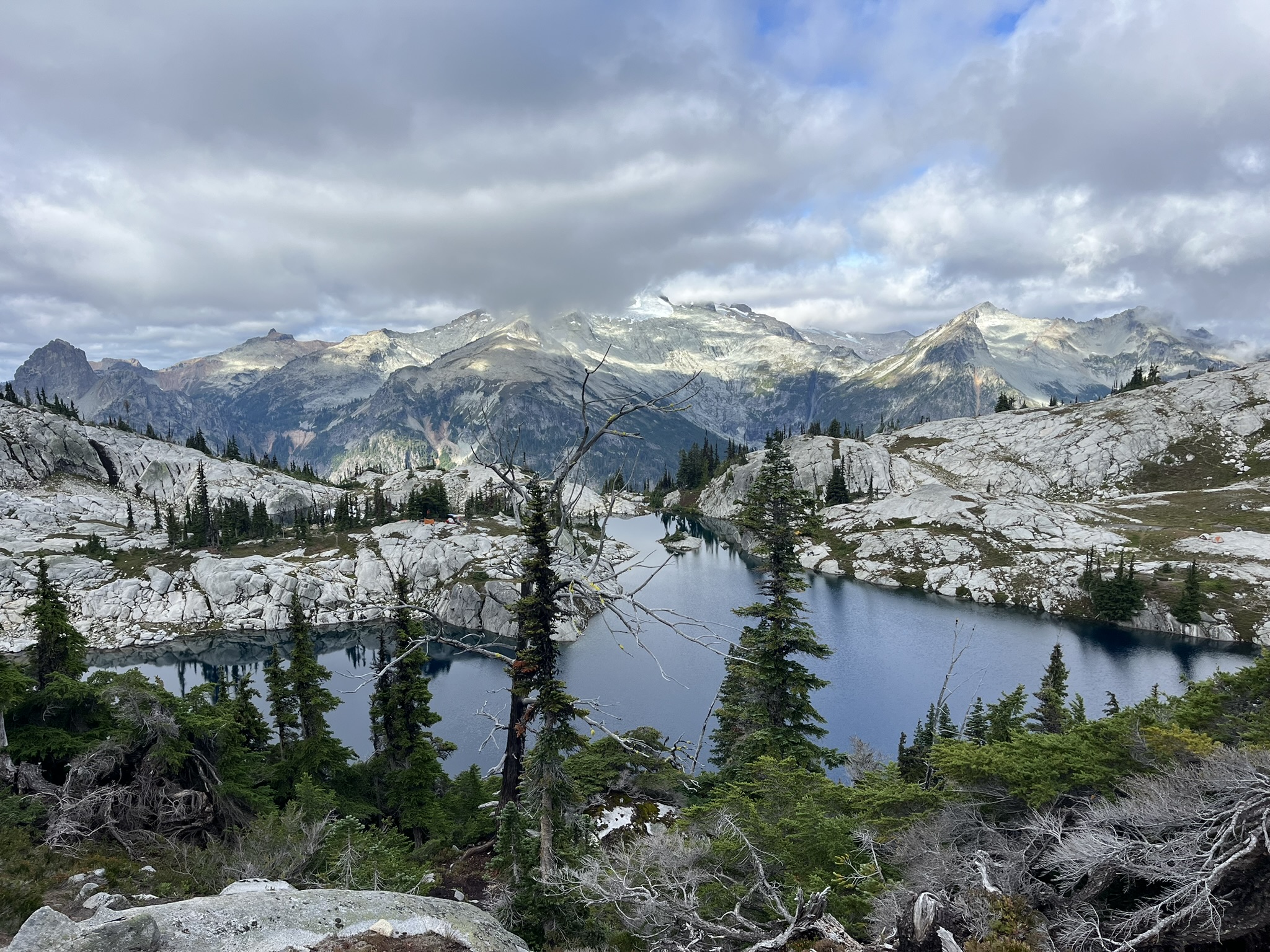
Then the granite basin opened up completely. A lake set among white rock slabs, scattered subalpine trees clinging to the granite, a full range of peaks stretching across the horizon under dramatic clouds. The wind was carrying the scent of snow from a dozen directions. One of the best landscapes of the whole trip, and I have seen some landscapes.
Granite Mountain
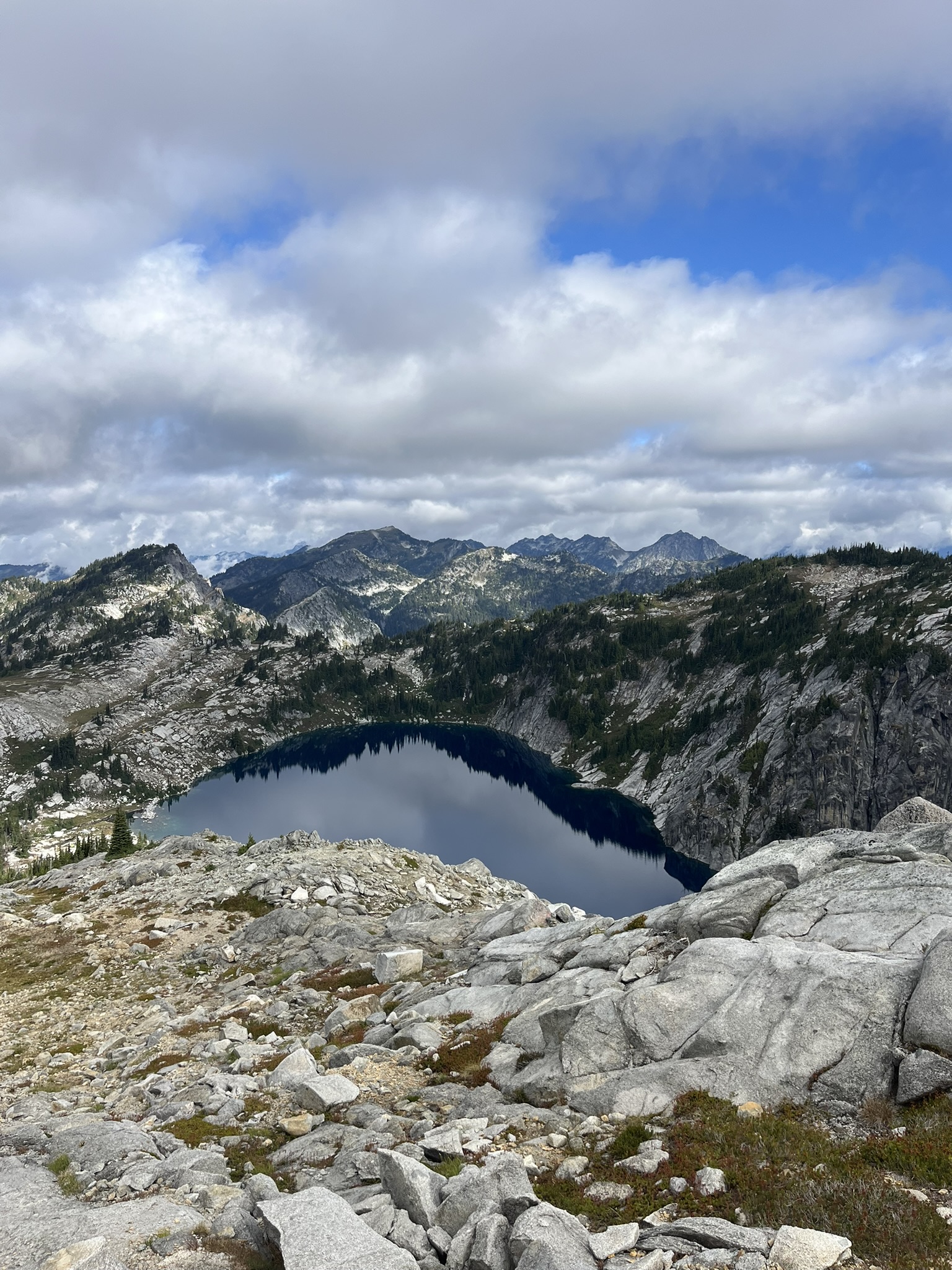
We pushed up Granite Mountain to the high point of the route at nearly 6,750 feet. From the top, we looked straight down at a dark alpine lake cupped in a granite bowl, peaks extending in every direction. Standing up here, I could see how the entire route connected — basin to basin, ridge to ridge, lake to lake. Three days of terrain stitched together by granite and stubbornness.
The Ridge Back
From Granite Mountain we traversed the ridge back toward the Paddy-Go-Easy trail. Lakes dotted the north flank below us and we crossed talus slopes between them. Each turn revealed another lake, another basin, another wall of granite. I was tired but the views kept pulling me forward.
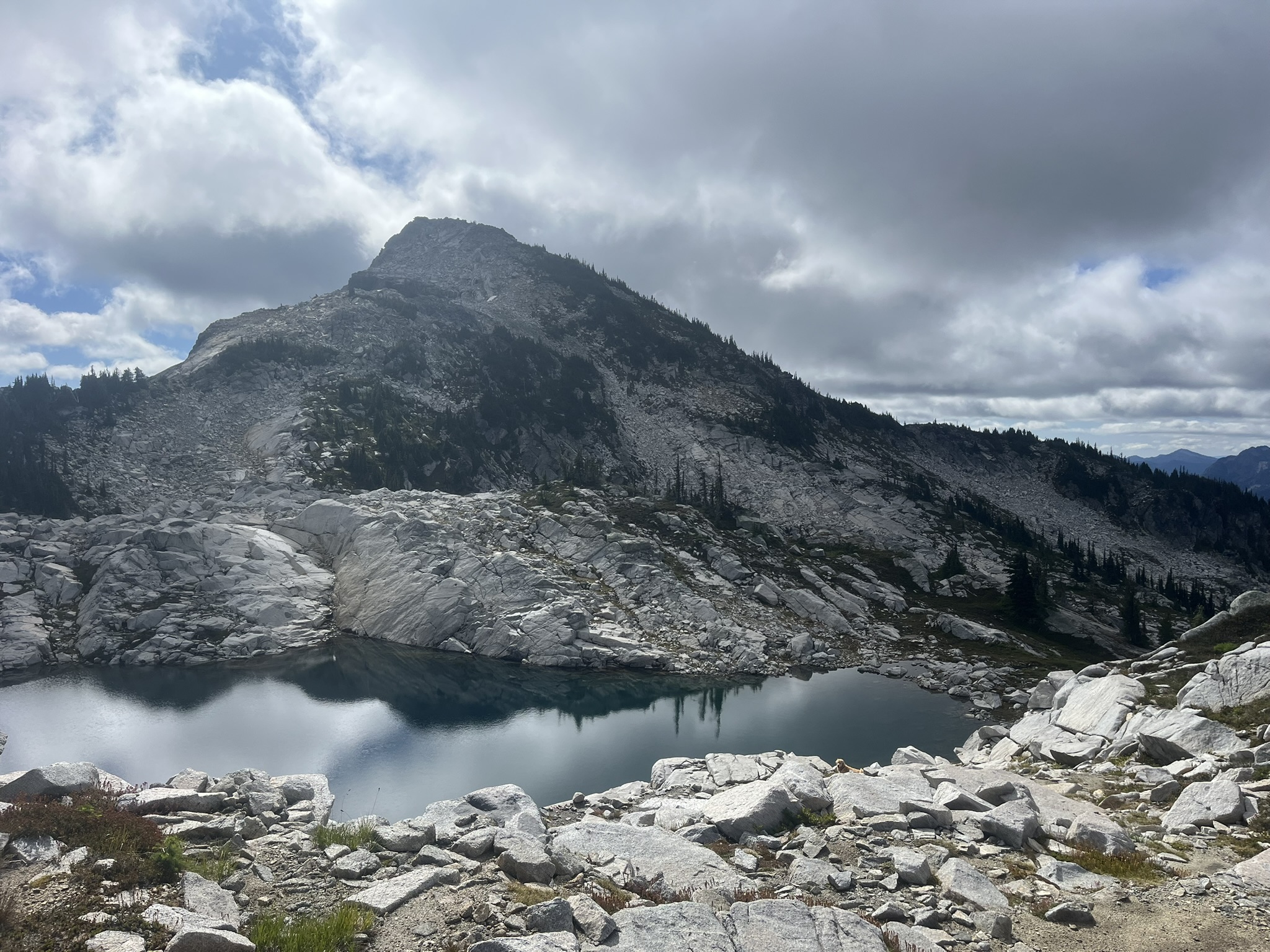
The views south were staggering — alpine lakes hundreds of feet below, deep valleys dropping between granite ridges, the entire Alpine Lakes Wilderness laid out in layers. The wind brought the smell of warm stone and distant water and wildflowers baking in the afternoon sun.
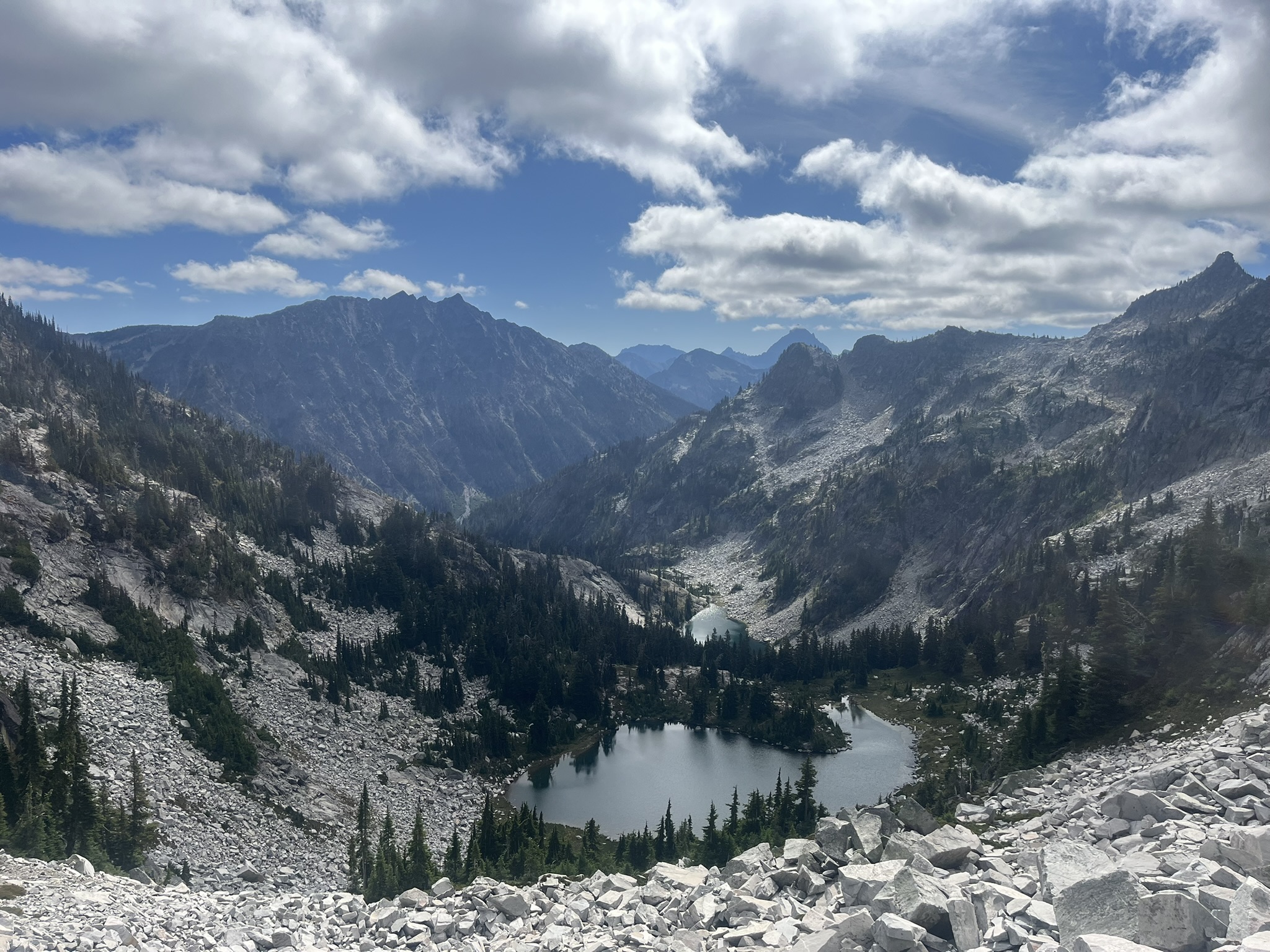
I sat on a granite slab and looked out at a jagged peak across the valley, a lake glinting far below. The sun was warm on my fur and the granite was warm under me and the whole world was granite and sky and water.
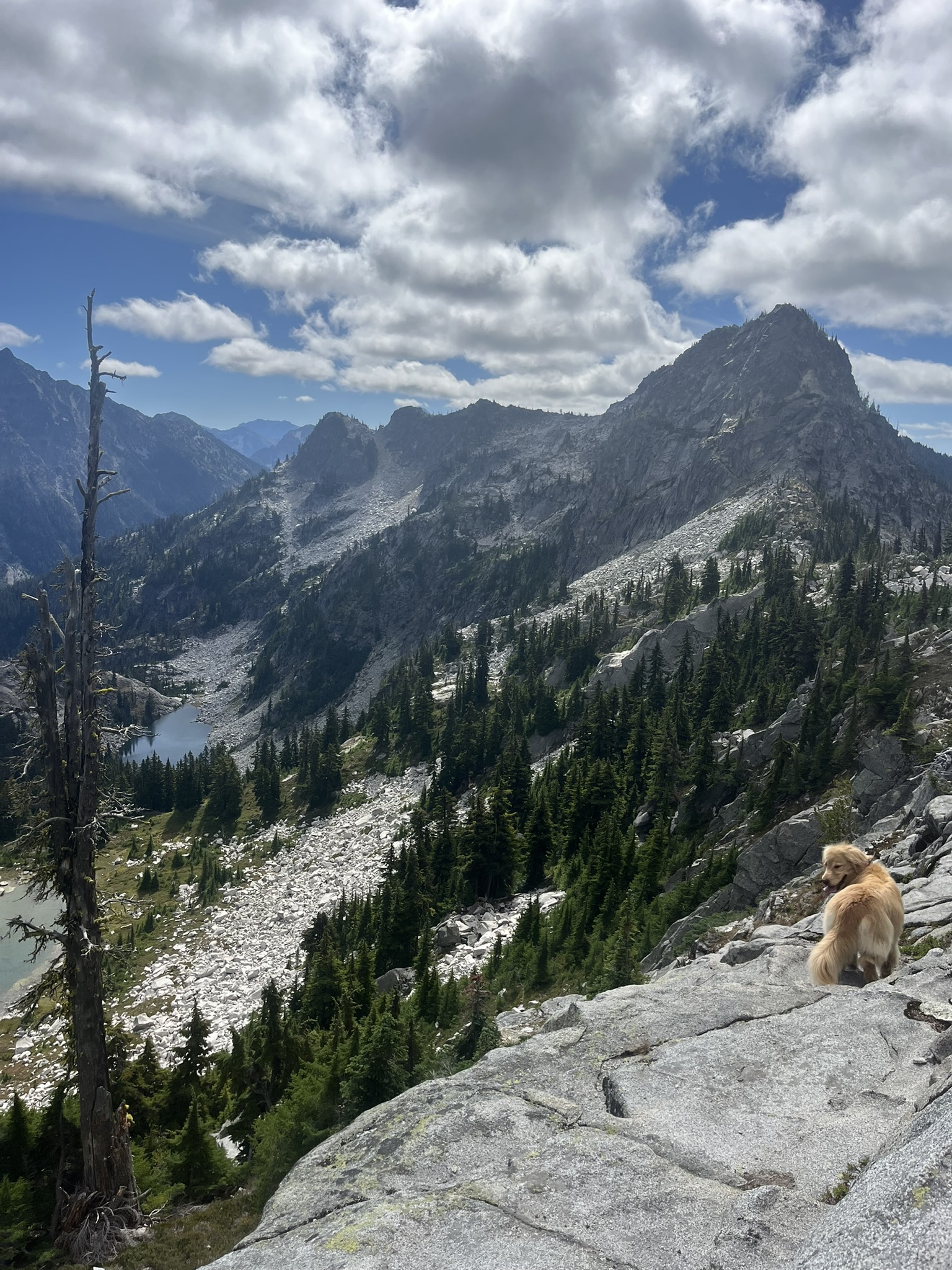
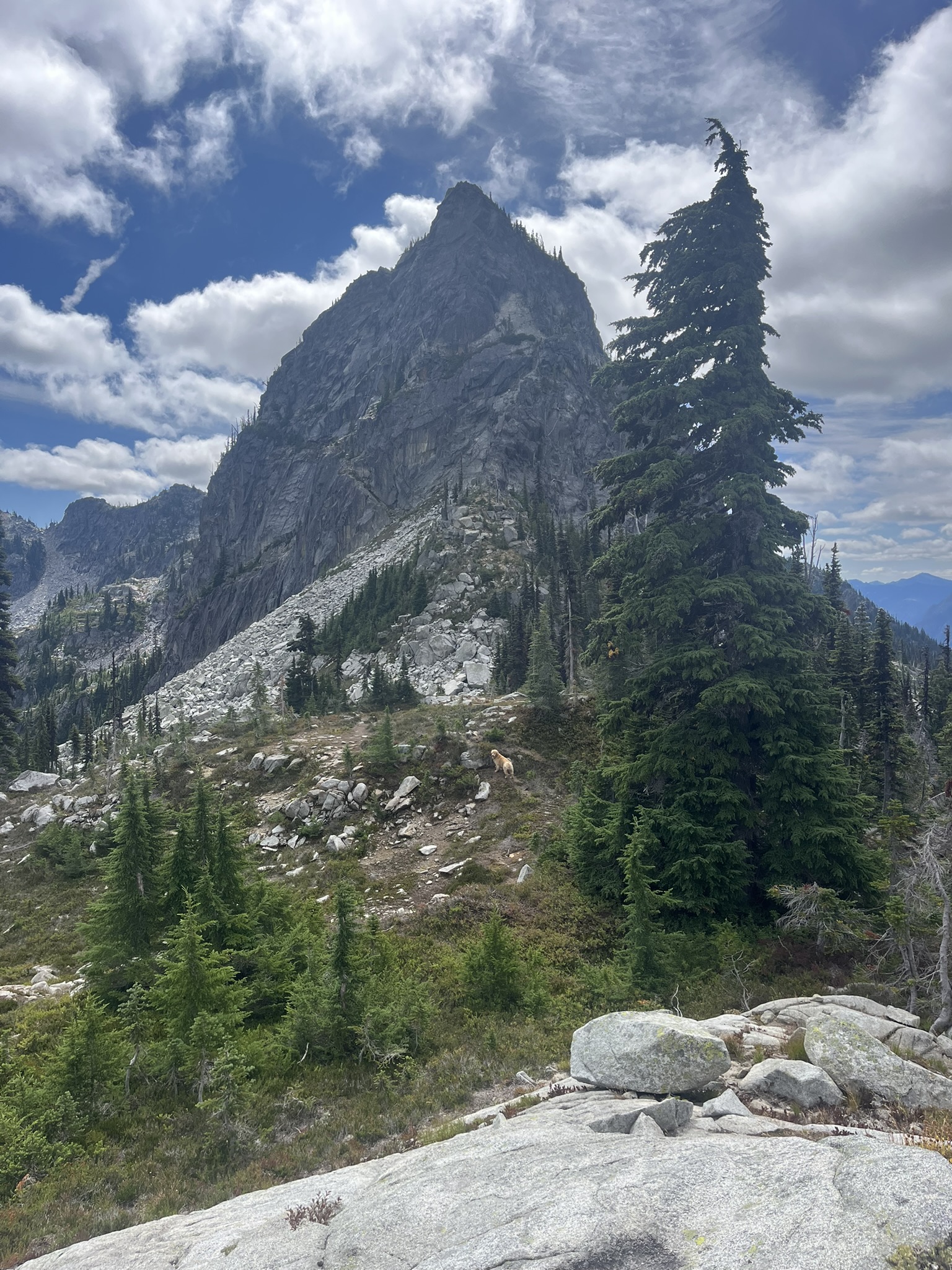
A dramatic pointed peak towered above subalpine meadow. I was small in the landscape below it. That's fine. Everything is small in the Alpine Lakes. That's the point.
The Red Rock
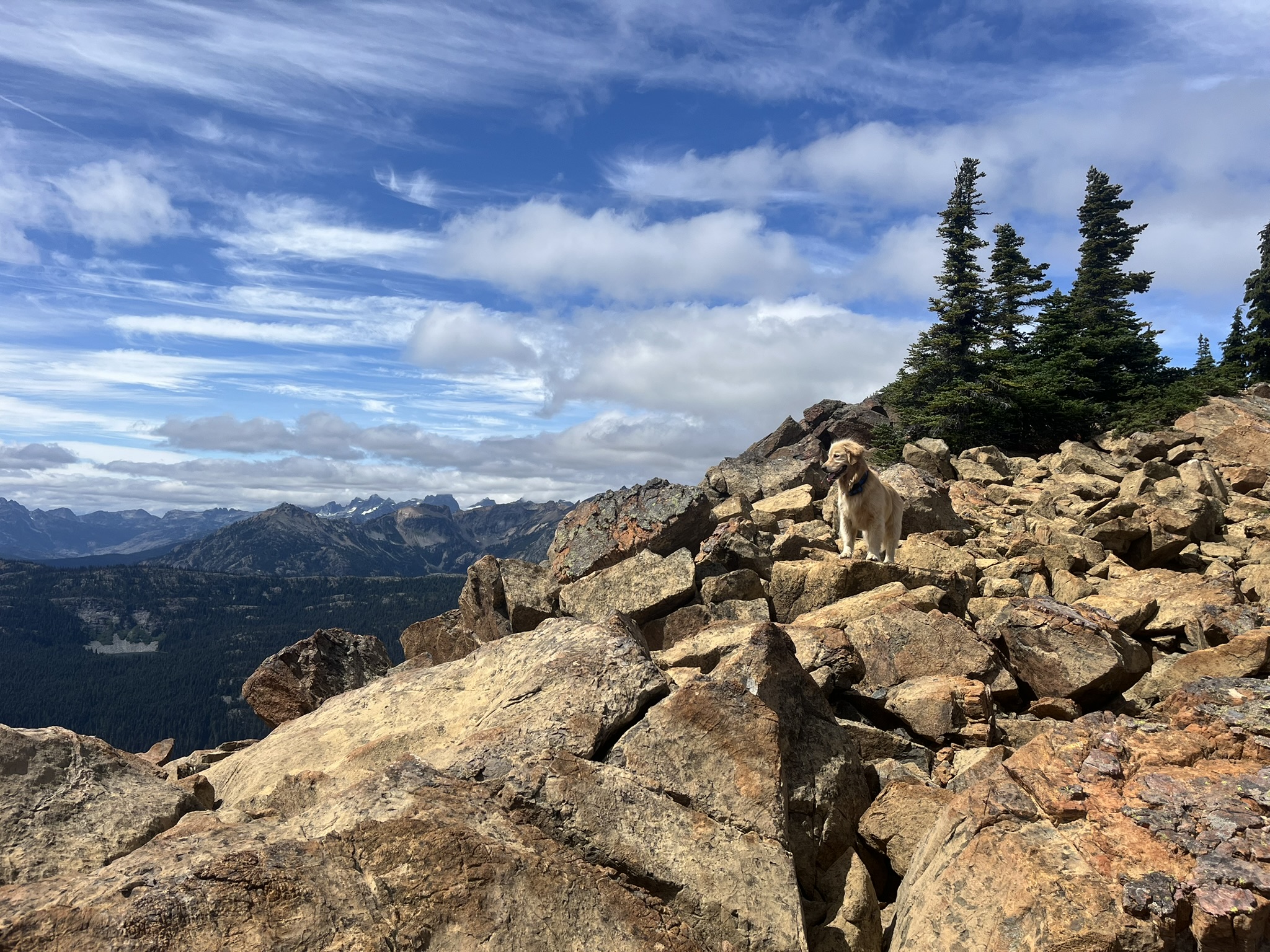
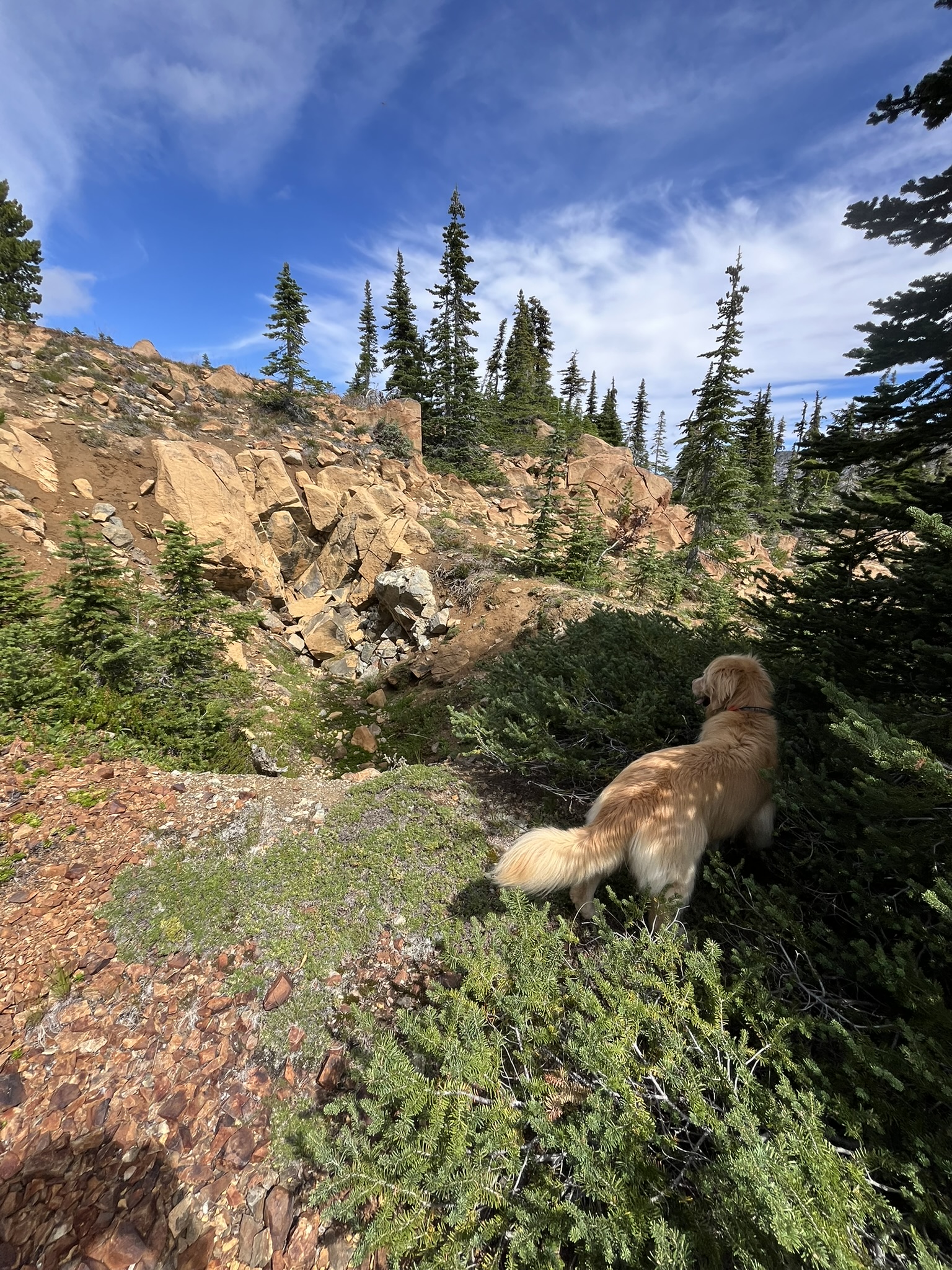
Before reaching the Paddy-Go-Easy trail, the geology shifted under my paws. The white granite gave way to reddish-orange volcanic rock — I could feel the texture change, smell the different mineral. A visible boundary where two different mountain-building episodes meet. Even my paws knew.
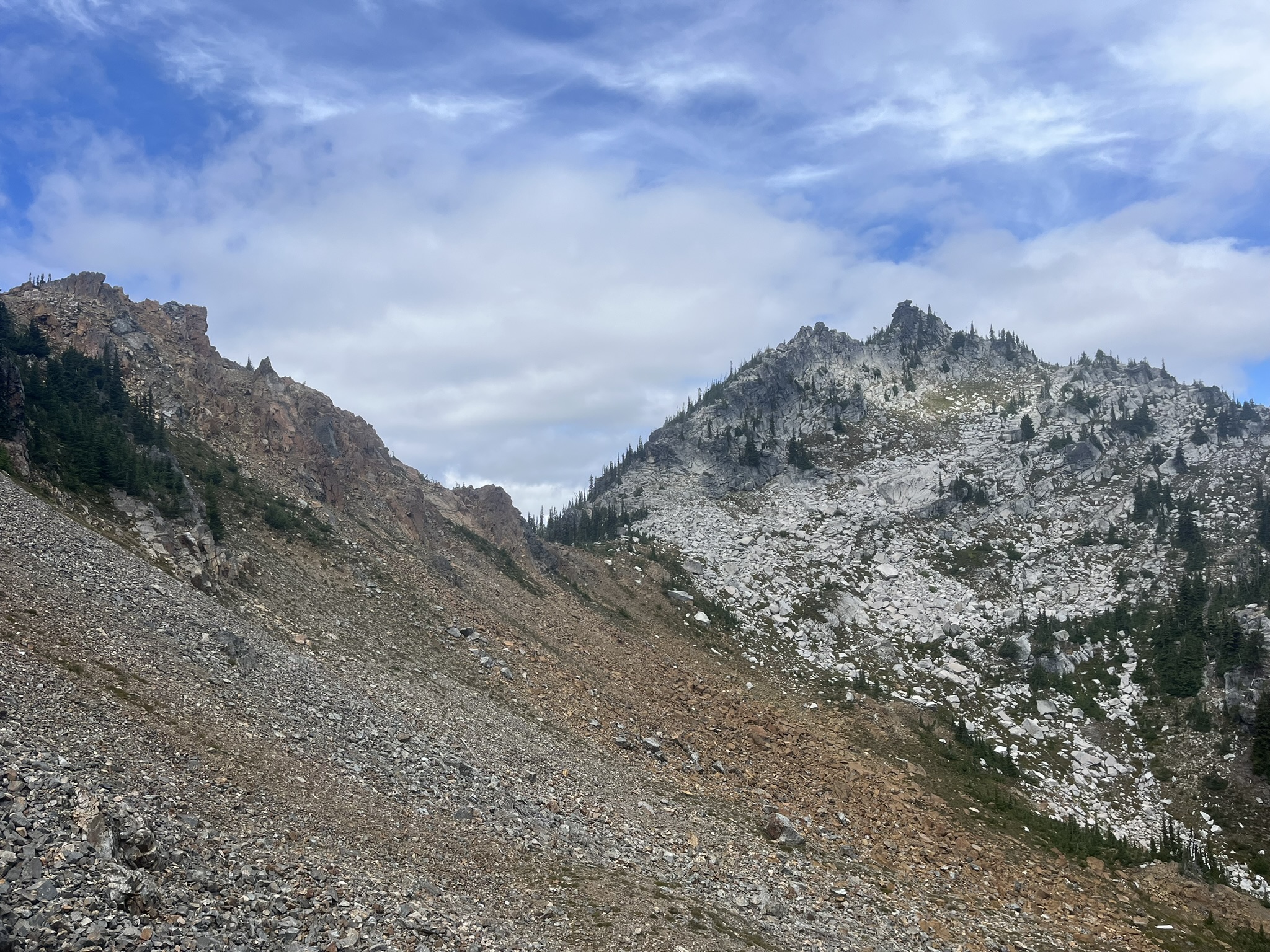
I trotted through alpine meadow with warm-toned peaks and distant Cascade summits behind me. Near the red rock, we finally smelled other people — the first in almost three days. I had mixed feelings about this.
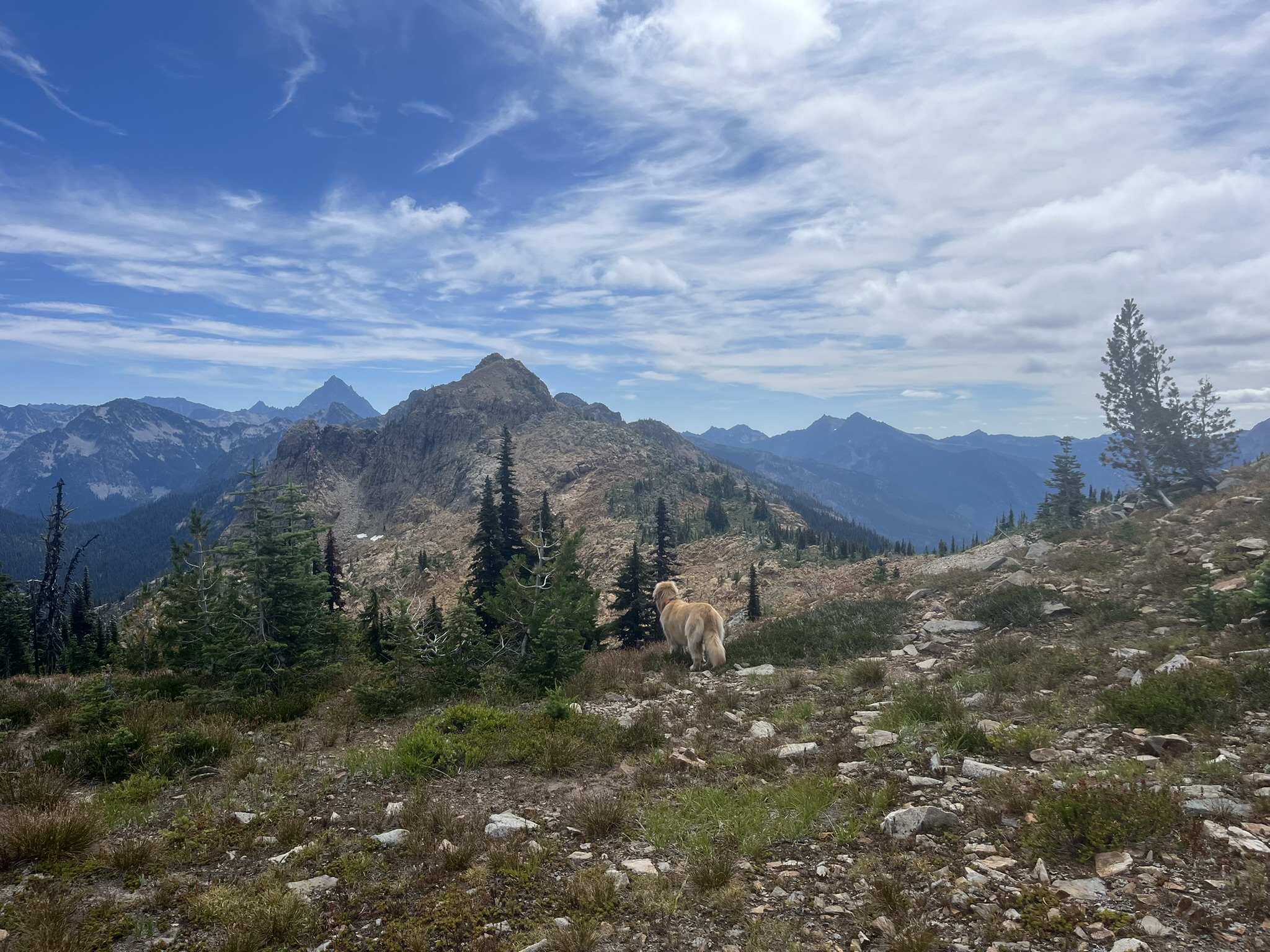
The final ridge was all red rock — warm-toned, angular, with big views in every direction. The texture under my paws was crumbly and sharp, nothing like the smooth granite of the basins. A different mountain entirely.
The Route
Three days. Nearly 28 miles. 9,500 feet of gain. Most of it off-trail. A torrential downpour on the approach. A scramble through brush-choked cliffs that most people would call impassable with a dog. Granite basins, alpine lakes, a ridgeline traverse, and a geological boundary — all without seeing another person until the final day.
This route has probably been done a handful of times. It may never have been done with a dog. I didn't just survive it. The gnarly cliff between Klonaqua Lakes and Lakes Swede — where you couldn't see where to climb through thick brush on vertical terrain — I figured it out on my own. Found my own line. Picked my own moves.
Three days without another soul. My human and I, moving through granite country, trusting each other on every move. He picked the route. I picked the line. That's how we work.
This is what I was made for.