Friday Evening — Into the Valley
We left the trailhead around 5 PM on a Friday in August. The air was thick with haze — a whole season of fires burning slow across the Cascades, and I could smell every one of them. The plan was to walk all the way around Mount Hinman. Thirty-three miles of off-trail granite, snowfields, and alpine lakes through some of the most remote terrain in the Alpine Lakes Wilderness. I was wearing my blue pack. I was ready.
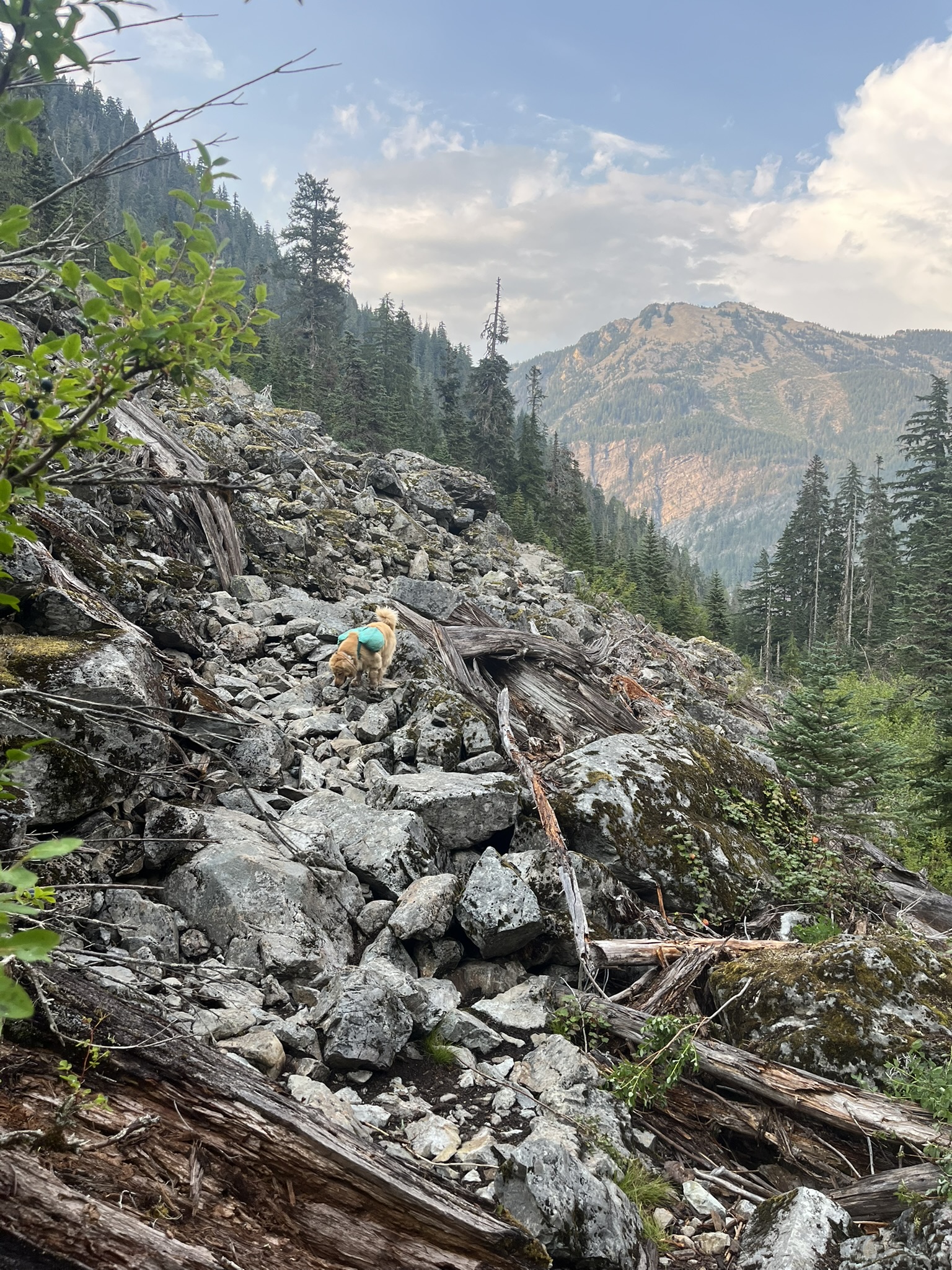
The first six miles followed the Necklace Valley trail through old-growth forest — the kind of forest that smells like centuries, all damp bark and fungus and fern. Then the route climbed into the upper valley and the trees fell away. By evening I was scrambling over boulder fields, picking my way through the rubble, a mountain peak catching the last warm light behind me.

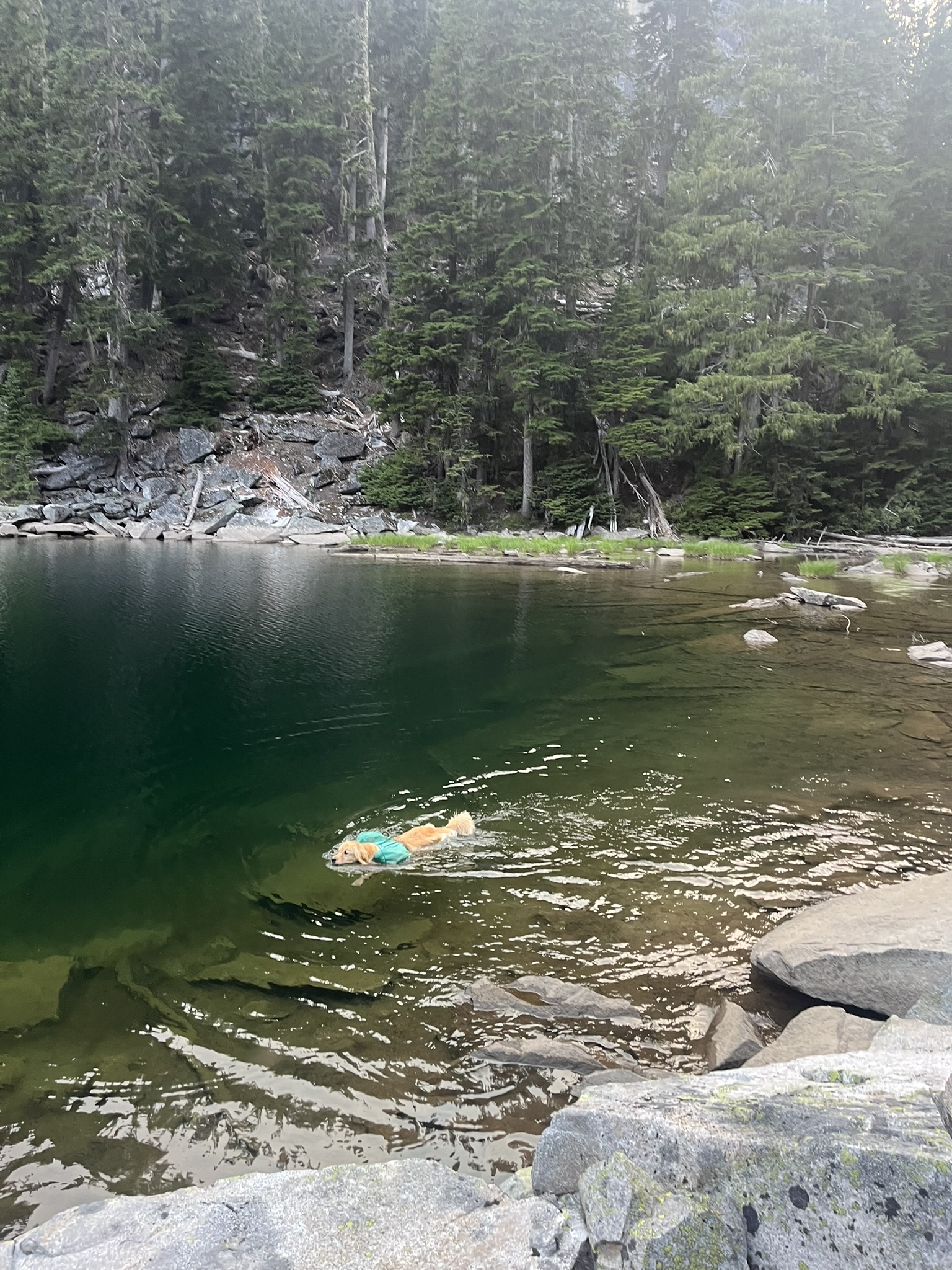
We reached the upper Necklace Valley lakes as the light faded, and I went straight in. Pack still on. The water was deep green and cold and perfect. I paddled across with the forest dark and still around the shoreline, the surface breaking around me in quiet ripples. Swimming with a pack on is slightly more effort and completely worth it.

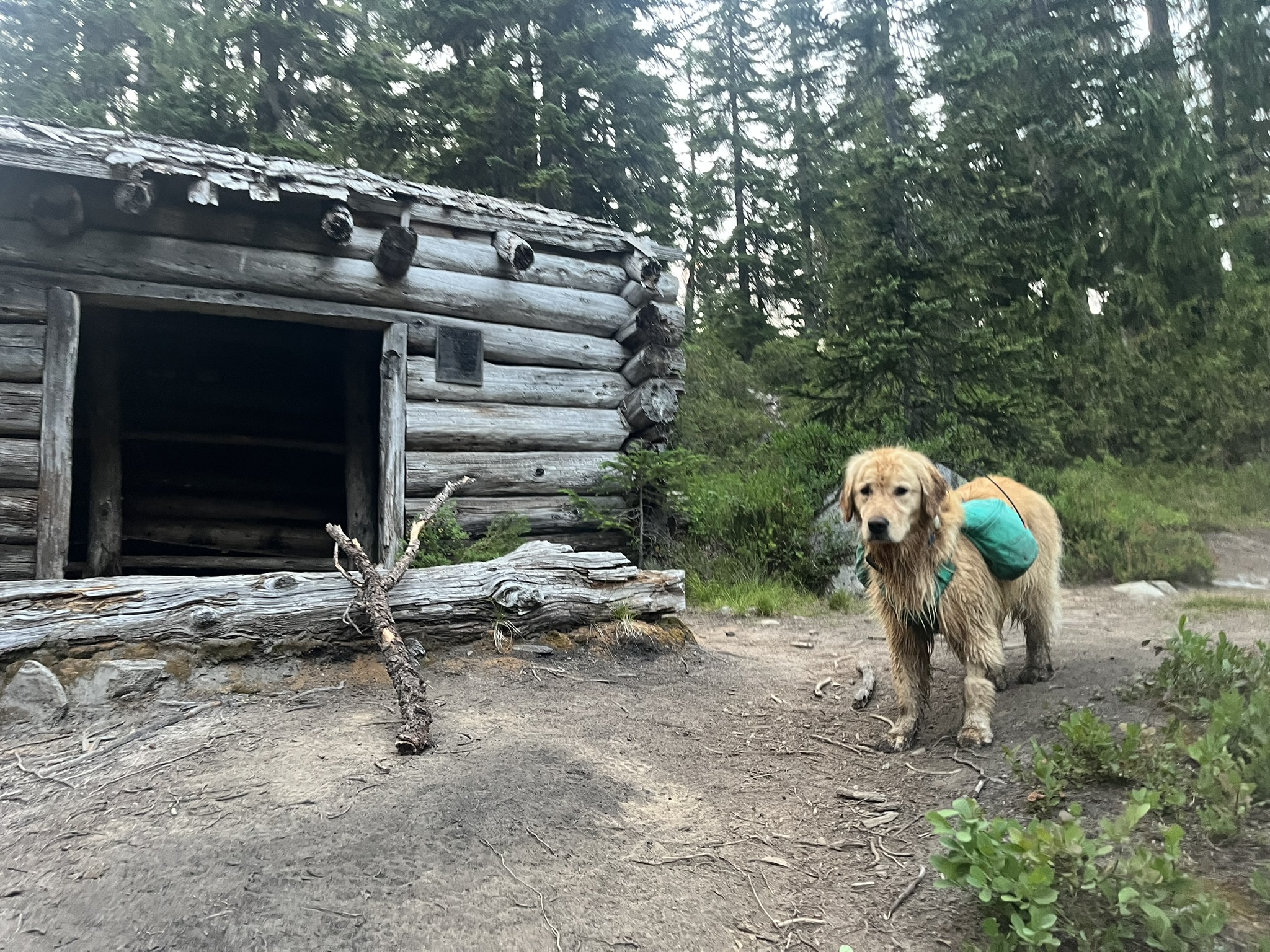
Near the lake we found the old La Bohn cabin — a weathered log shelter that smelled like decades of wood rot and mouse nests and rain. It's been standing in these woods long enough to look like it grew here. I stood in the clearing out front, soaked and ready for whatever came next.
That night, lightning cracked across the ridgelines. I lay in the tent and watched the sky flash white through the fabric, the thunder rolling up the valley in long slow waves. The air smelled like ozone and hot rock. My ears tracked every rumble — every shift in the wind, every crack that echoed off the granite walls. The storm was loud and close and wild. I pressed against my human's side and he put his arm over me. Not because I was scared. Because that's what we do when the world gets loud. We stayed like that and watched the light show until it passed.
Saturday Morning — Smoke and Stone
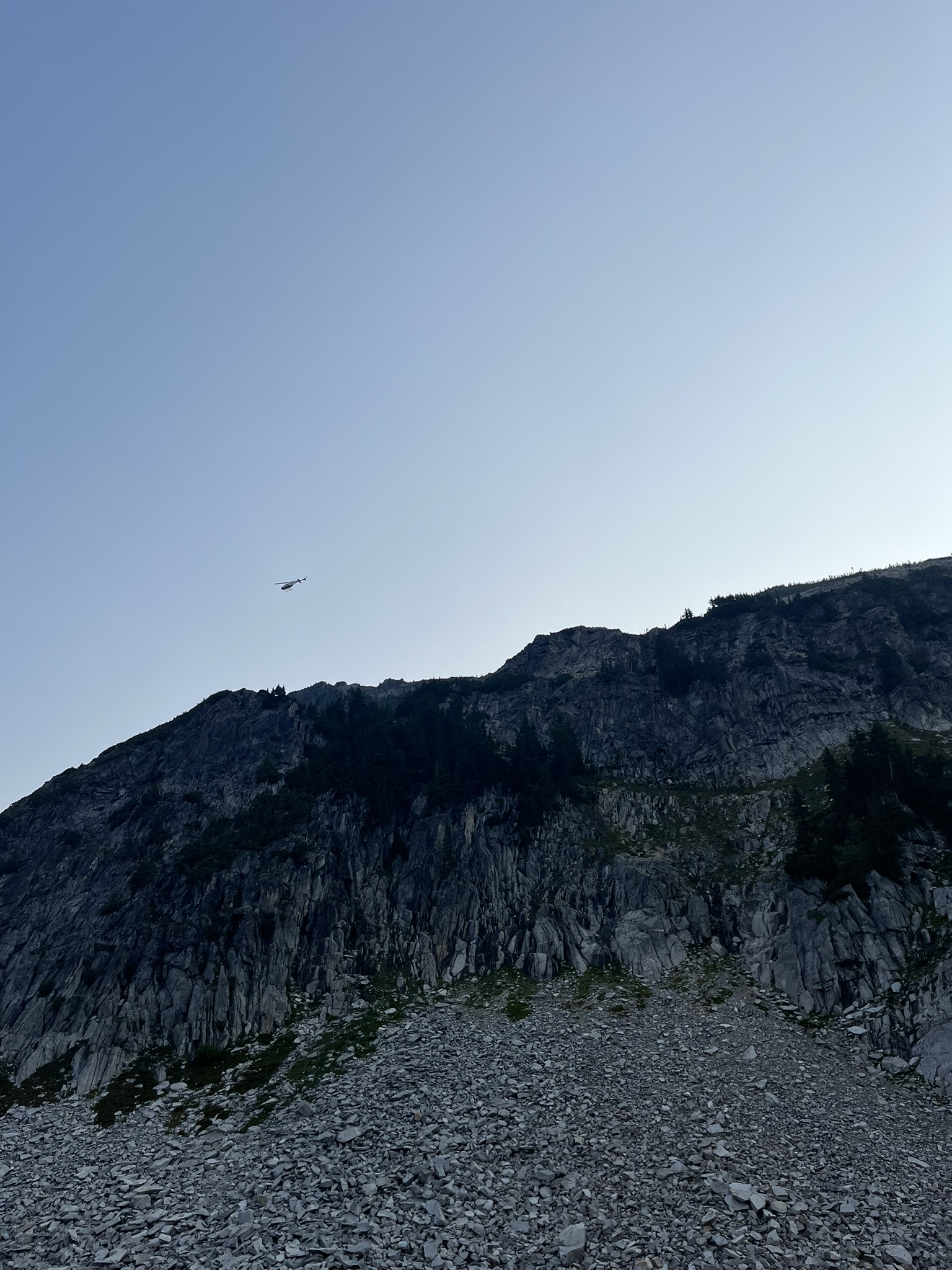
By morning, the lightning had started fires. Thin columns of smoke rose from the ridges to the south and west, and I could smell them — sharp and acrid, different from campfire smoke, more chemical. A helicopter appeared above the cliffs, circling low, its rotors thumping off the granite walls. It banked behind a ridge, came back, banked again. I watched it with my ears pricked. Loud, but not a threat.
We packed up and pushed south into the alpine. The haze from the fires softened everything — distant peaks turned to layers of gray and blue, the hard edges gone. The terrain opened up into granite slabs, boulder fields, subalpine meadows with scattered fir. I stood on a rock spine at 5,900 feet with the whole smoky world behind me, mouth open, wind on my tongue. Above treeline is where I make the most sense.
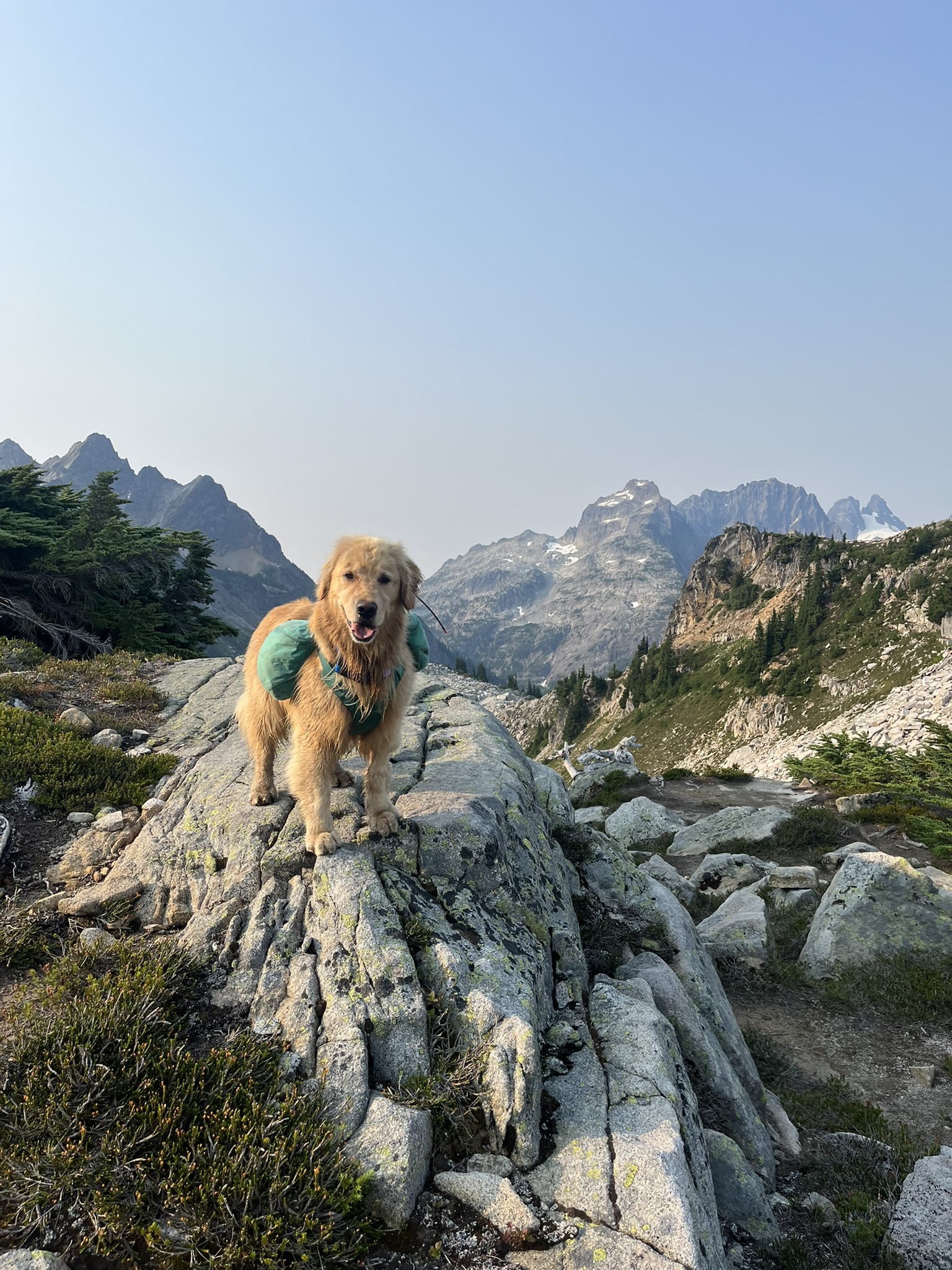
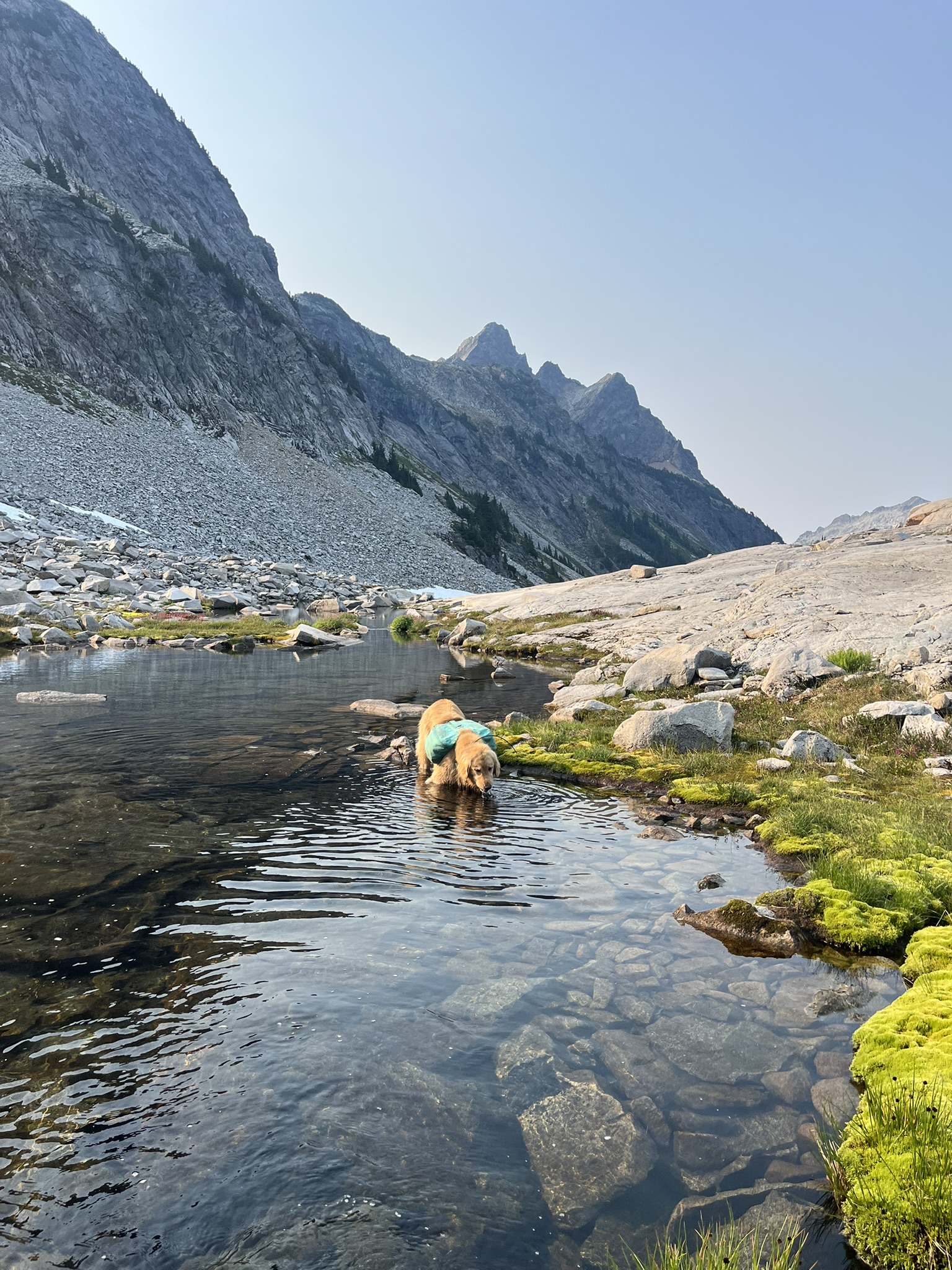
The route dropped through a rocky basin, crossing meltwater streams between huge angular boulders. I stopped to drink from a clear pool — ice-cold, tasting of granite and snowmelt, the best water in the world. Jagged peaks reflected through the haze above me.
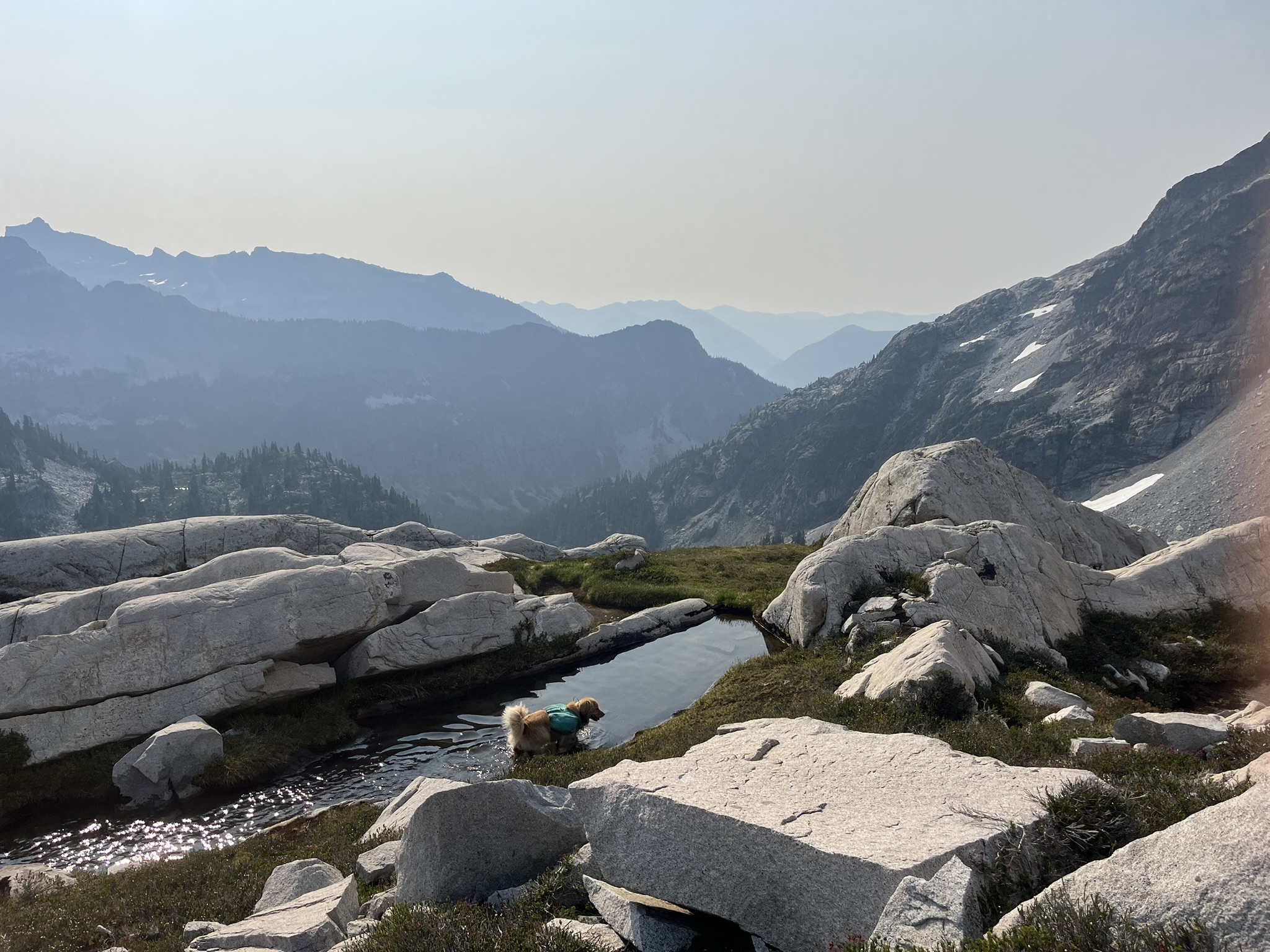
By mid-morning we'd climbed to a high shelf dotted with tarns. I waded into one of them — a shallow pool cupped in polished granite, the whole smoky valley opening up behind me. The water was cold enough to make my legs ache and clear enough to see every pebble on the bottom. I stood there and let it soak in. The cold. The view. The silence.
Lake Rowena
The terrain on Hinman's south side dropped into the Lake Rowena basin — turquoise lakes, deep and cold enough to make your teeth hurt. My human says the color comes from glacial flour in the meltwater. I say the color comes from the lake being perfect. In the August sun they looked almost tropical, completely wrong for a granite cirque with cliffs rising a thousand feet above. I loved it.
I stood at the shore and looked out over the water. The whole basin was silent except for the occasional crack of a rock releasing from the cliffs above. I could smell wet stone, snowmelt, the faint sulfur of mineral deposits. No animal scent for miles — whatever lives up here had given this cirque wide berth. Just rock and water and sky. The kind of silence that fills you up instead of emptying you out.
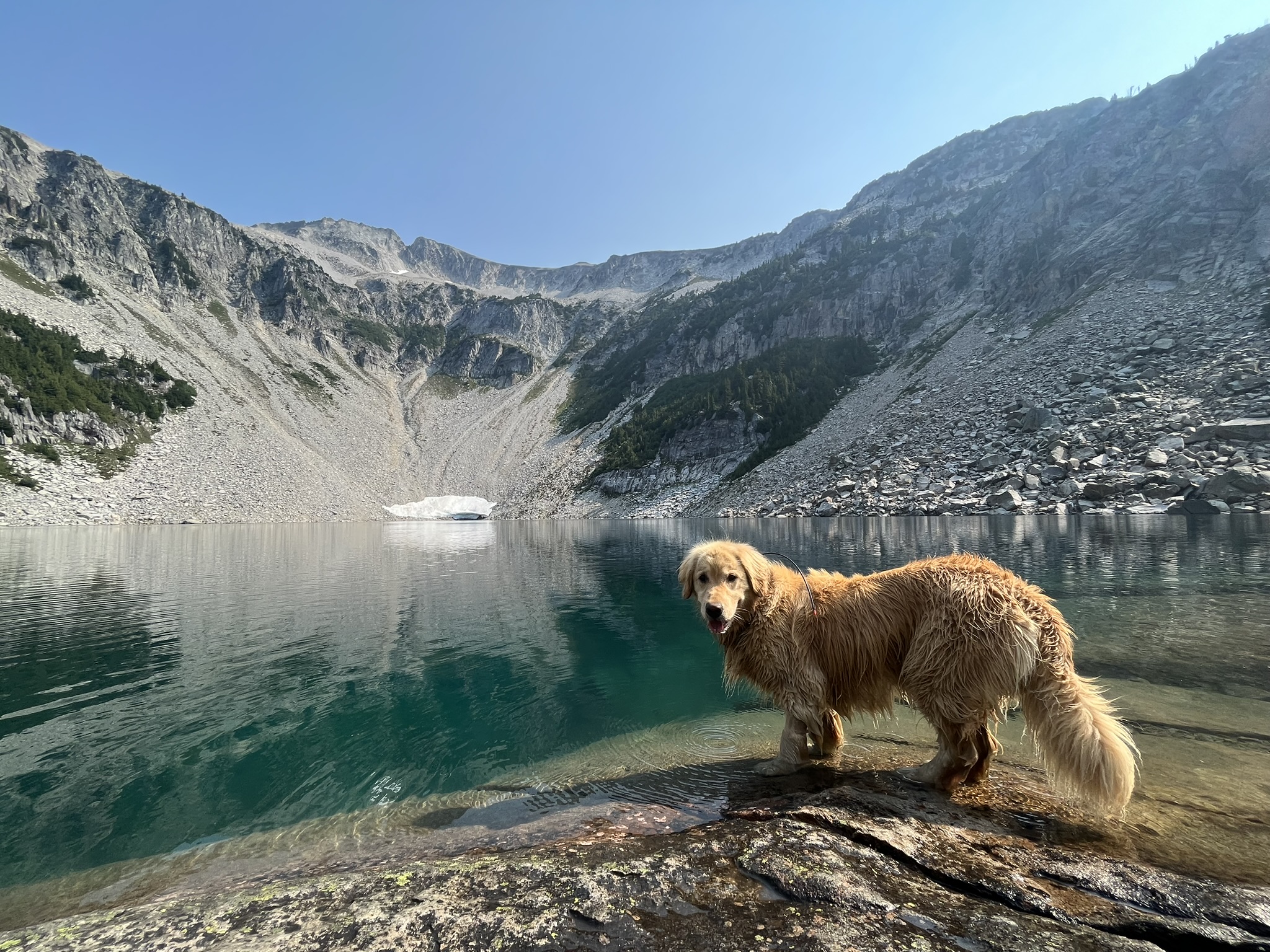
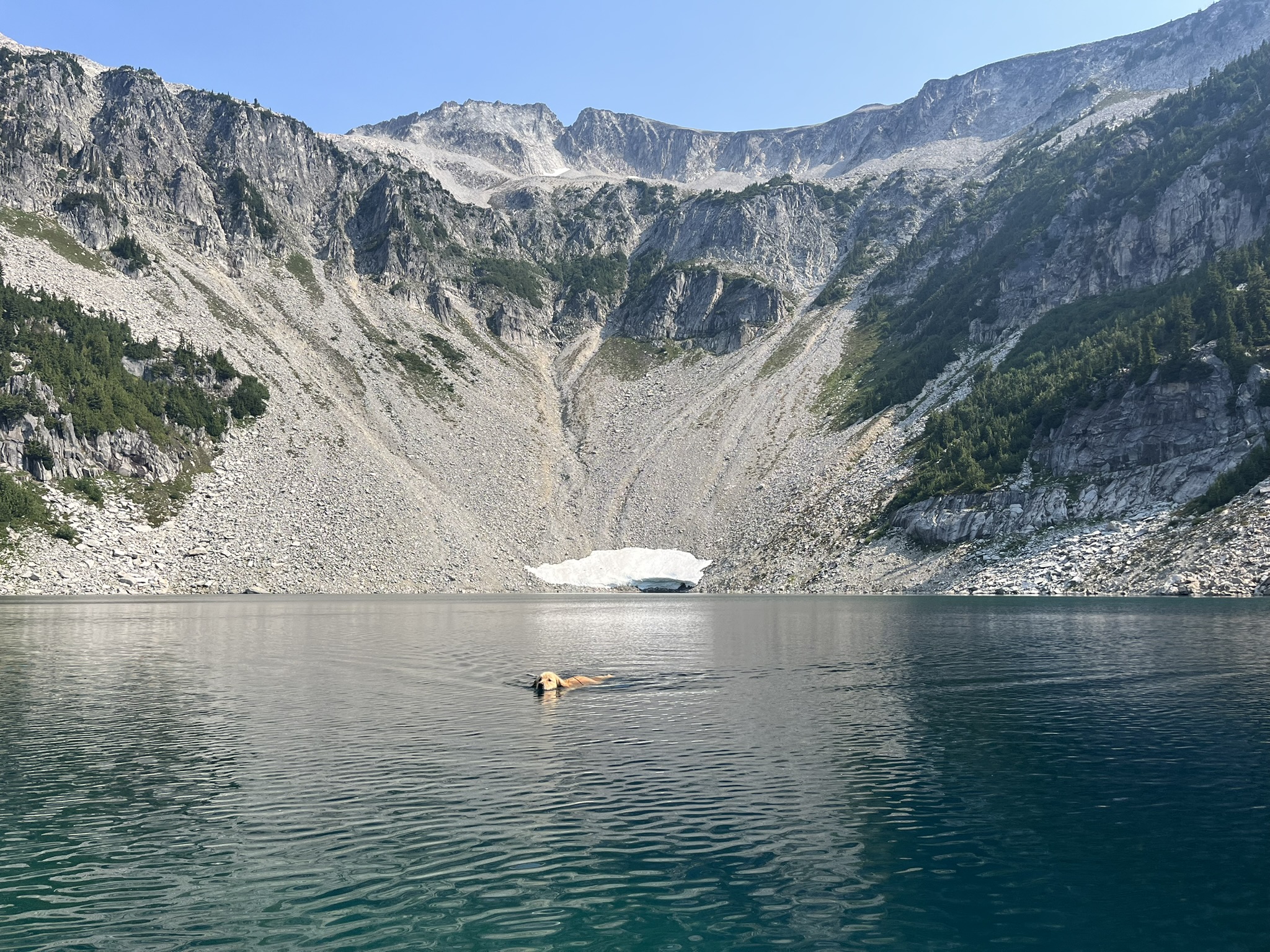
Then I was swimming. Out past the shallows into the deep turquoise, my golden head the only warm color in a world of gray and blue. The cirque wall rose sheer behind me, a snowfield clinging to its base. The water was so cold it buzzed against my skin, and I didn't care. I never care. Cold water is good water.
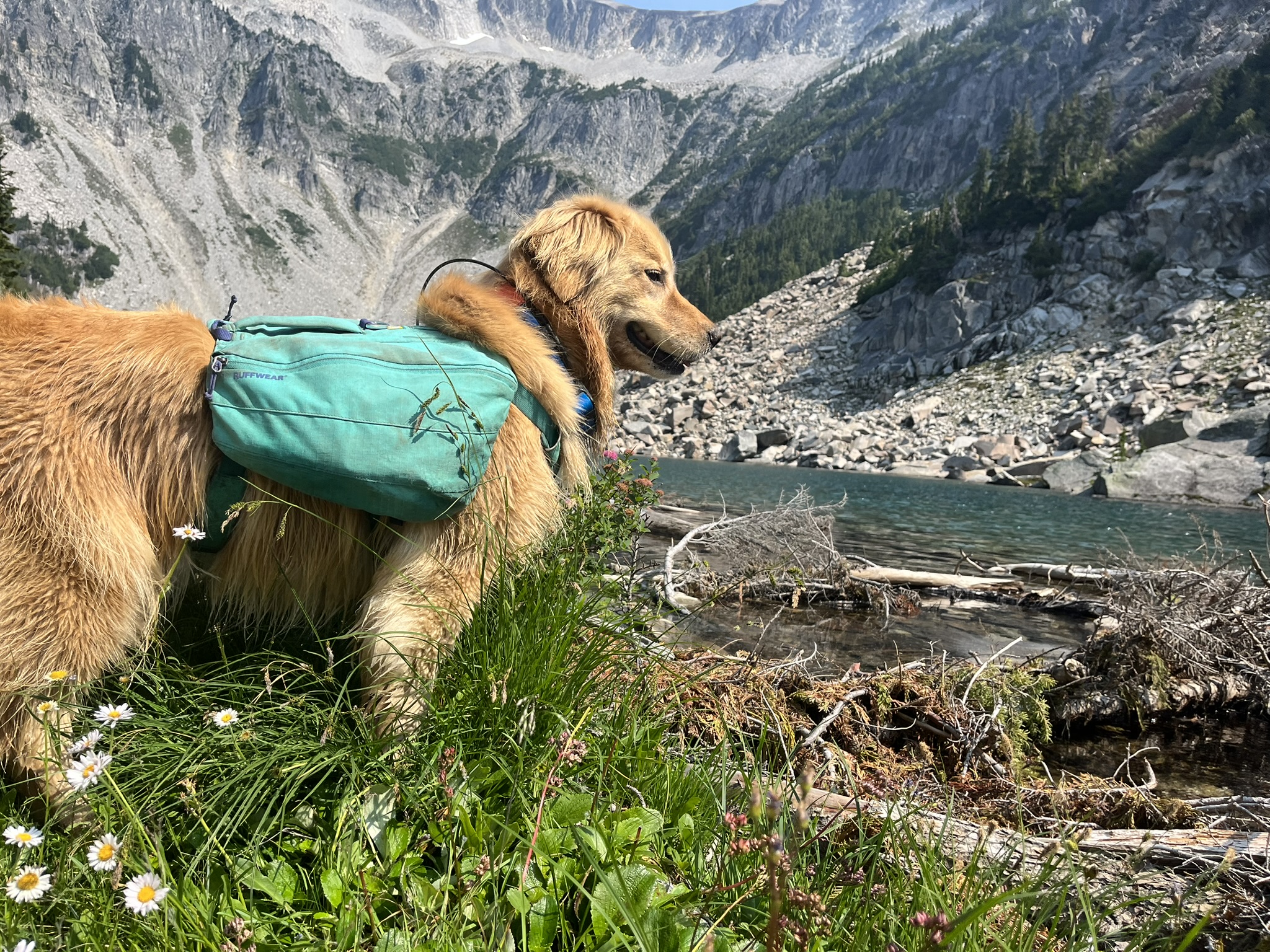
I climbed out and stood in the wildflowers at the water's edge — daisies and paintbrush growing in a thin strip of soil between granite and lake. Wind ruffled my fur and carried the faint sweetness of the flowers mixed with cold stone. I stared off into the middle distance at something. My human always asks what I'm looking at. The answer is: everything and nothing. The wind tells me more than my eyes.
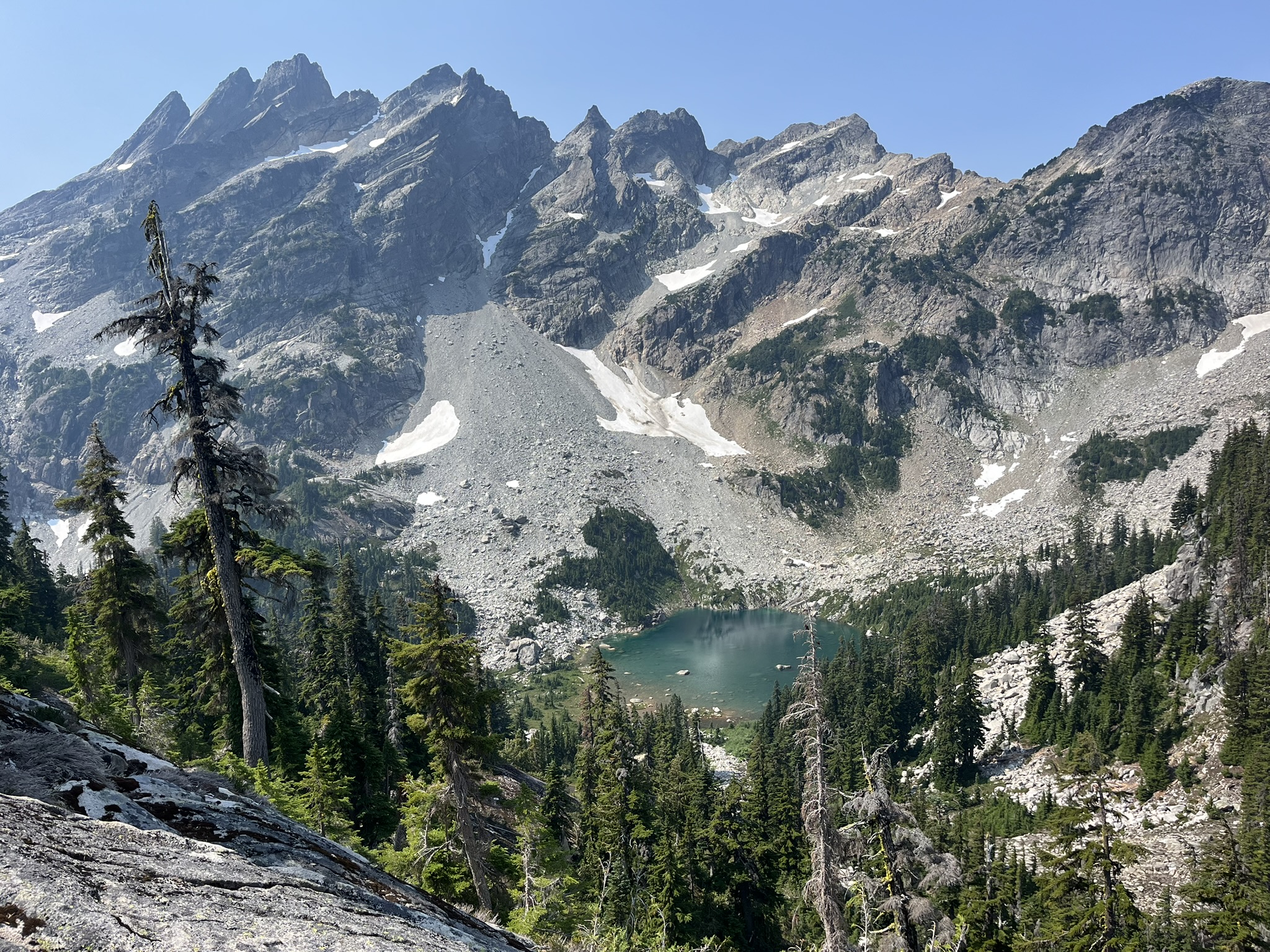
From the ridgeline above, the full scope of the basin came into view — a deep green lake in a perfect cirque, jagged peaks ringing the horizon, snow clinging to north-facing gullies. No trails. No signs. No one else for miles. This is the part of the mountains I like best. The part where the trails end and the real terrain begins.
The High Point
The route climbed northeast from Lake Rowena up Hinman's southeast shoulder — extremely loose talus, the kind where every step sends something sliding and every scramble requires four-point contact. My four points are better than my human's four points. We climbed. To the south, the Pea Soup Lakes sat in their basin, and beyond them the ridgelines stretched out hazy and familiar. I crossed a snowfield at 6,400 feet — a small golden shape on a white slope with the whole Central Cascades behind me. The snow was suncupped and firm, good traction for claws.
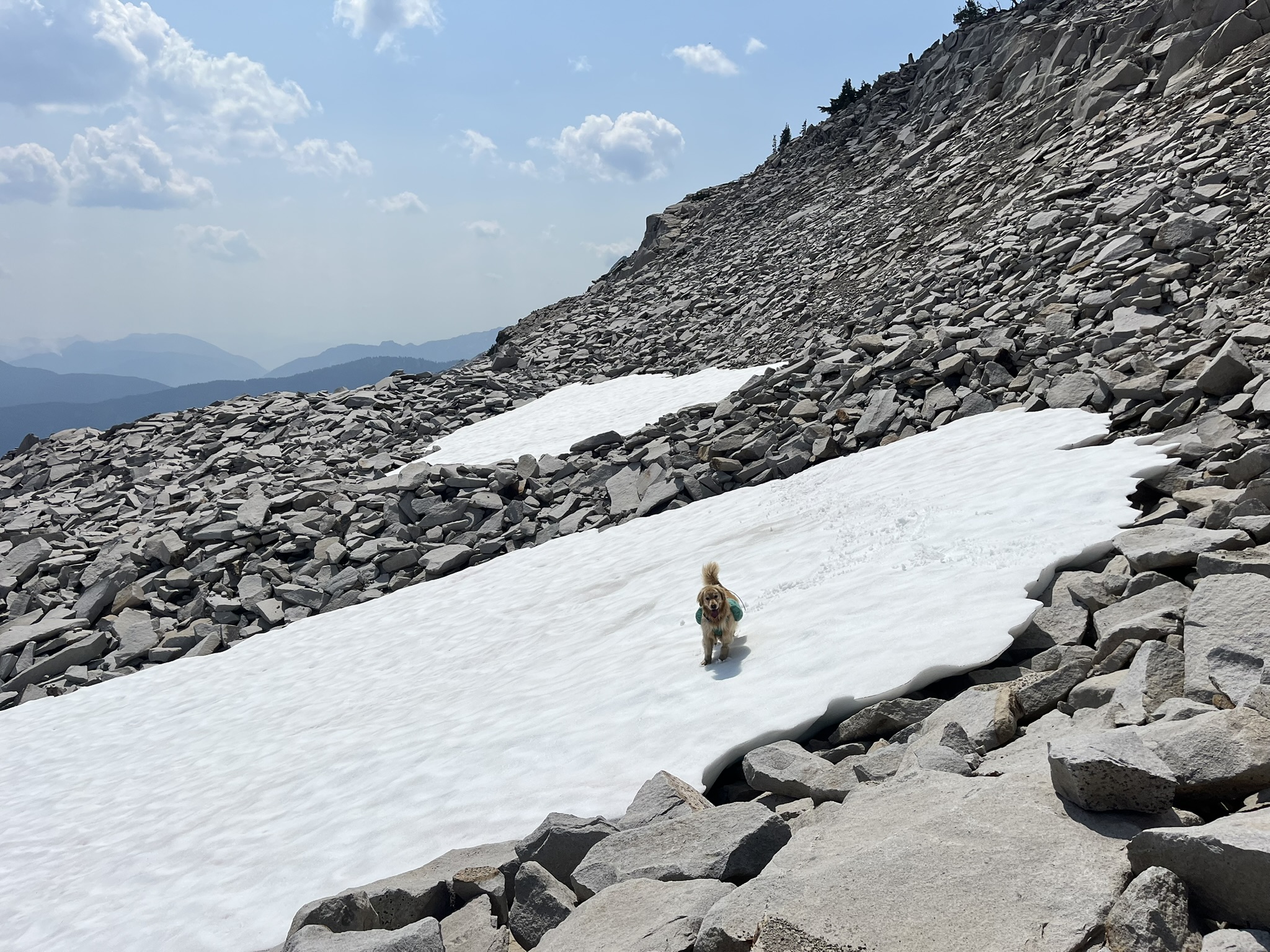
Higher up, the rock turned from gray granite to gold and orange. Suncupped snow stretched across broad shelves between boulder fields. The air thinned. I was ahead, as usual — a spot of gold on white, the summit of Hinman somewhere above in the clouds. The wind up here tasted different. Thinner. Colder. Clean in a way that lower air never is.
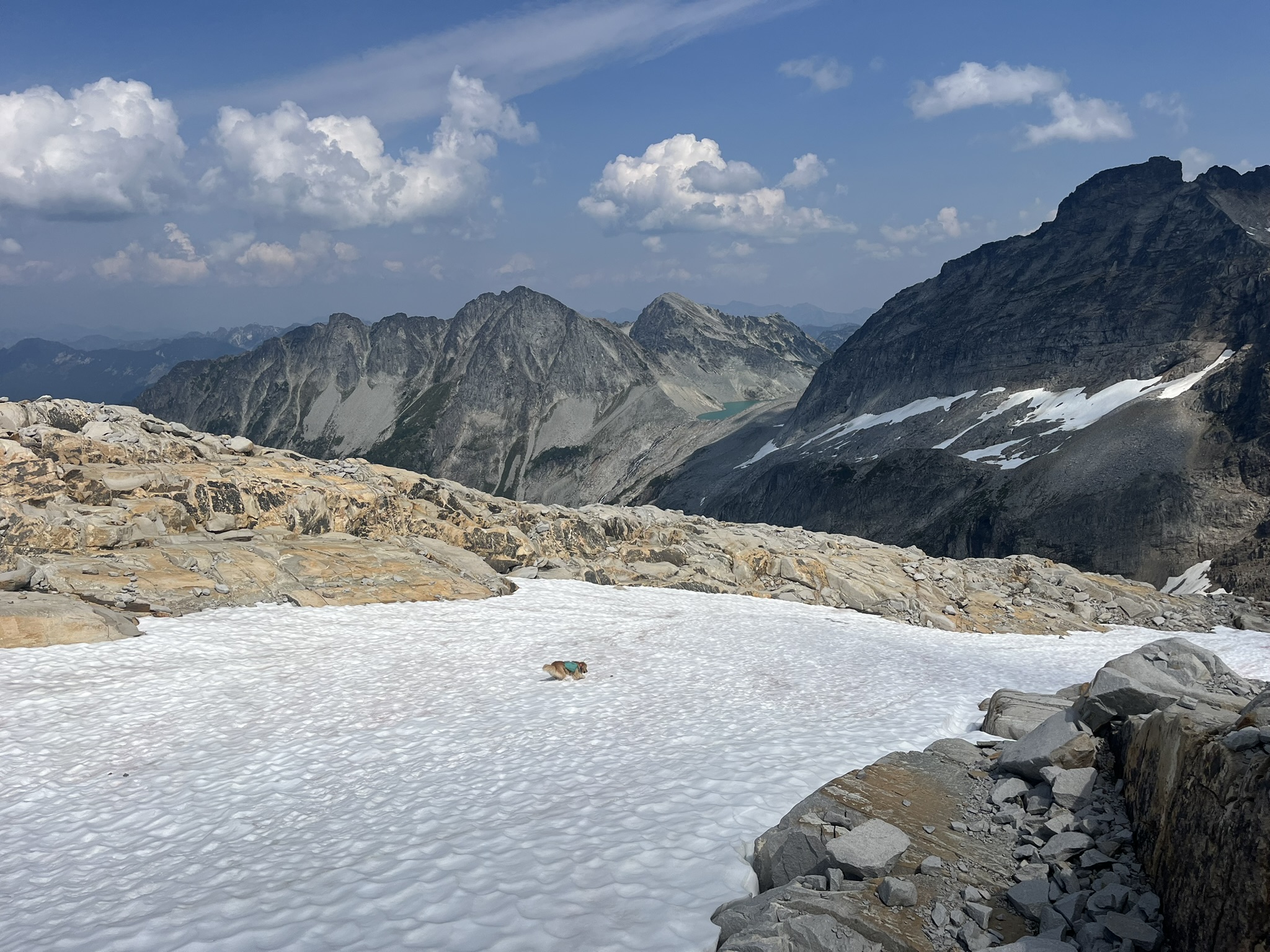
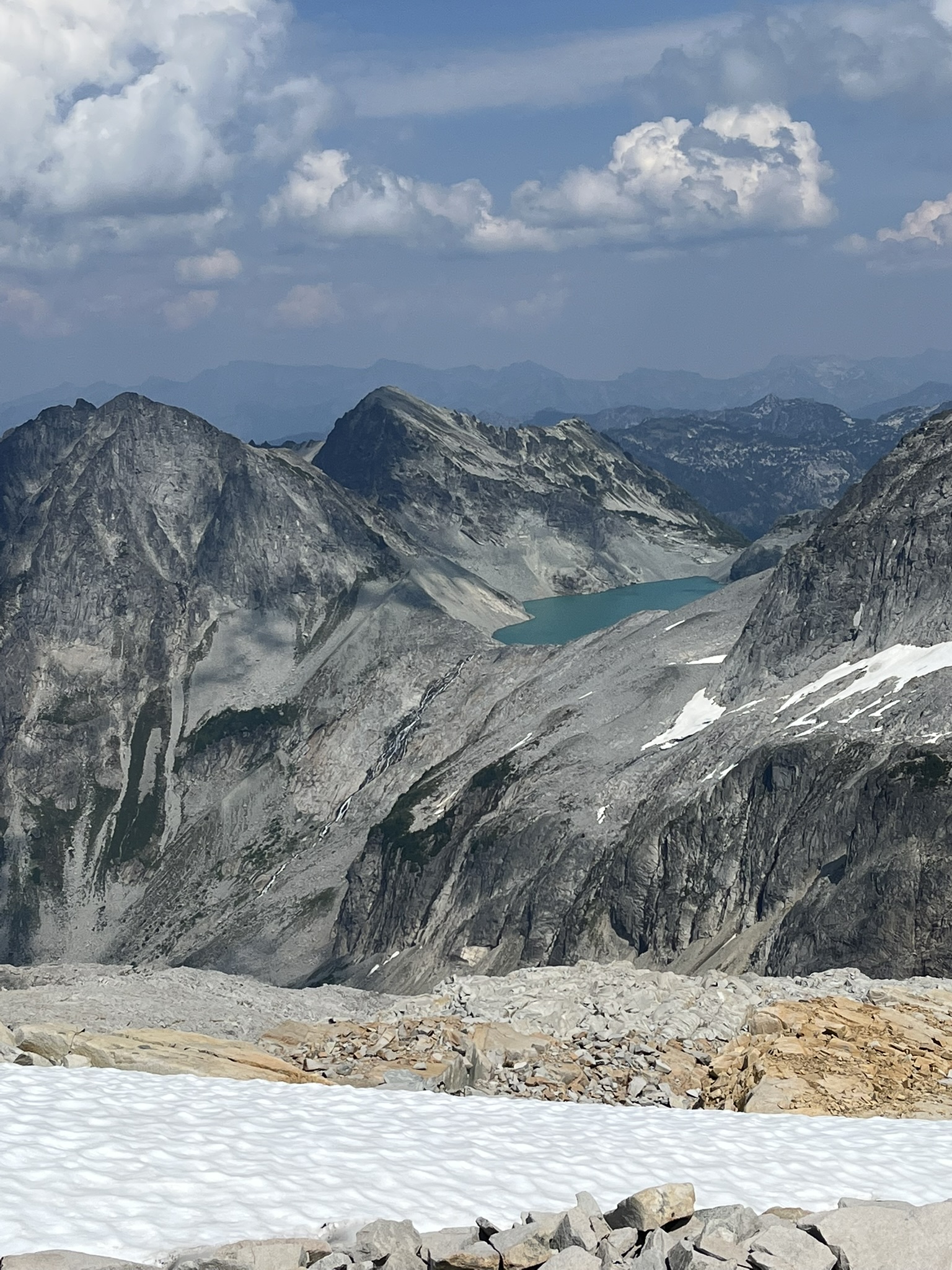
At 7,375 feet, we looked straight down a thousand-foot drop to a turquoise lake cradled in the cirque below. Snow in the foreground, then nothing, then water. The scale made my human dizzy. I just looked. Heights don't bother me the way they bother humans. The wind was steady and the footing was solid and the view was the kind you remember in your bones.
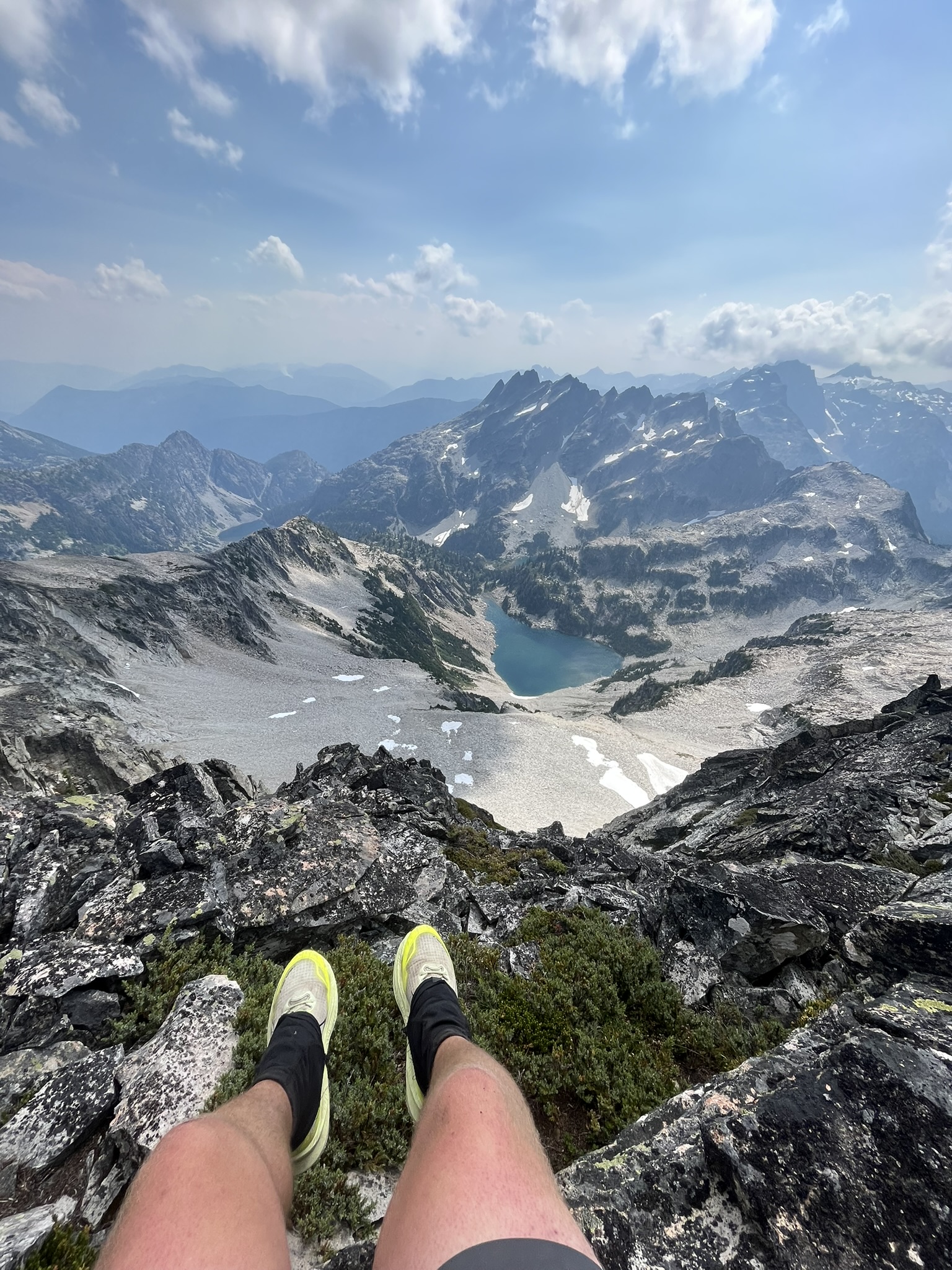
The high point came at 7,480 feet — a rocky perch on Hinman's upper ridge with views in every direction. Lakes below, peaks on the horizon, snow and granite in between. My human sat down and let his legs hang over the edge. I was somewhere behind him in the rocks, sniffing the wind, cataloging everything it carried. The Cascades stretched out smoky and blue and endless.
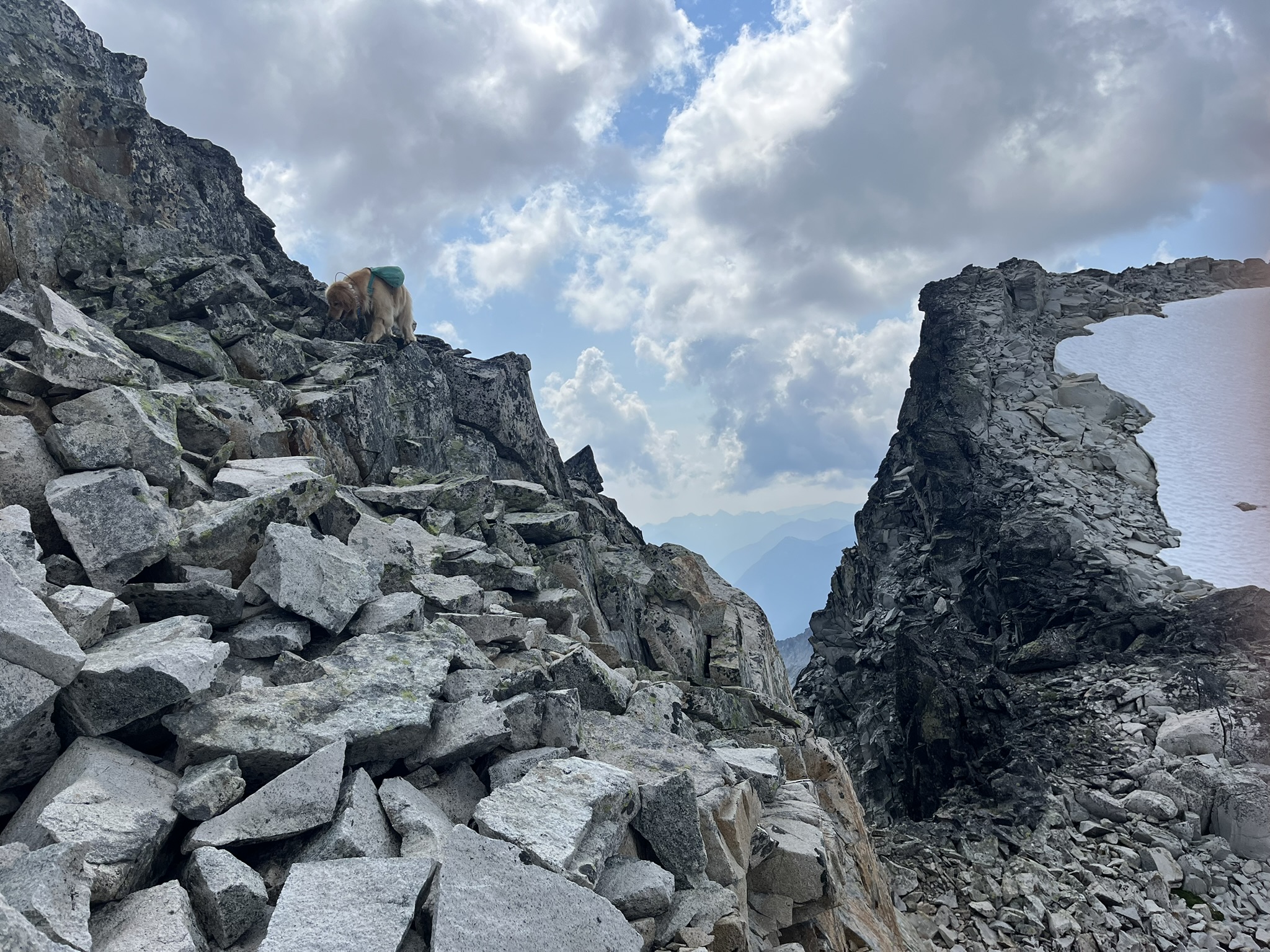
The descent off the high point dropped through a notch in the ridge. I scrambled over angular blocks between two rock spires, my pack bobbing, totally at home. This is terrain that would give most dogs pause. I am not most dogs.
The Unnamed Glacial Lake
We dropped northwest off Hinman's upper flanks, losing 2,000 feet through talus and snowfields to a lake that stopped us both. It sat in a narrow glacial valley — milky turquoise water flanked by sheer rock walls, with a gap at the far end that framed the sky like a window. My human says he hasn't found anyone online who's written about this lake. The topo maps are wrong here — the glacier has pulled back so far that the terrain doesn't match the paper, and the scramble down required careful route-finding where the contour lines lied.
I waded in without hesitation. The water was glacier-fed and cold enough to numb a human's feet in seconds. It felt like electricity on my legs, sharp and bright. I waded deeper. Obviously.
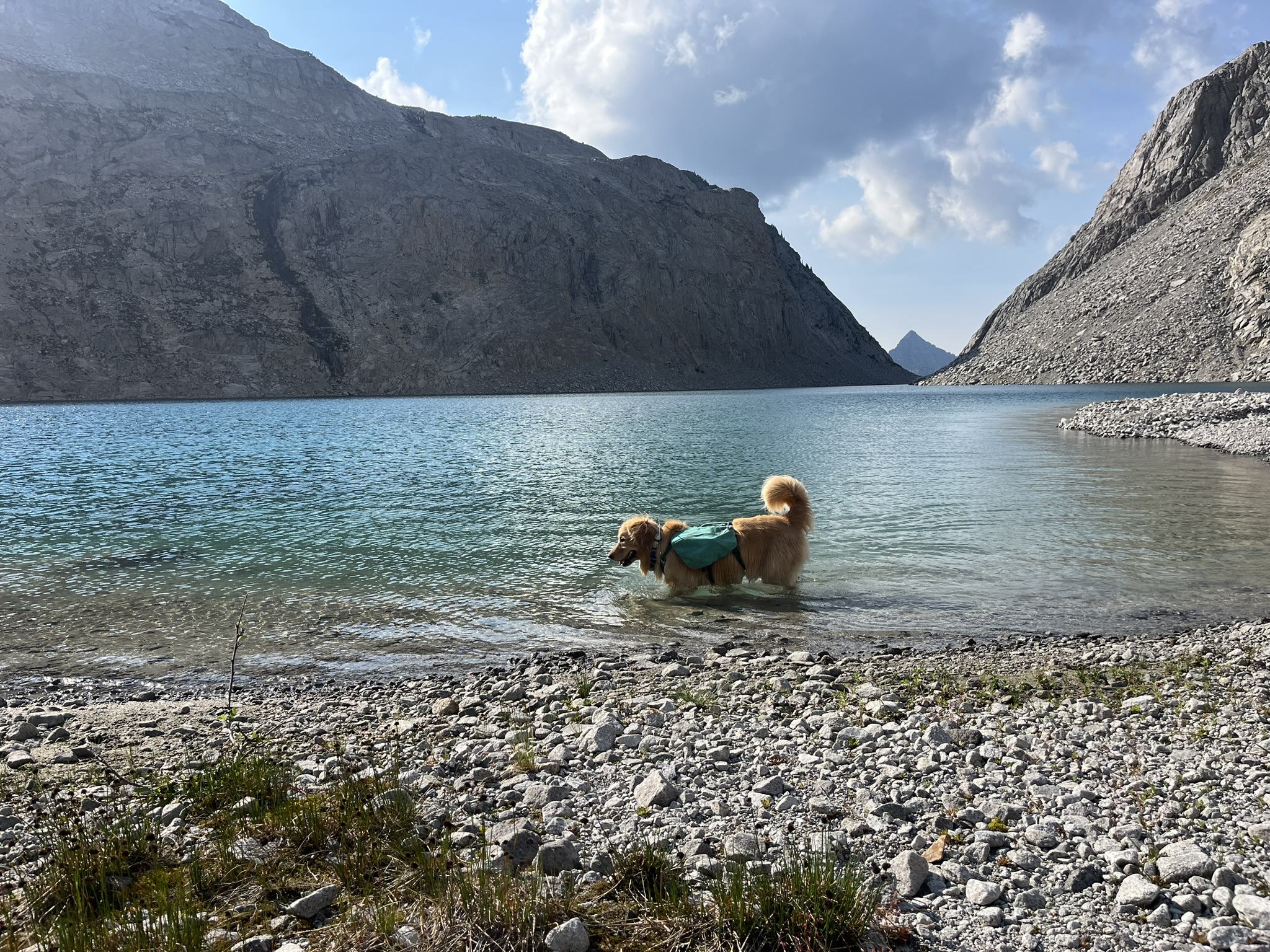
The view down the lake was the kind of thing you could stare at for an hour. Turquoise water stretching between parallel rock walls to a V of sky and mountain at the far end. Not a tree. Not a trail. Just water and stone and silence and the smell of glacial cold, which is its own smell — clean and mineral and ancient.
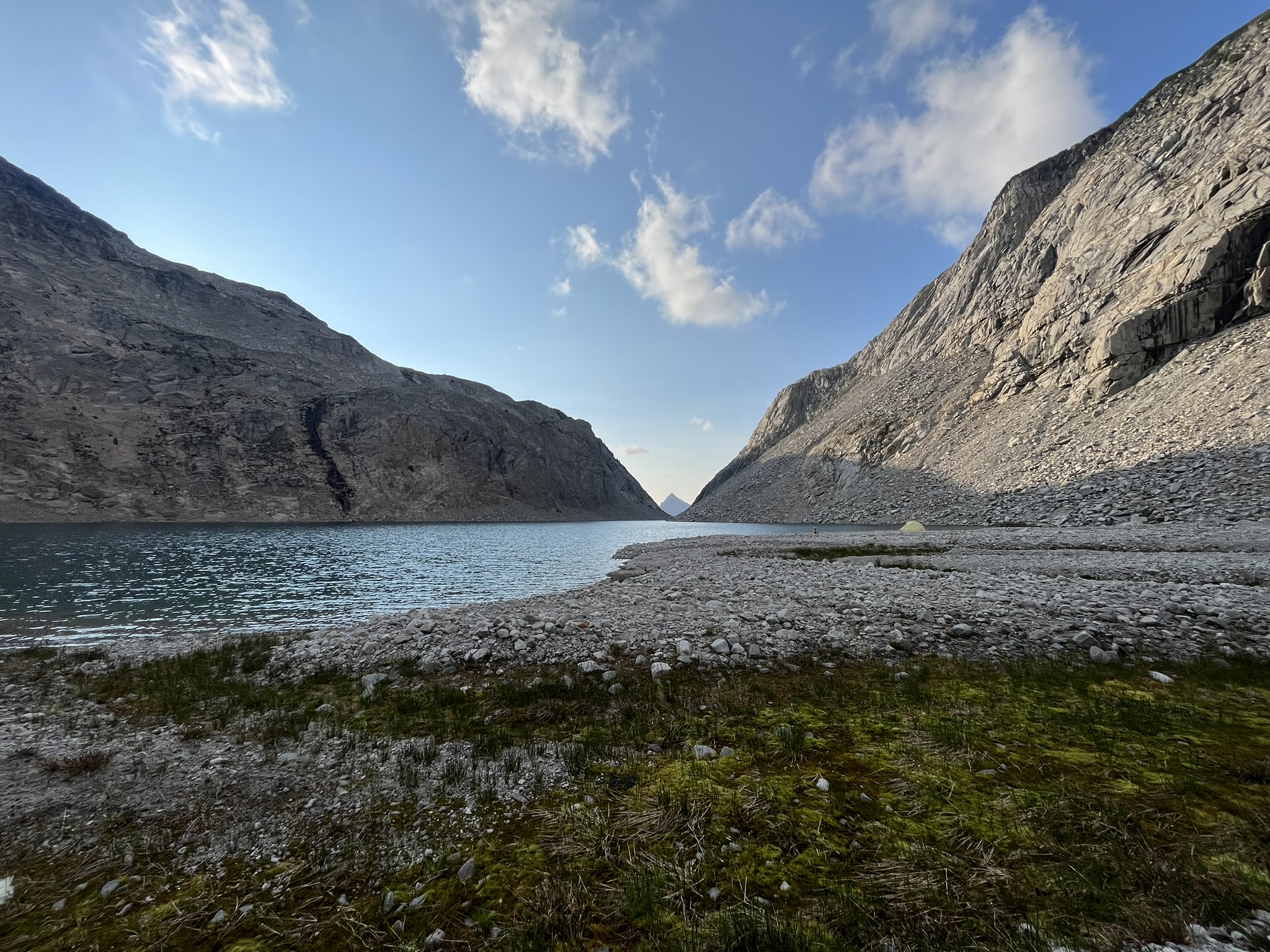
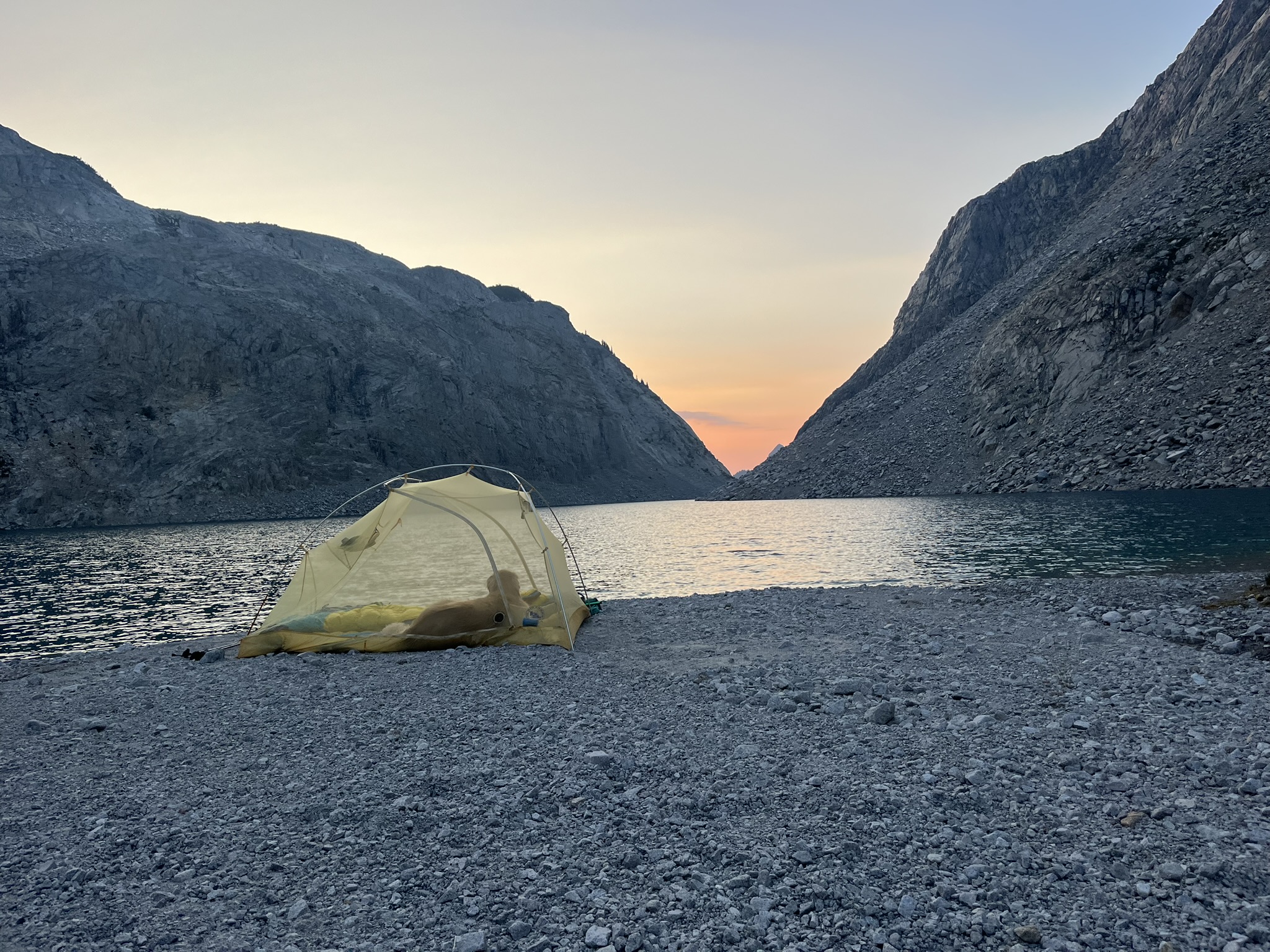
We set up the tent on the gravel shore and watched the sun set through the gap in the valley walls. The light went from white to gold to pink, and the lake turned from turquoise to silver. I lay in the tent doorway and watched it with my human. The gravel was cold under my belly. The air smelled like snow and stone and the very end of a day.
Sunday — Completing the Circuit
Morning came clear and cold. I could see my breath. We broke camp early and headed south, climbing back up toward the high country to complete the western side of the circuit. I led the way up smooth granite slabs toward snowfields and a rocky peak lit by the first sun. The granite was cool and rough under my paws, perfect grip, and the morning air carried nothing but cold and clarity.
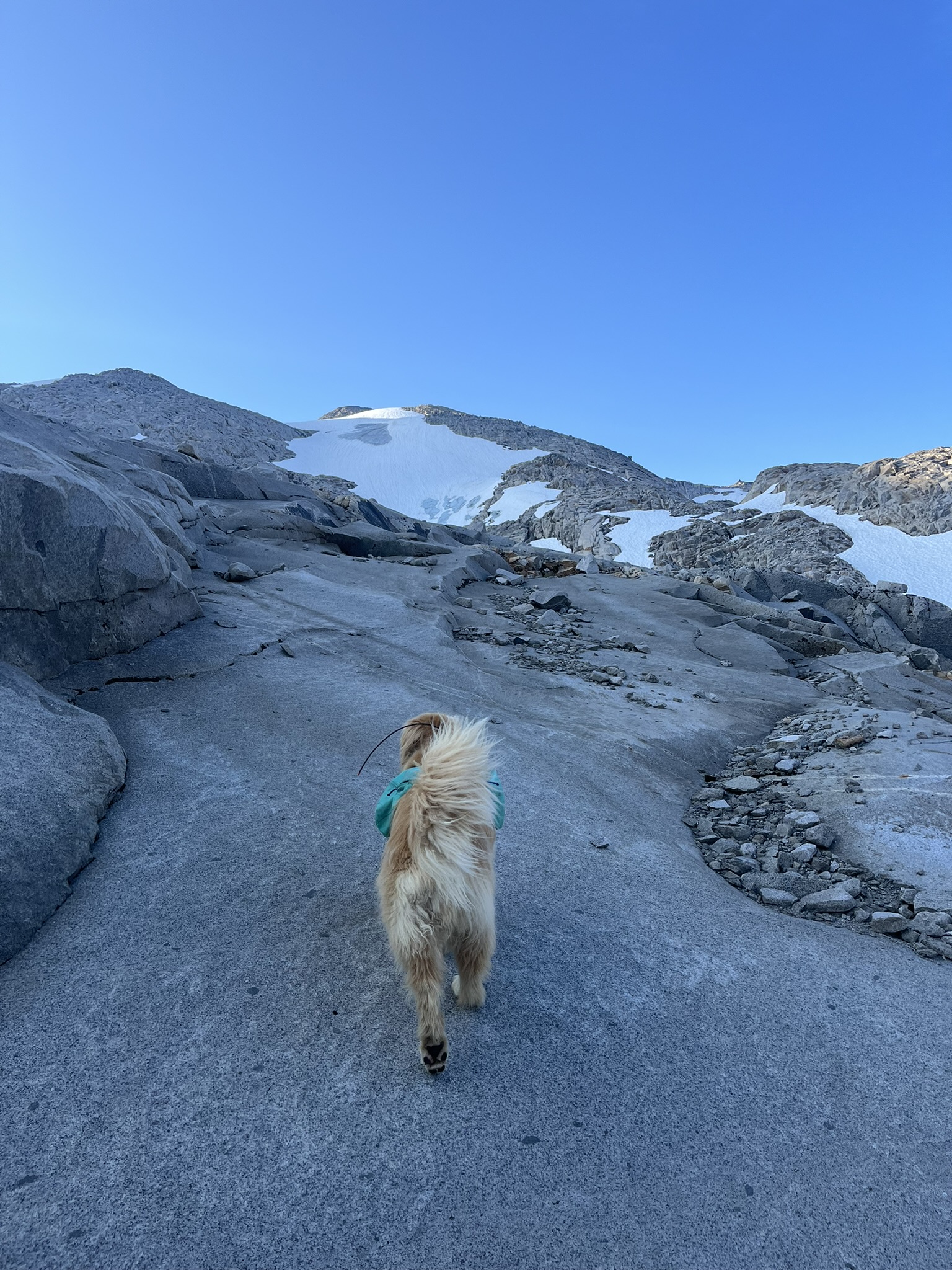
The west side of Hinman was different from the east — broader snowfields, bigger glacial features, a feeling of openness that the cramped cirques on the other side didn't have. I crossed a suncupped snowfield with the summit pyramid rising behind me. Golden fur against white snow against blue sky. Three days into the trip and I felt like I could keep going forever.
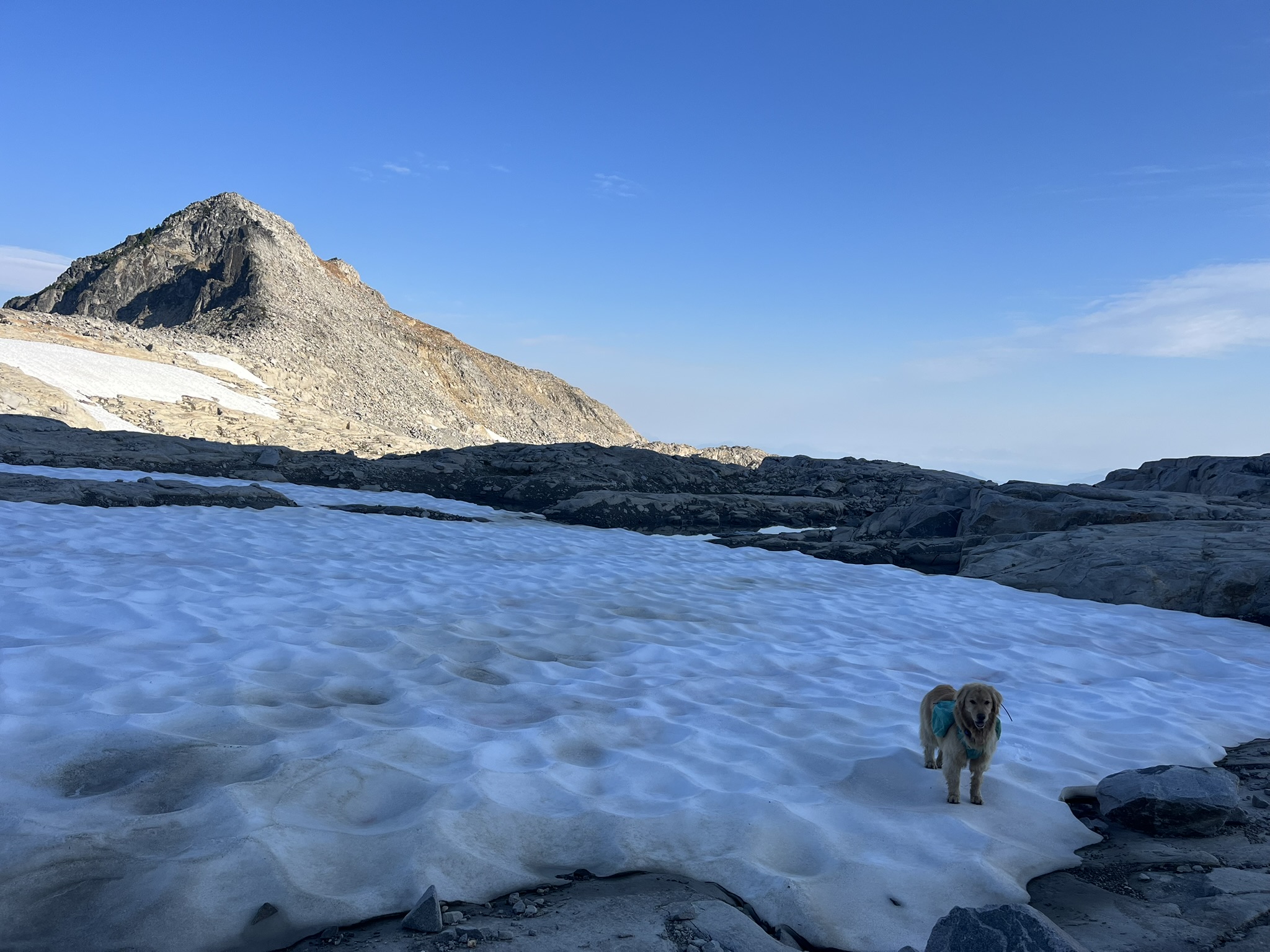
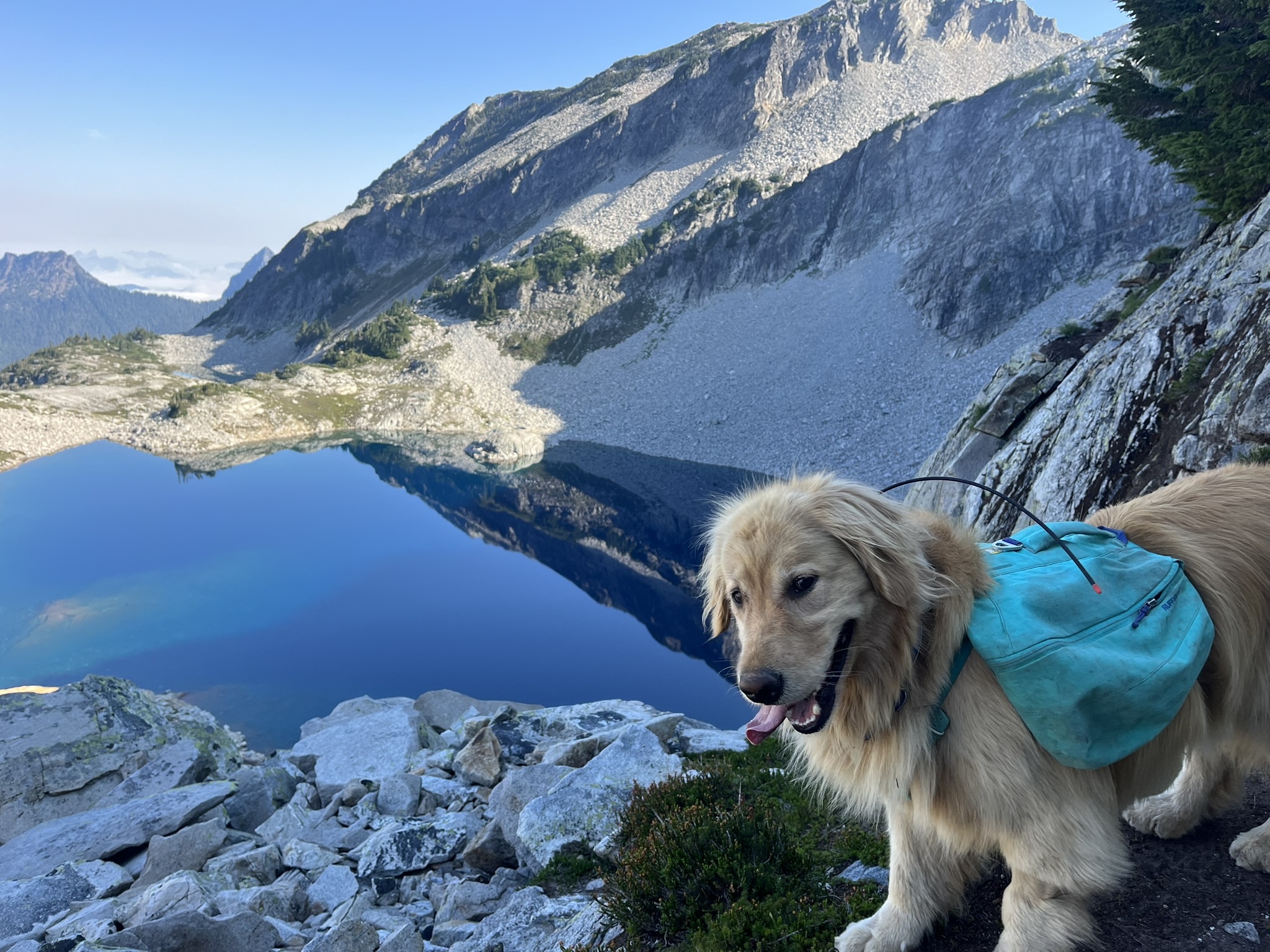
The descent brought us past one more lake — deep blue, perfectly still, reflecting the mountain above like a mirror. I stood at the edge with my tongue out, running on whatever fuel I run on when I'm exactly where I'm supposed to be. It's not food. It's not rest. It's the mountains themselves. They fill something in me that nothing else does. My human says the same thing, in his own way. I think that's why we work. We both need this — not the summits, not the miles, but the being here. Together, in places like this.
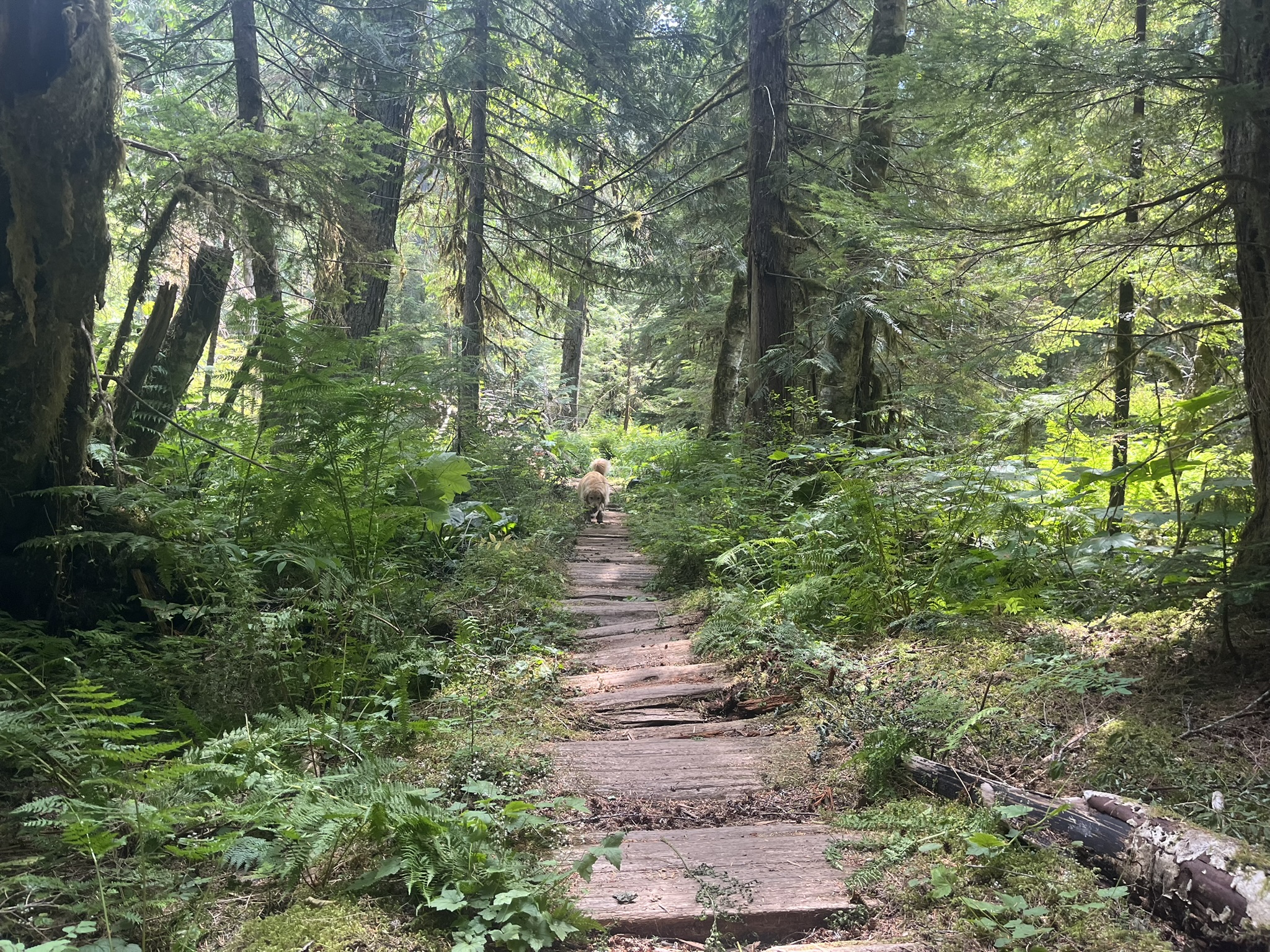
By mid-morning we'd dropped back into the Necklace Valley basin and turned north toward the trailhead. The last ten miles were forest — old-growth fir and cedar, fern understory, wooden puncheon bridges over wet ground. After three days of granite and snow it smelled like a different world. Damp wood, rotting leaves, mushrooms, the thick green scent of living things. I picked up fresh cougar scent along the boardwalk — strong, recent, maybe a few hours old. I stopped dead and held, nose to the planks, hackles barely lifting. My human stopped behind me without a word. He trusts my reads. We waited. Listened. Nothing moved. The cat was long gone but had walked this exact stretch that morning. I filed it away and kept moving, running ahead on the boardwalk, feet drumming on the planks, the forest closing in warm and soft around me.
We reached the car around 1:30 PM on Sunday. Thirty-three miles, 10,000 feet of gain, three days, one lightning storm, one circumnavigation. I slept the whole drive home and dreamed about turquoise water.