Friday Evening — Into the Dark
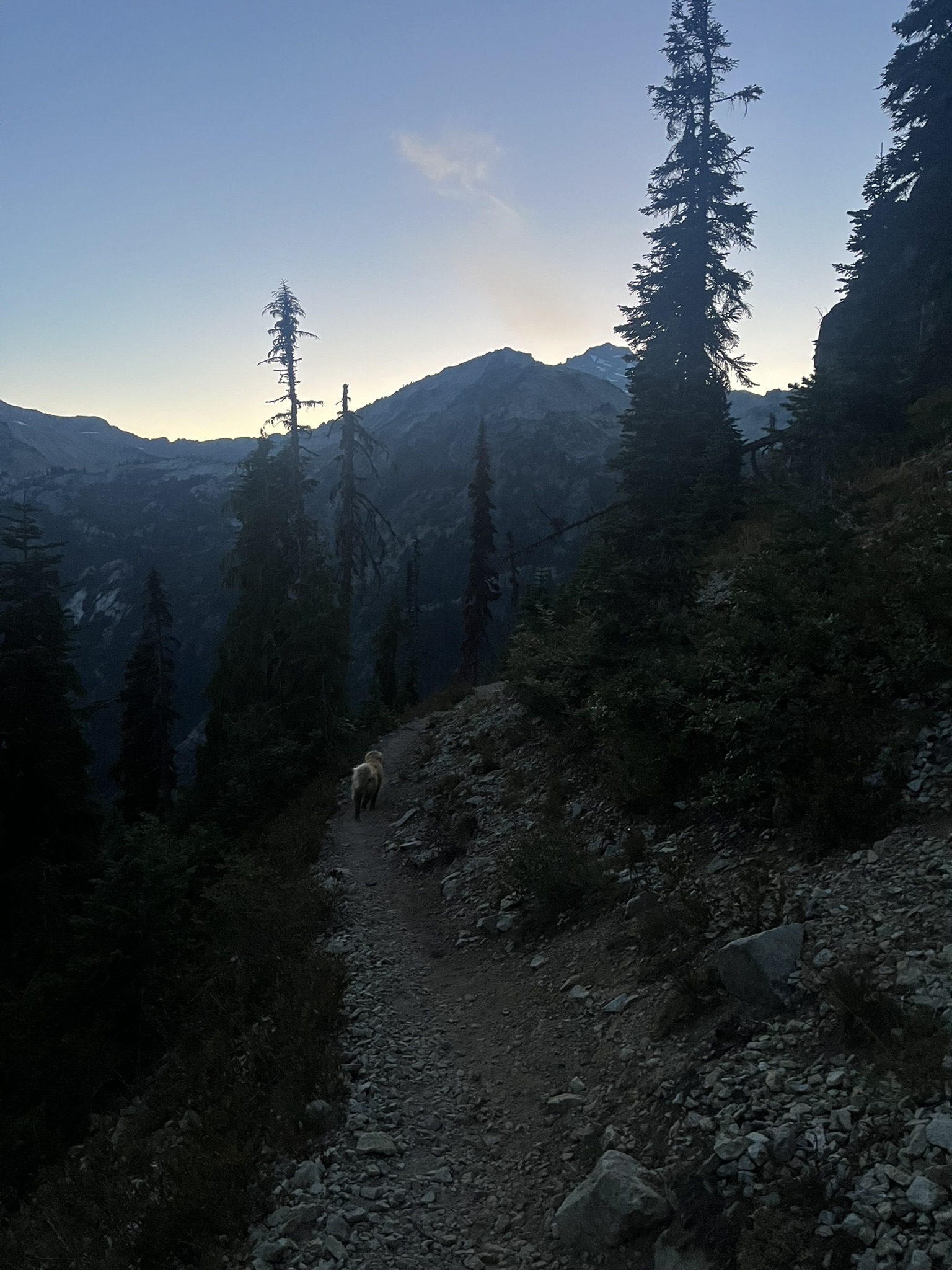
We left Tucquala Meadows around 7 PM on a Friday in mid-August. My human had that after-work energy — tight jaw, fast pace. I matched it. The trail climbed through forest, then broke into alpine meadows as the light shifted to blue. Mount Daniel's bulk sat ahead through the trees, snow and rock catching the last color. I could smell the glacier from here. Cold mineral air, snowmelt, something ancient.
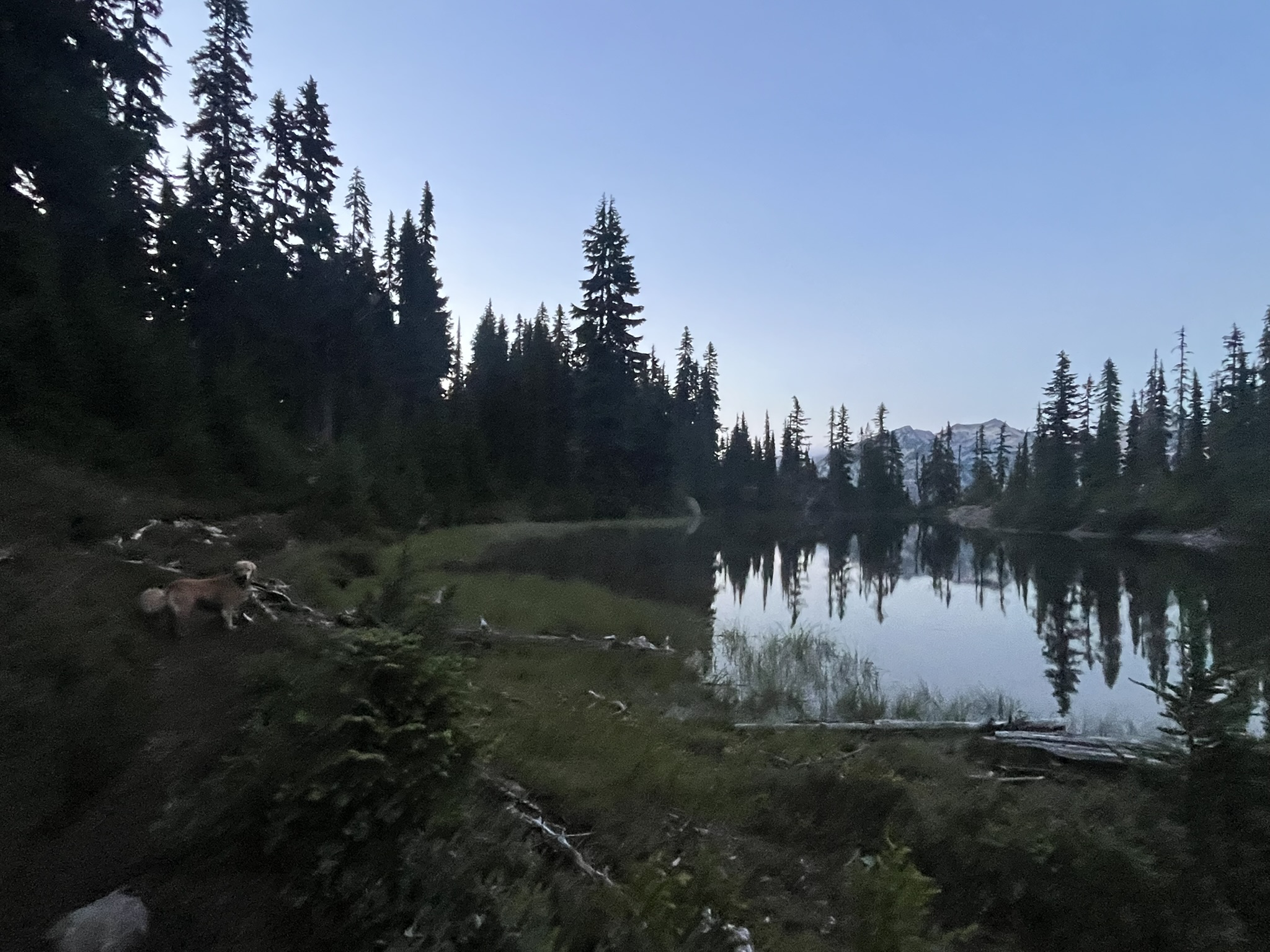
We passed a lake on the approach — dead still, conifers reflected on the surface, a peak glowing above the treeline. I paused at the shore. Briefly interested. But the water smelled shallow and weedy and we had miles left, so I kept moving.
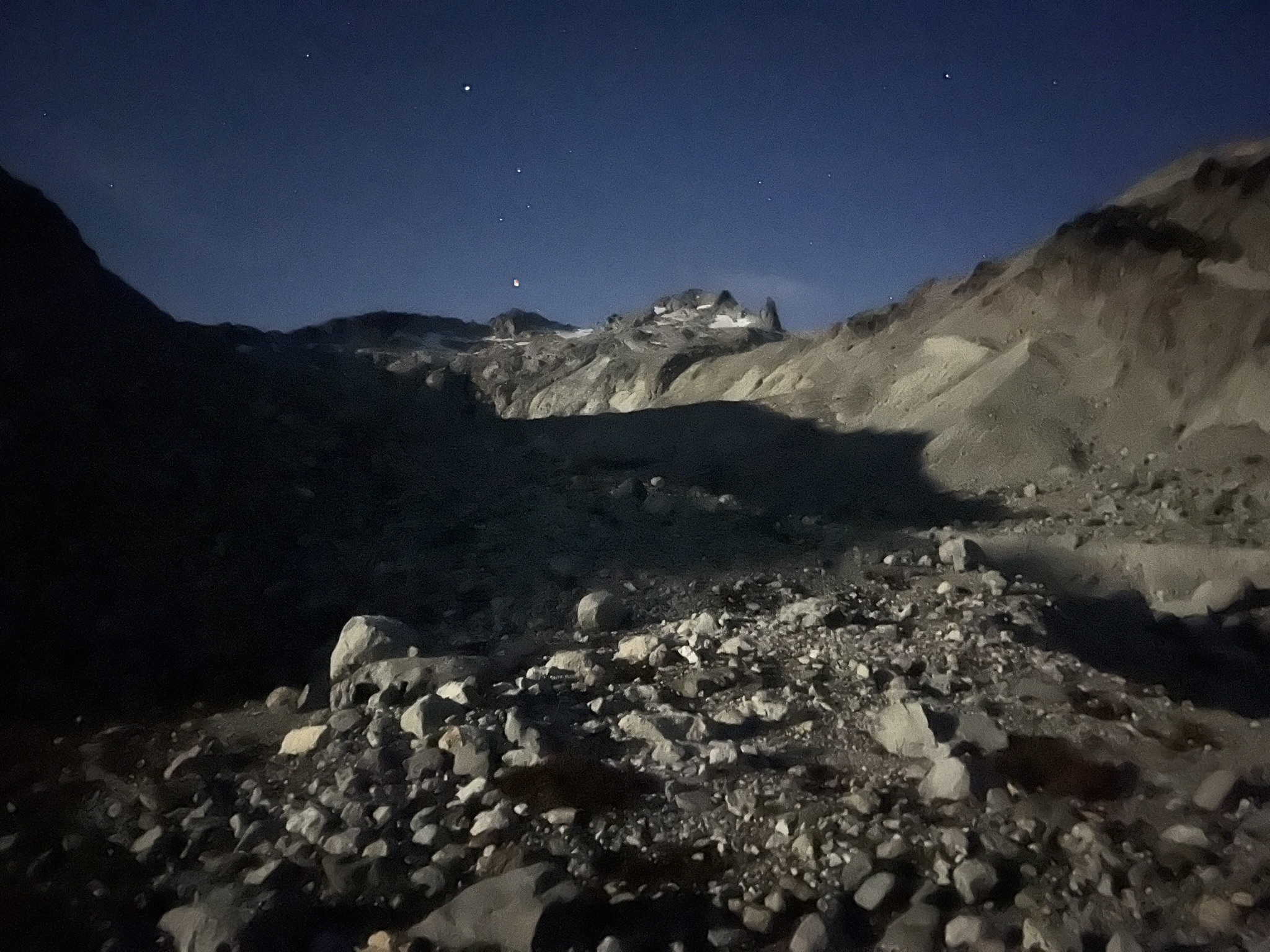
Camp went up at the edge of the Daniel Glacier moraine, where the forest gives way to rubble and the cirque opens its mouth. By 10 PM — full dark, stars overhead, the glacier and summit ridge glowing pale in the moonlight. The only sound was meltwater running somewhere below us in the rock. I curled up on a flat spot and listened to the mountain breathe. Something moved in the talus below us — too heavy for a marmot, too quiet for a deer. I lifted my head and held still. My human was already asleep. I kept one ear on it until the sound faded up the moraine and away. Whatever it was, it had its own business tonight. I let it go.
Saturday — The Glacier and the Summit
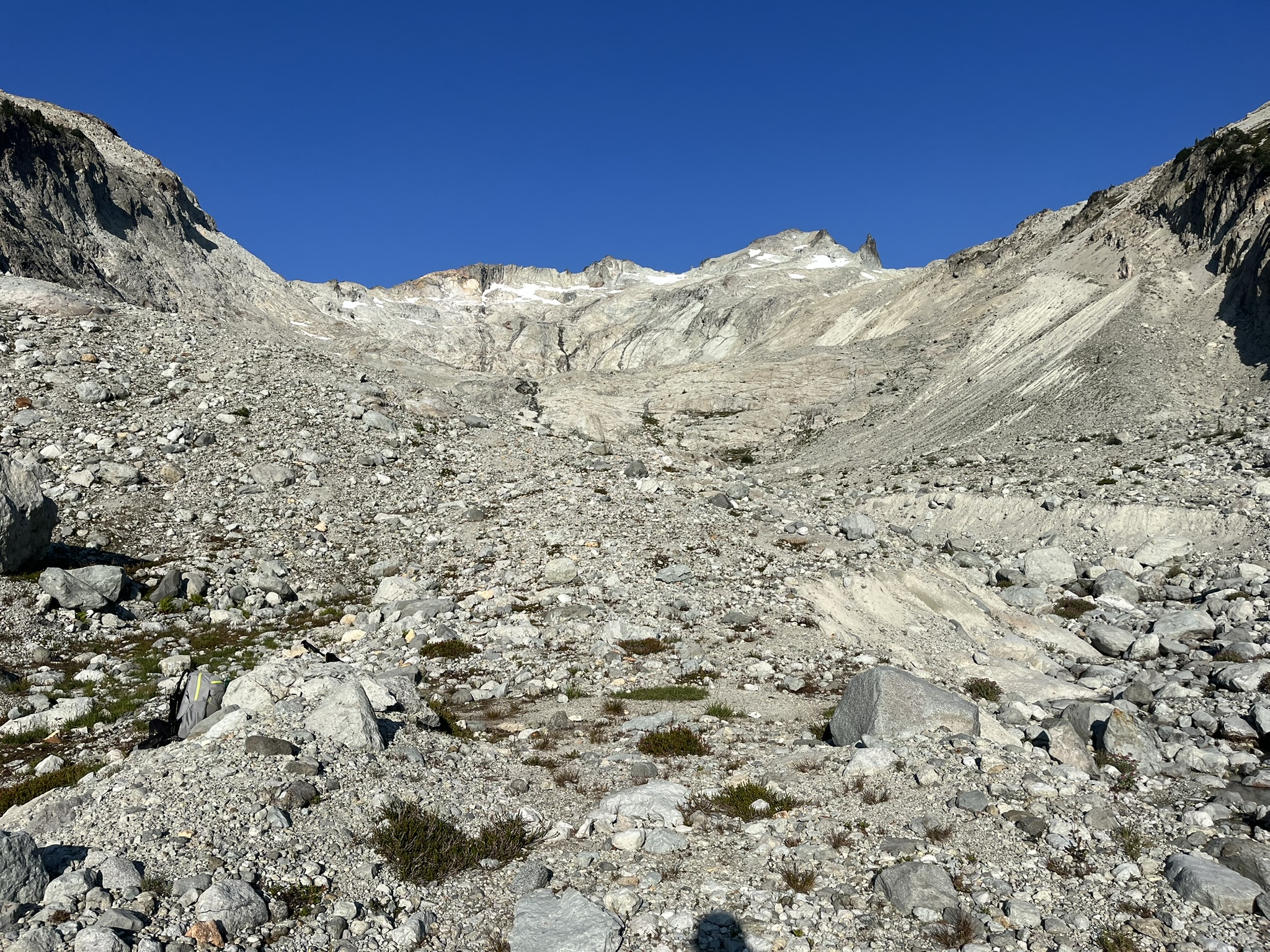
Morning showed me what we'd slept beneath. The Daniel Glacier cirque — a massive amphitheater of rubble, polished rock, and lingering snow, the summit hidden somewhere above the headwall. The scale of it hit my nose before my eyes: cold air pouring down from the ice, stone dust, the sharp clean nothing of altitude. I stood in the moraine and let it settle over me.
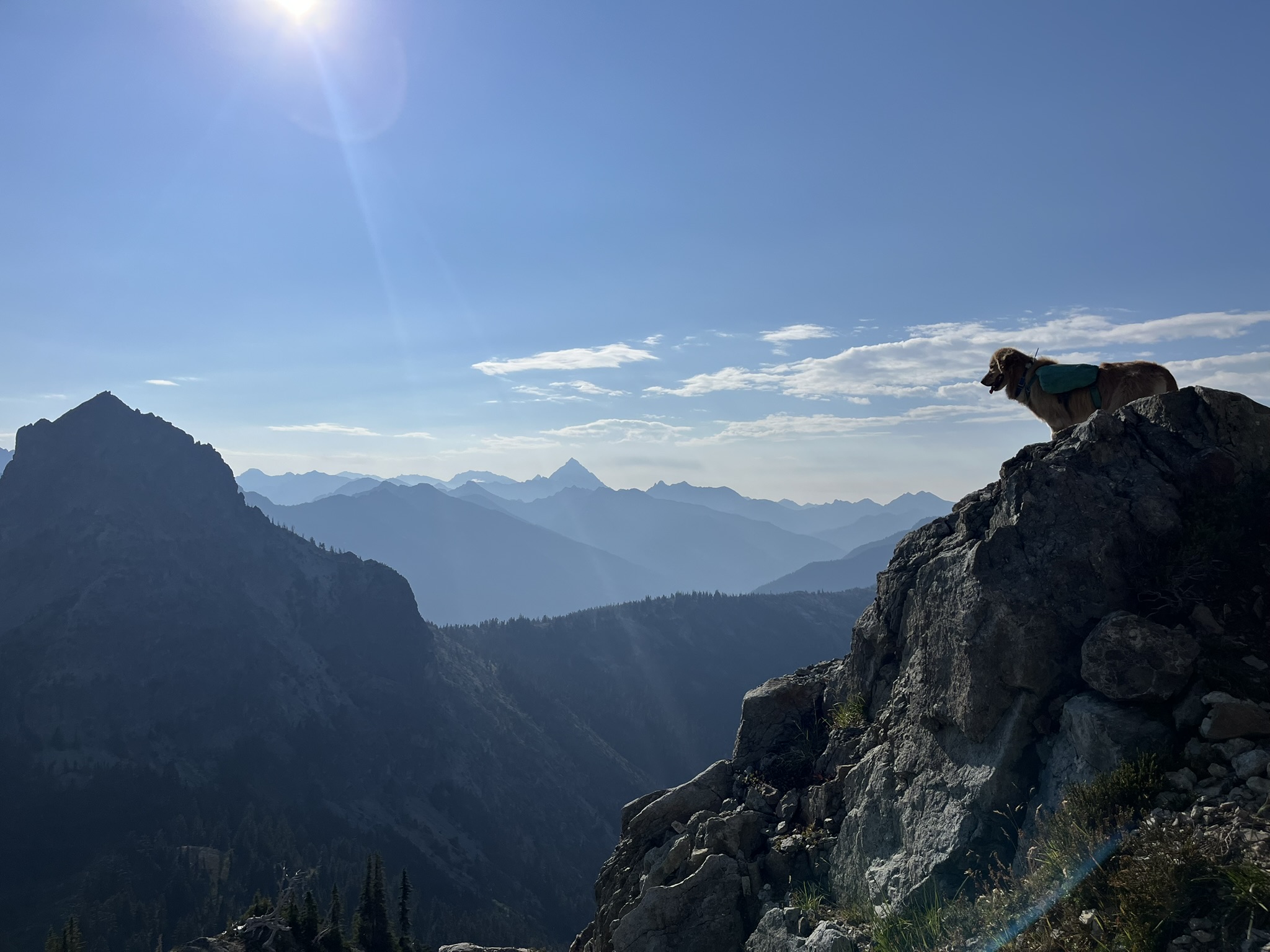
We climbed. By 6,400 feet the world was all rock and air. I stood on an outcrop with the morning sun behind me — layer after layer of smoky Cascade ridges fading into haze in every direction. The wind pressed my ears flat. Below us, everything.
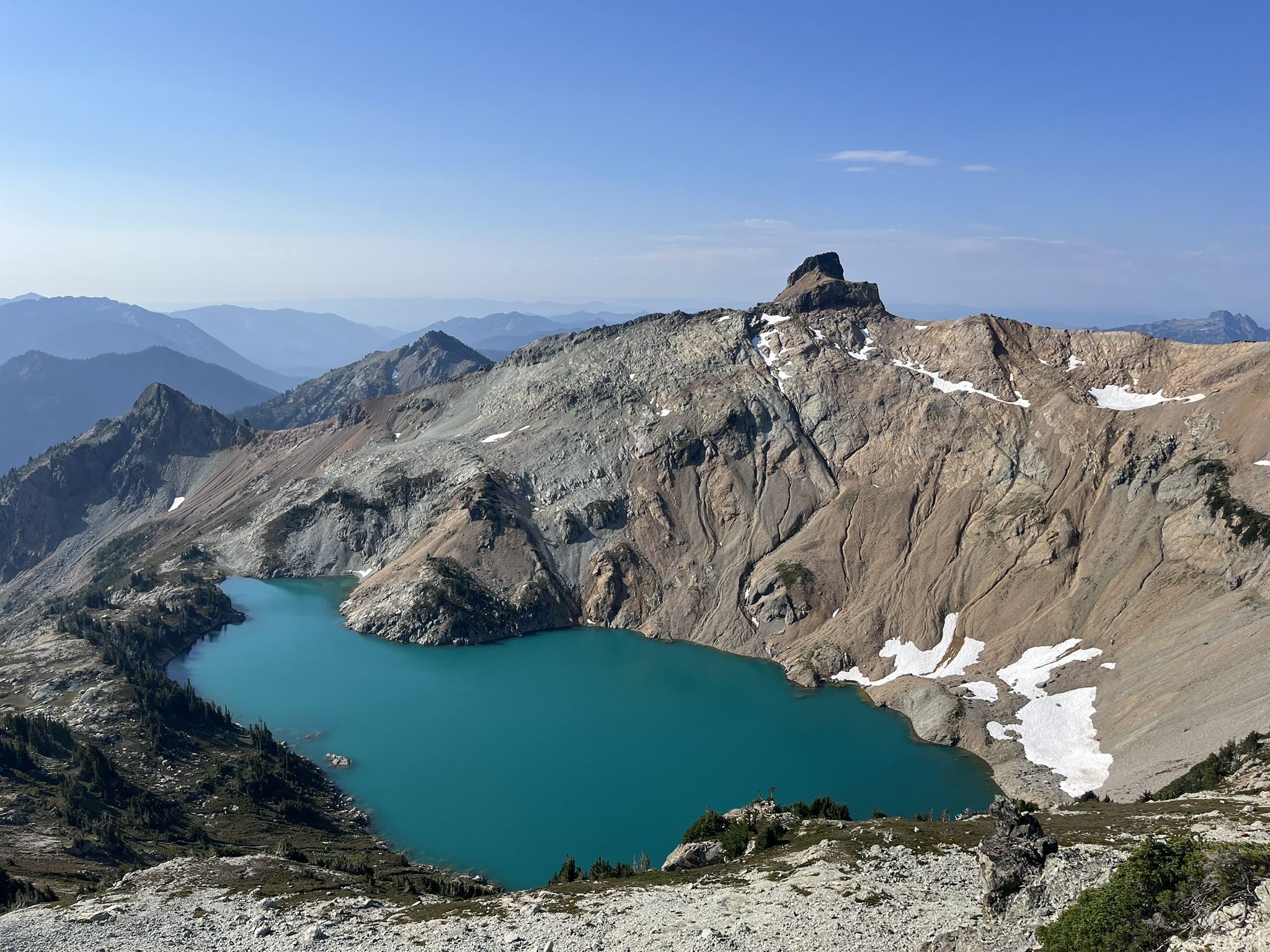
At seven thousand feet, the route crested a shoulder and I saw it — Pea Soup Lake, filling a perfect cirque a thousand feet below. The color was absurd. Turquoise so bright it didn't look real, a single dark spire standing guard behind it. I could see the bottom through thirty feet of water. I wanted in. Noted for later.
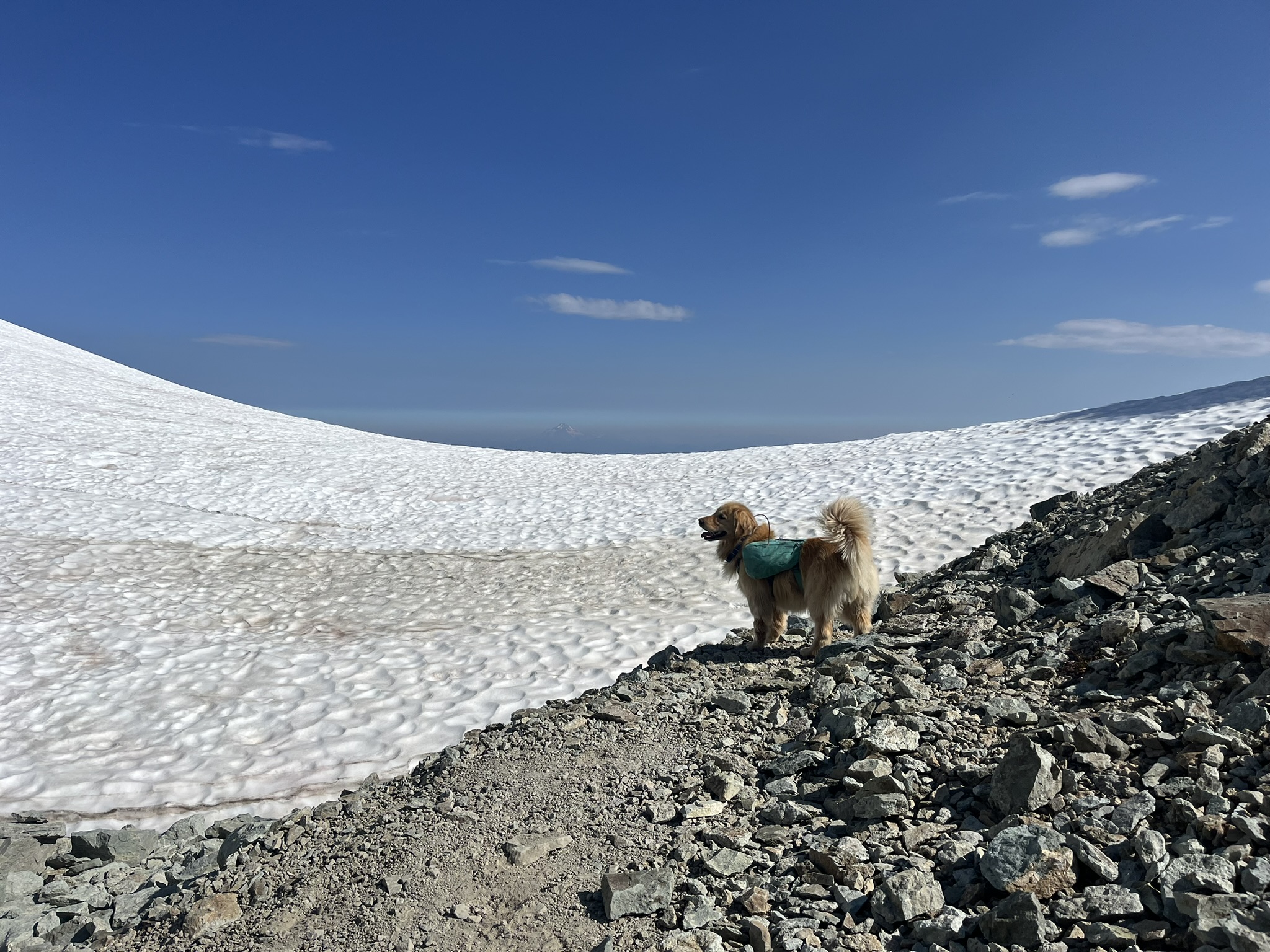
Higher still, the glacier proper. A broad snowfield across Daniel's upper flanks, suncupped and firm under my paws. I stood at the edge on loose scree and looked up at it. I've done this before. The snow smelled like iron and sky.
The Lynch Glacier opened below as we gained the upper ridge — a sweeping curve of snow dropping from the summit block to a turquoise lake far below. The summit itself was a dark crag rising from ice. It looked like nowhere I'd ever been, and I've been to a lot of places.
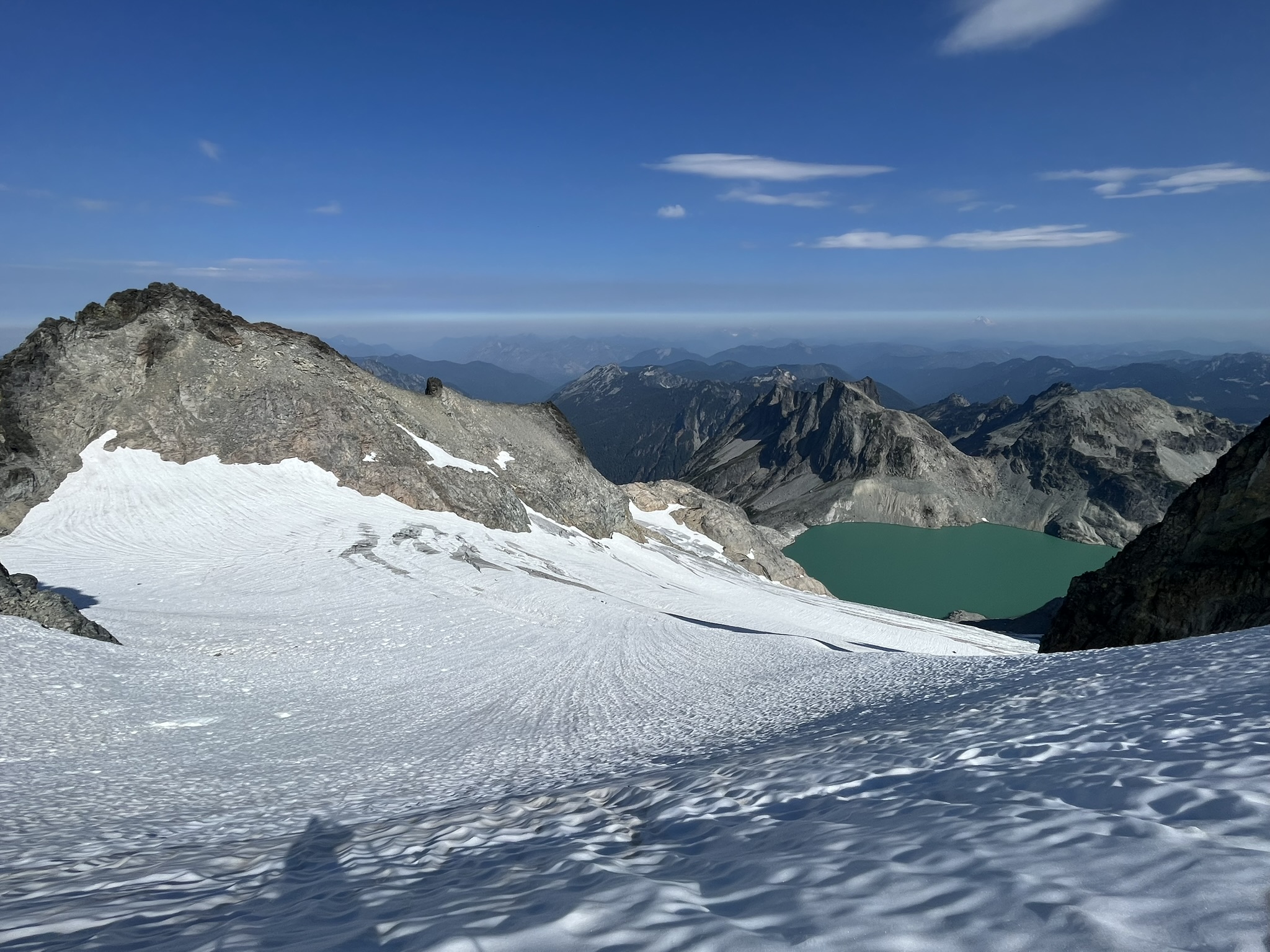
Then we were there. 7,958 feet. The summit ridge of Mount Daniel, the highest point in King County. I sat on the exposed rock and looked out over the glacier and the lake below. No pack, no leash. Just me on top of a mountain, the wind lifting my fur, the whole Cascades laid out in every direction. This is what I'm built for.
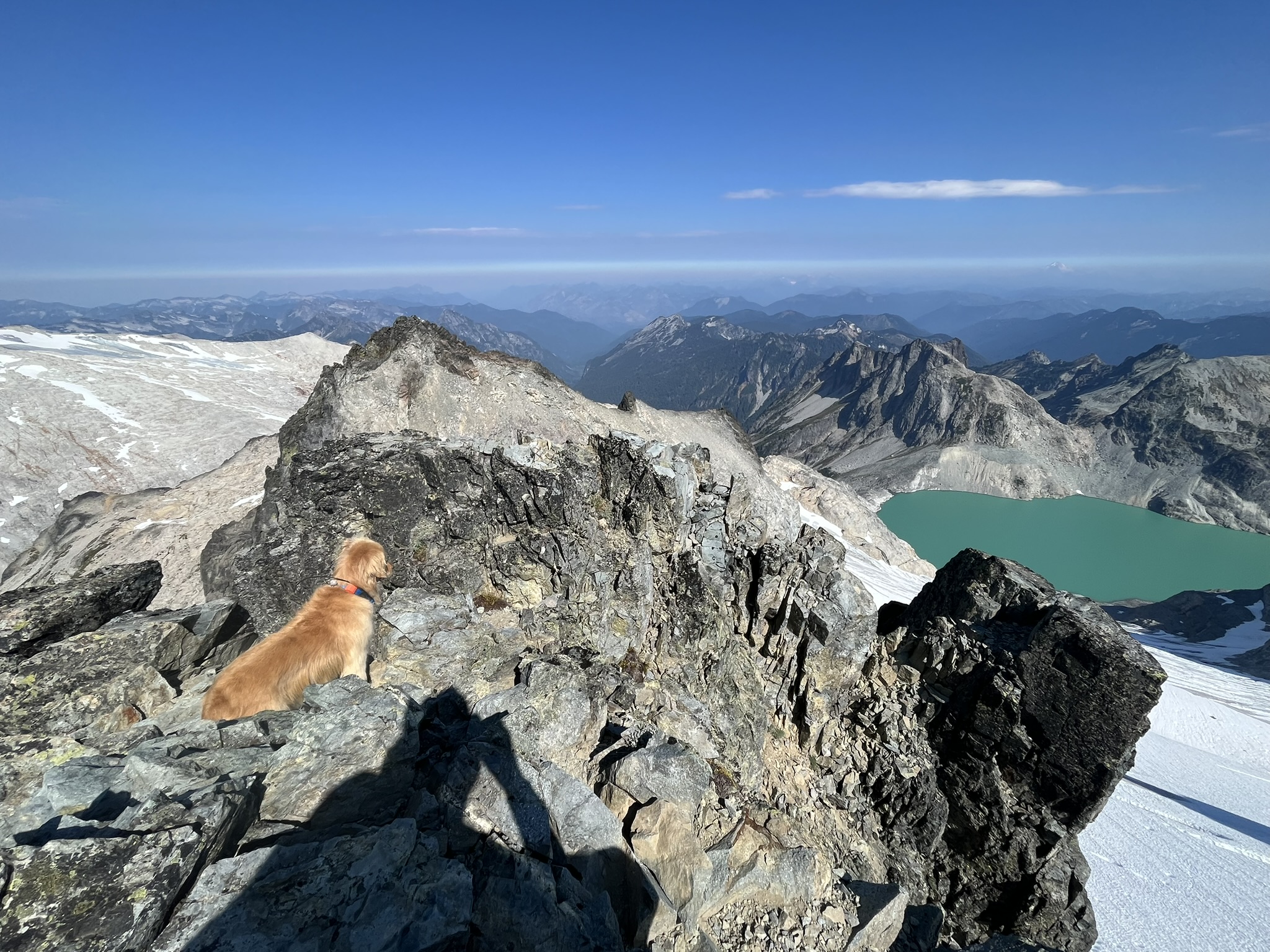
The views were endless. To the west, a dark pinnacle rose from the ridge with jagged peaks stretching into smoky distance. I was a small shape on the rock. Good. That's the point — the mountains should be bigger than you.
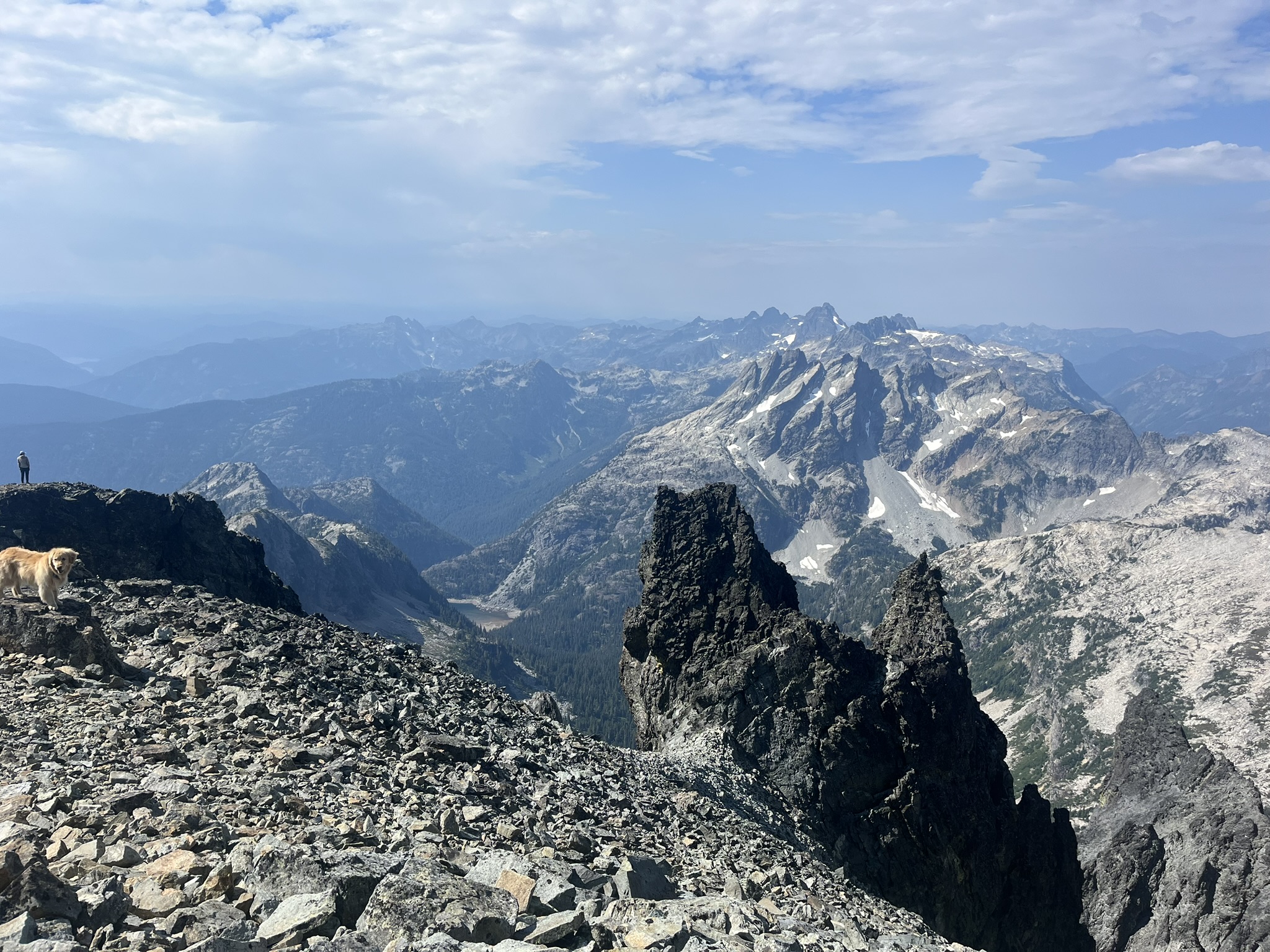
Down to Venus
The plan had been to descend the Lynch Glacier directly — straight down the snowfield we'd been staring at all morning. But from the summit ridge, it looked wrong. Too open. Crevasse risk, bad runout, no good options if things went sideways. My human made the right call. We reversed back toward Circle Lake and cut south instead, picking up the circumnavigation route toward Venus Lake.
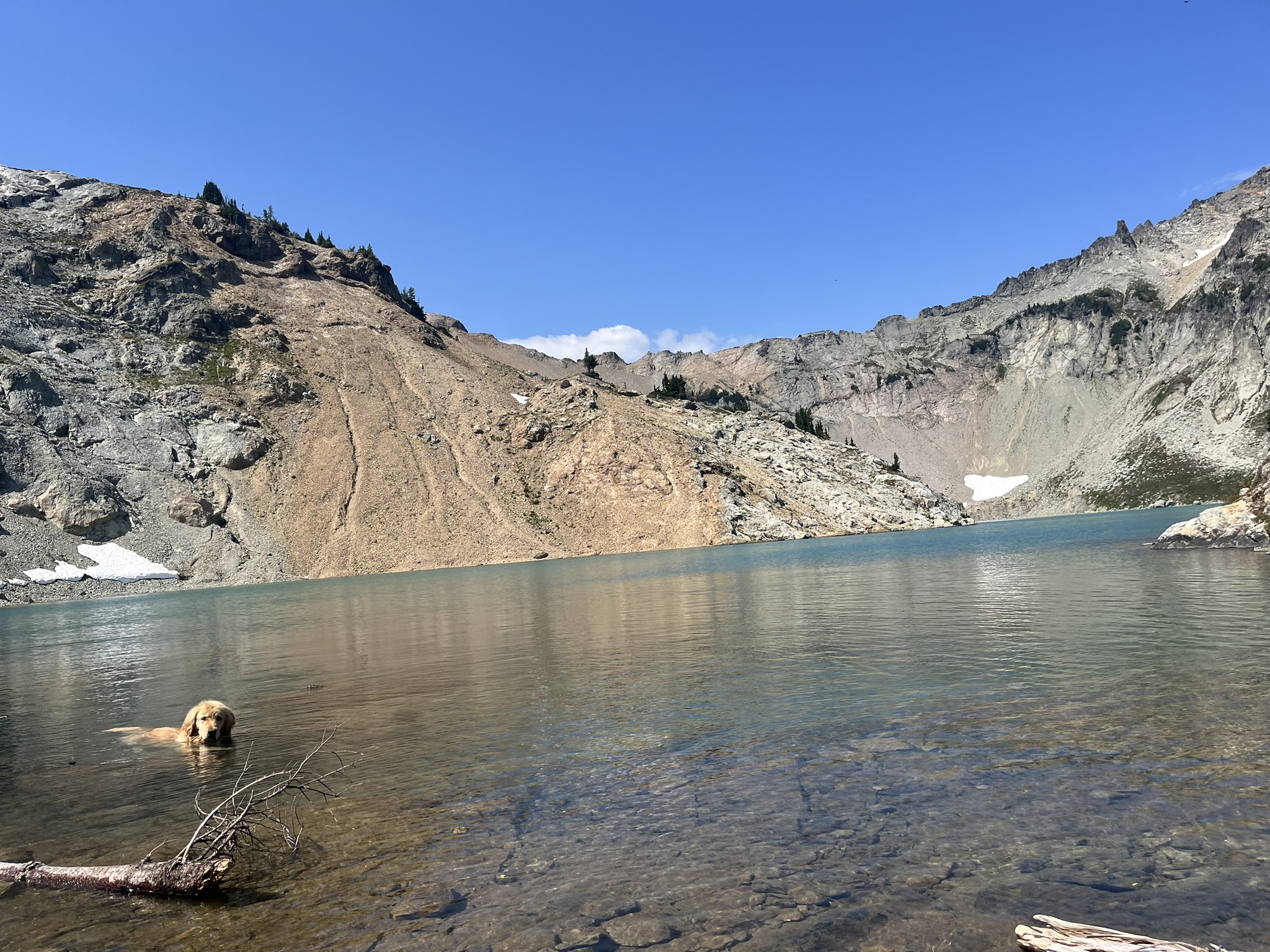
The detour added miles but the terrain was beautiful. And — more importantly — there was swimming. I found a lake along the way, turquoise and cold, the cirque walls warm with color in the midday sun. I swam with just my head above the surface and let the cold press into every part of me.
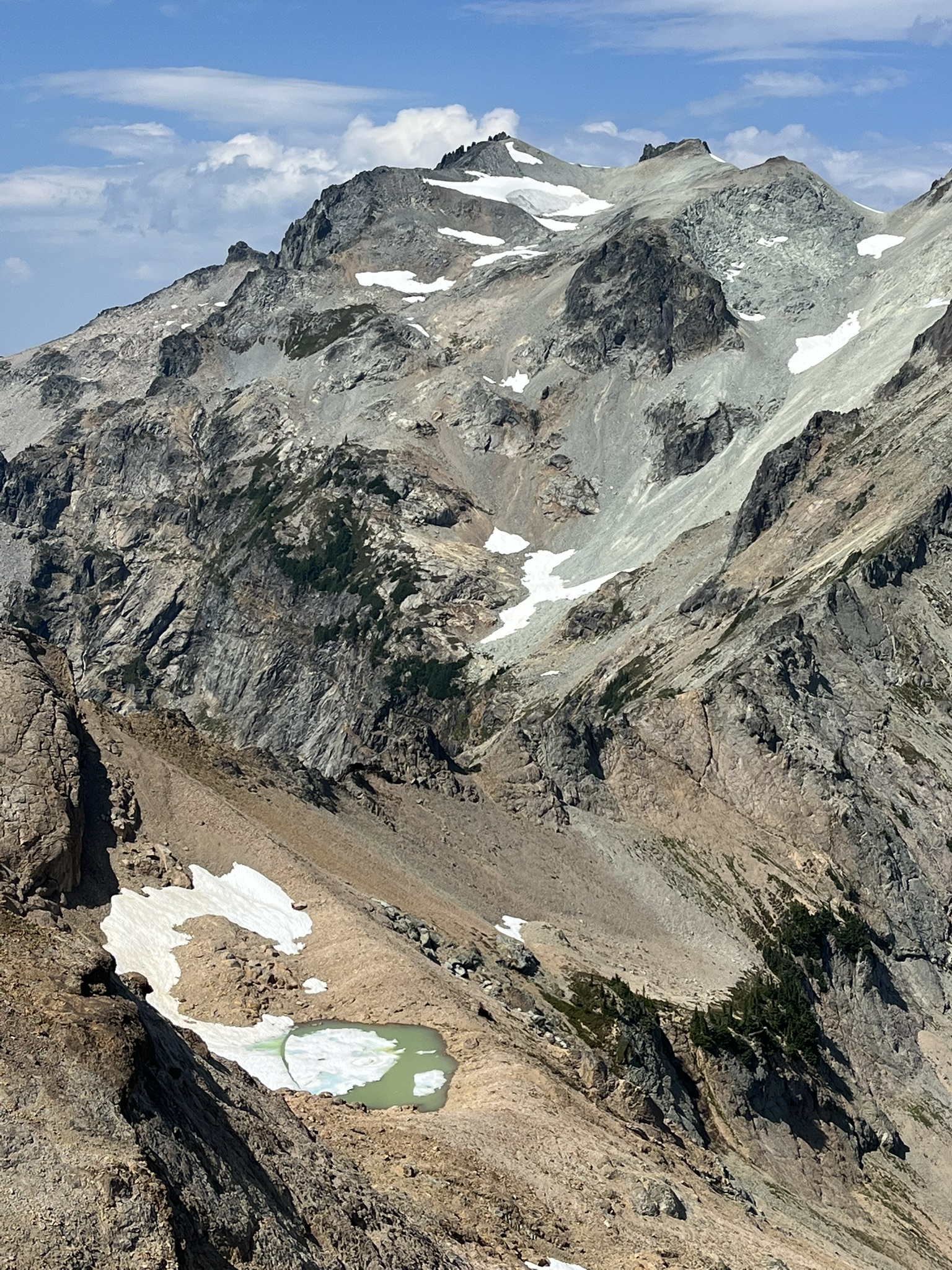
Looking back at Daniel from the south, the mountain was a stranger. A massive dark bulk with snow patches and talus, a small green tarn at its feet. Clouds building above. The wind had shifted and I could smell weather coming.
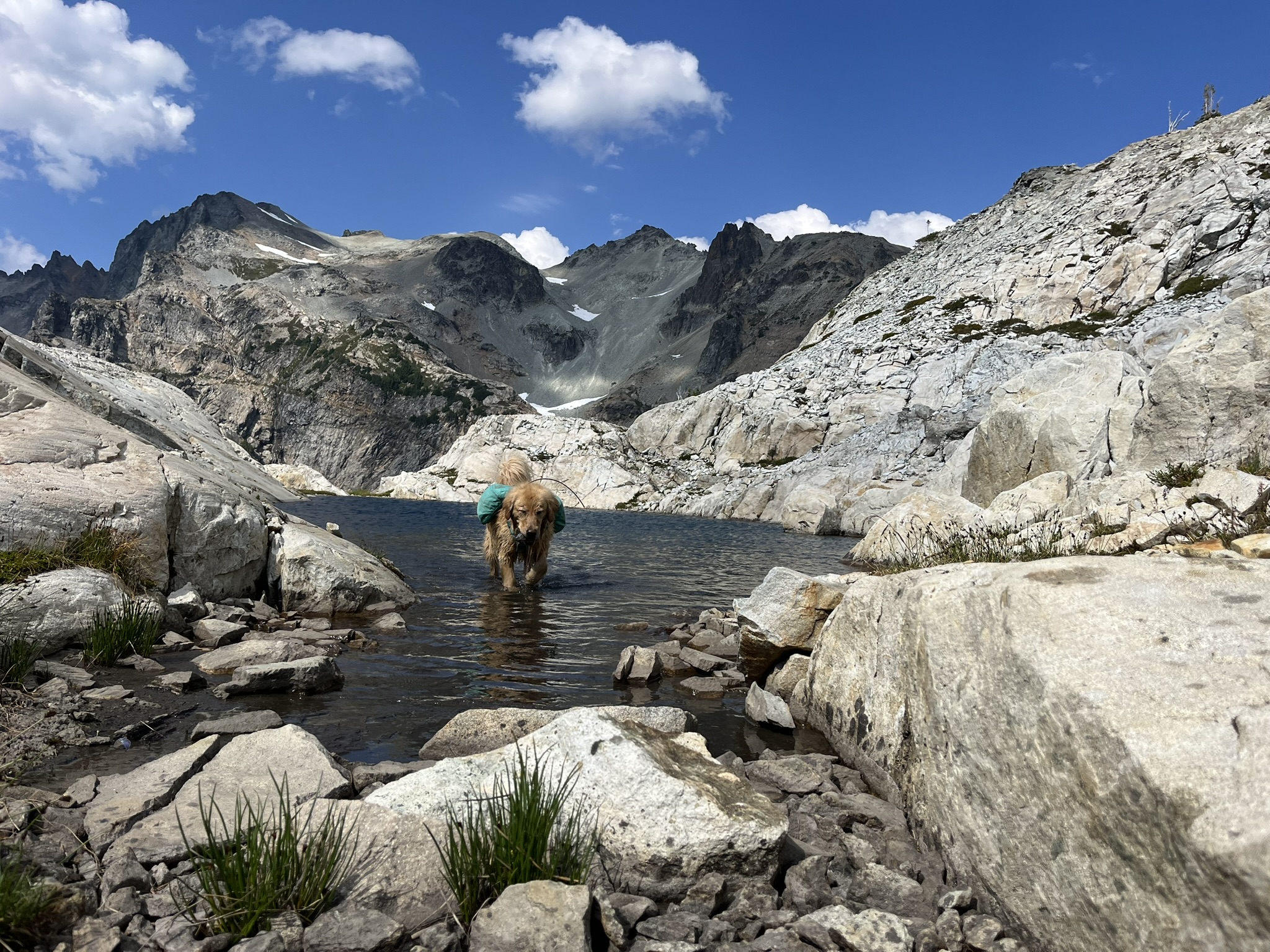
Lower down, I waded into a tarn cupped in granite boulders. Clear. Cold enough to make my chest ache. I stood chest-deep and stared up at the peaks reflected in the water around me. My blue pack was still on. I didn't care. Some moments you just stand in.
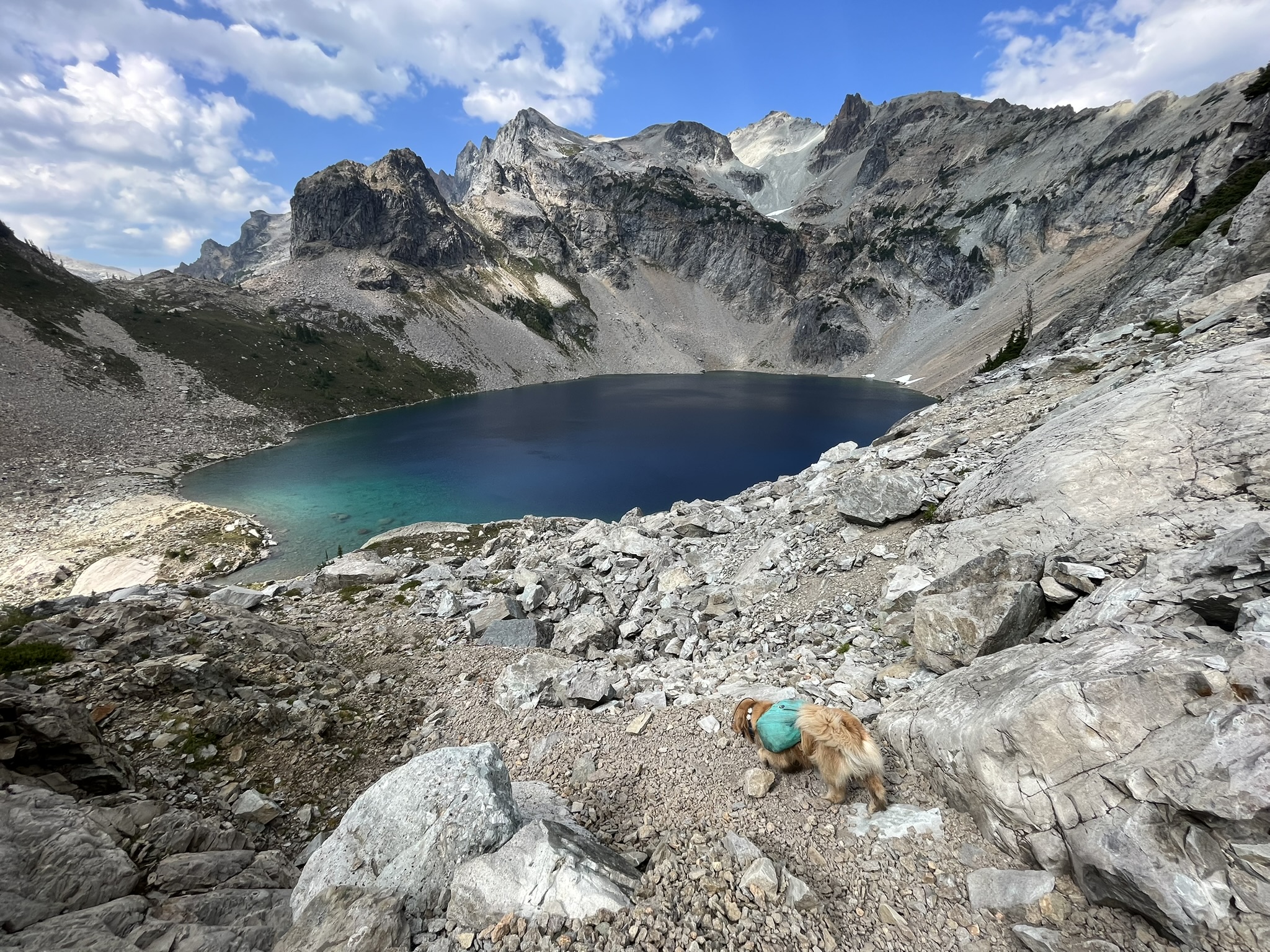
Venus Lake appeared below — deep, dark water in one of the most dramatic cirques I've ever seen. I lay down on the rubble above the shore, pack still on, and just looked at it. Steep rock walls enclosed the basin on three sides. The air was heavy and still. Something about this place made me want to be quiet. Some places in the mountains ask that of you — to just arrive and be still and let the land hold the weight of the moment. I'm good at that.
Camp at Venus
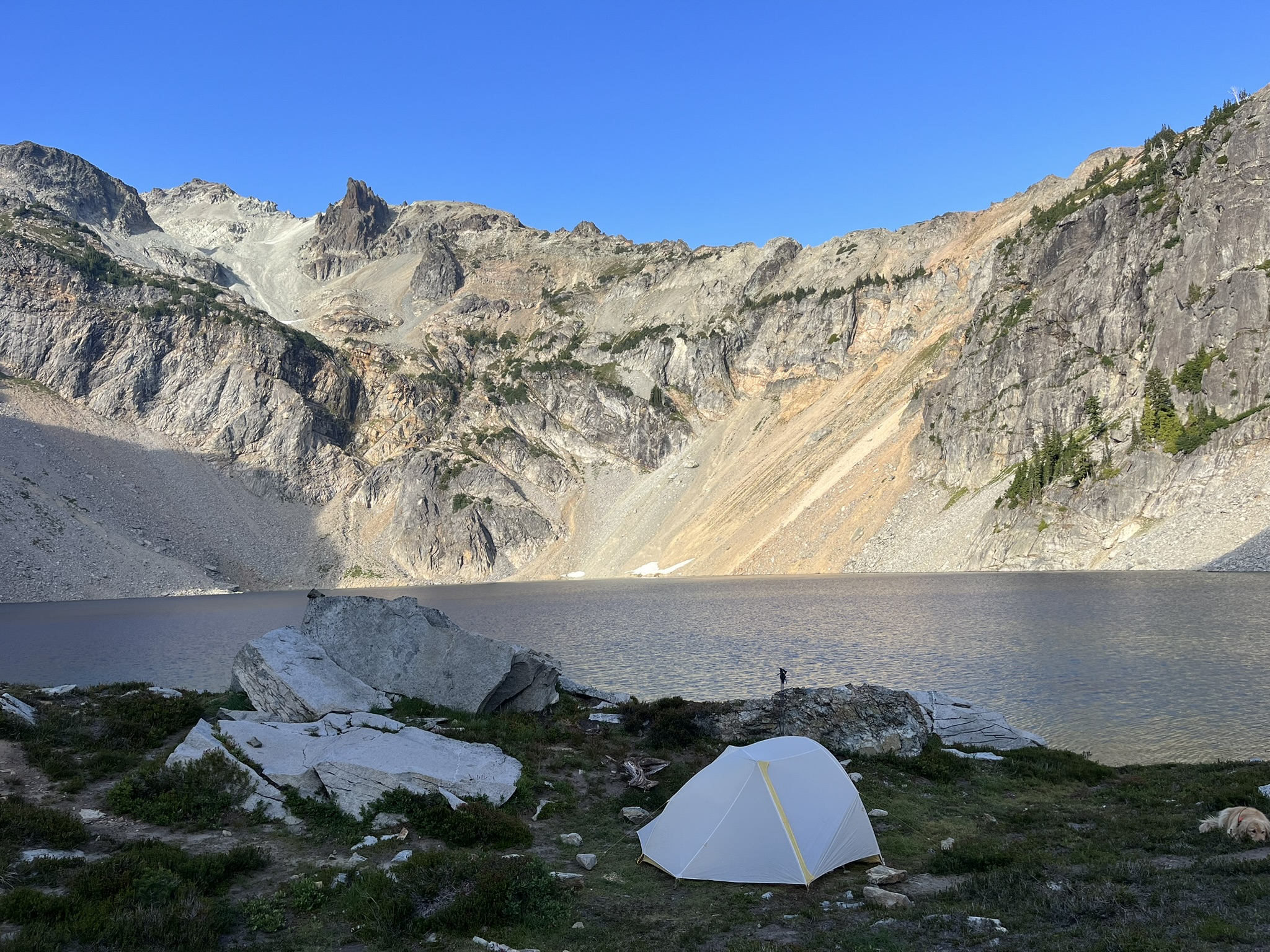
The tent went up on a grassy shelf at the water's edge. Behind Venus Lake, the headwall — hundreds of feet of sheer rock face rising straight from talus, orange and gray and black. The kind of wall that makes you step back and look up even if you've been staring at mountains all day.
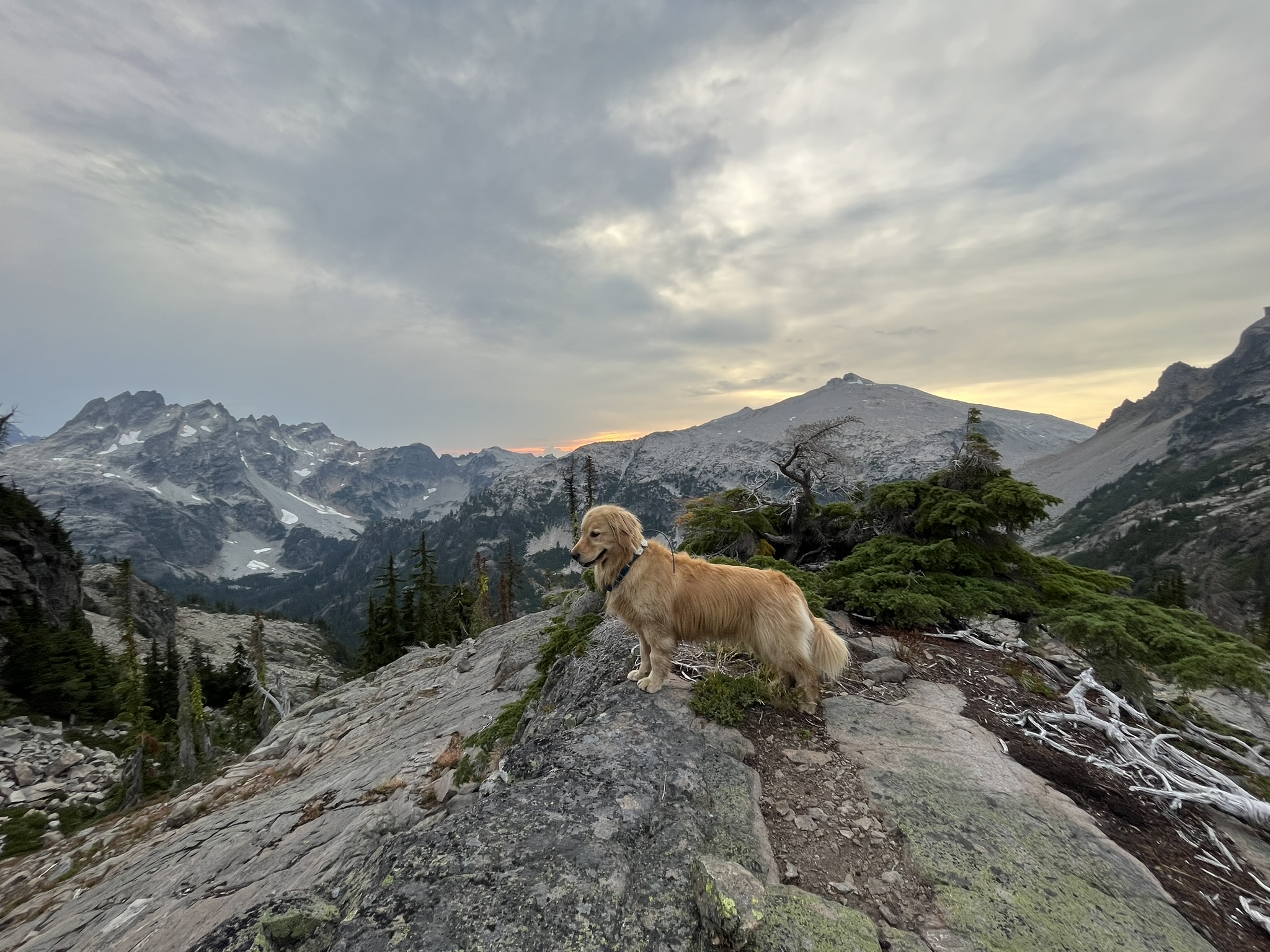
After dinner we climbed the ridge above camp to watch the light go. I stood on a granite slab with the alpine world spread out behind me — snow-capped peaks catching the last warmth, clouds building dramatic overhead, subalpine trees framing the view below. The wind was gentle and smelled like heather and stone. I stood in profile and didn't move for a long time. Some views you hold with your whole body.
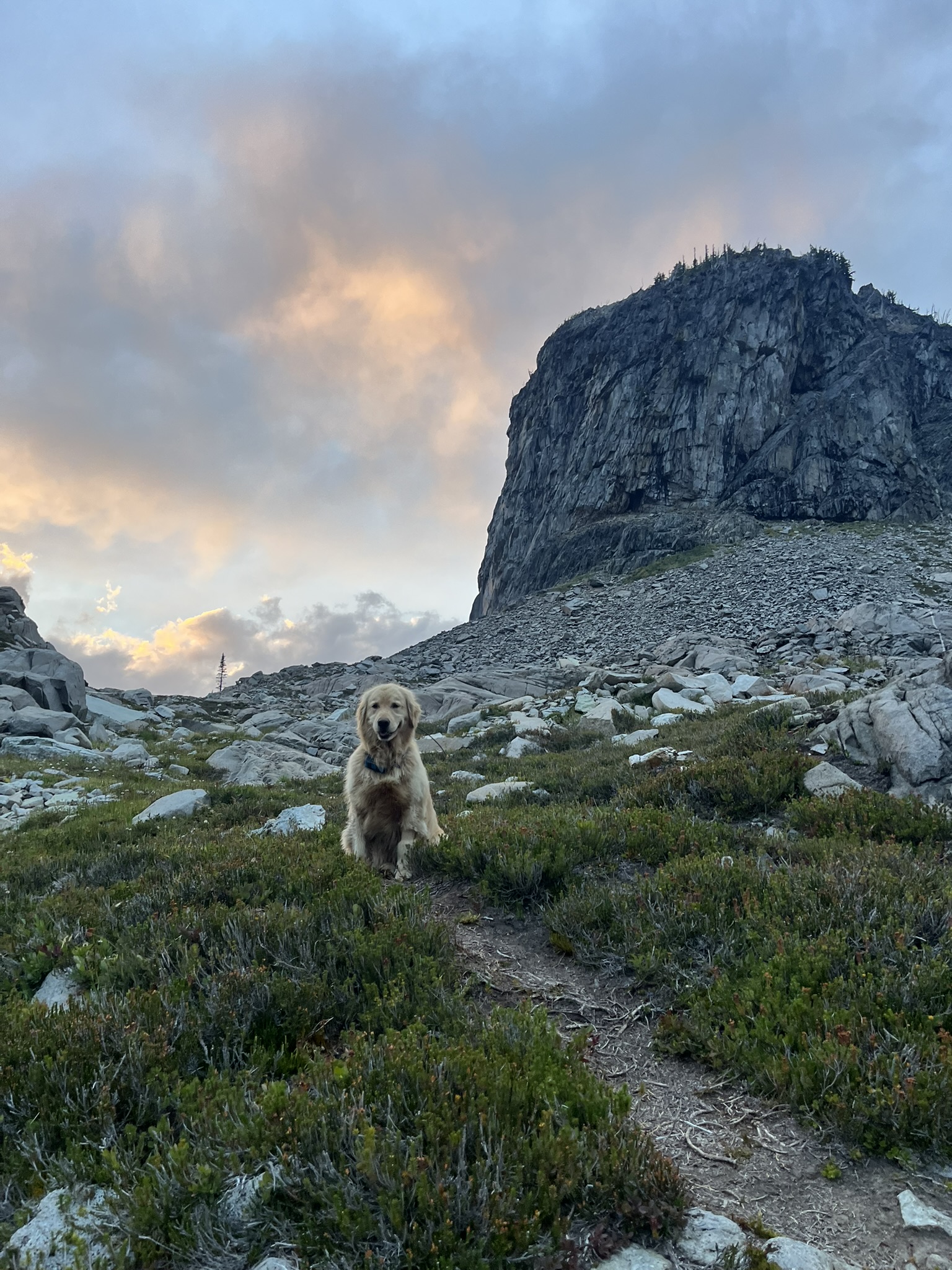
The light went soft and pink. I walked toward my human on a path through alpine heather, a massive dark buttress rising behind me, sunset clouds glowing warm above it. He had the camera out. Obviously.
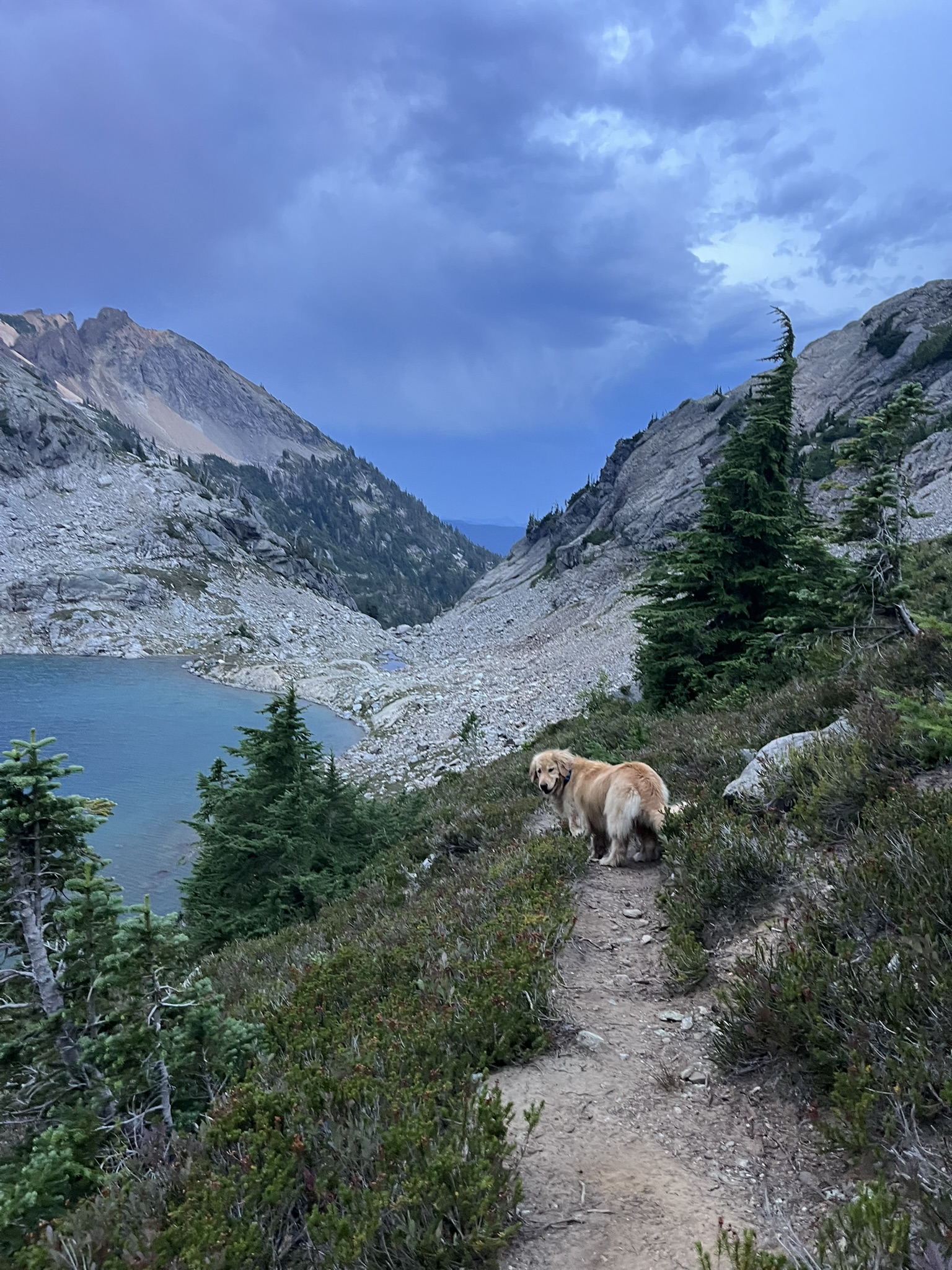
We dropped back toward camp as the color faded. I walked the trail above Venus Lake — the water still and turquoise below, the cirque walls closing in, the sky going blue and gray. The evening smelled like cooling rock and the sharp green of wet heather.
Then the sky broke. A thunder and lightning storm rolled in and sat directly on the Daniel massif. Not distant flashes along a ridgeline — direct strikes on the rock a few hundred feet above us. The thunder hit my chest before it hit my ears. The whole cirque lit white. Rain came hard — not drizzle, not mist, but a wall of water. New streams appeared where there had been dry ground. The tent floor became a shallow lake. My human got up in the dark, broke camp in the storm, and moved everything to higher ground where the water would drain instead of pool. Lightning still cracking the peaks above us, the thunder so loud it was more feeling than sound. I watched him work — headlamp swinging, hands fast, rain pouring off his jacket. He does this for us. Every time. I trust him to make the right call in the dark. He trusts me to wake him if something moves in the night. Then I went back to sleep on the new spot. What else was there to do.
Sunday — Fog
We woke to nothing. The cirque walls had vanished — just gray mist where the headwall had been, the lake invisible, the world reduced to ten feet of wet rock and dripping heather. Trekking poles leaned against the tent. The mountains would come back when they were ready.
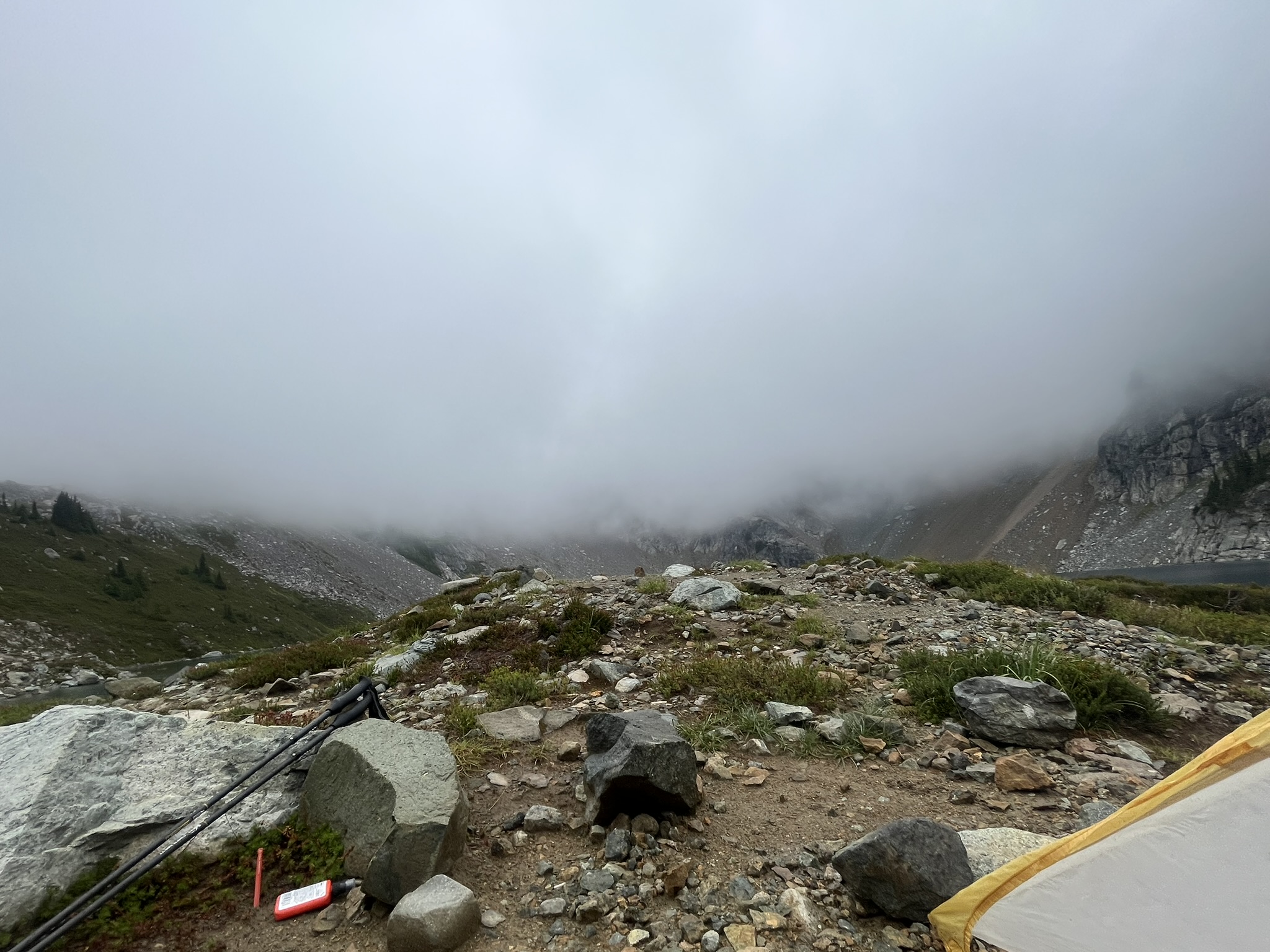
By mid-morning the fog started to lift, revealing the headwall in pieces — vertical rock faces appearing through clouds, the lake slowly materializing below. Like watching the cirque remember itself.
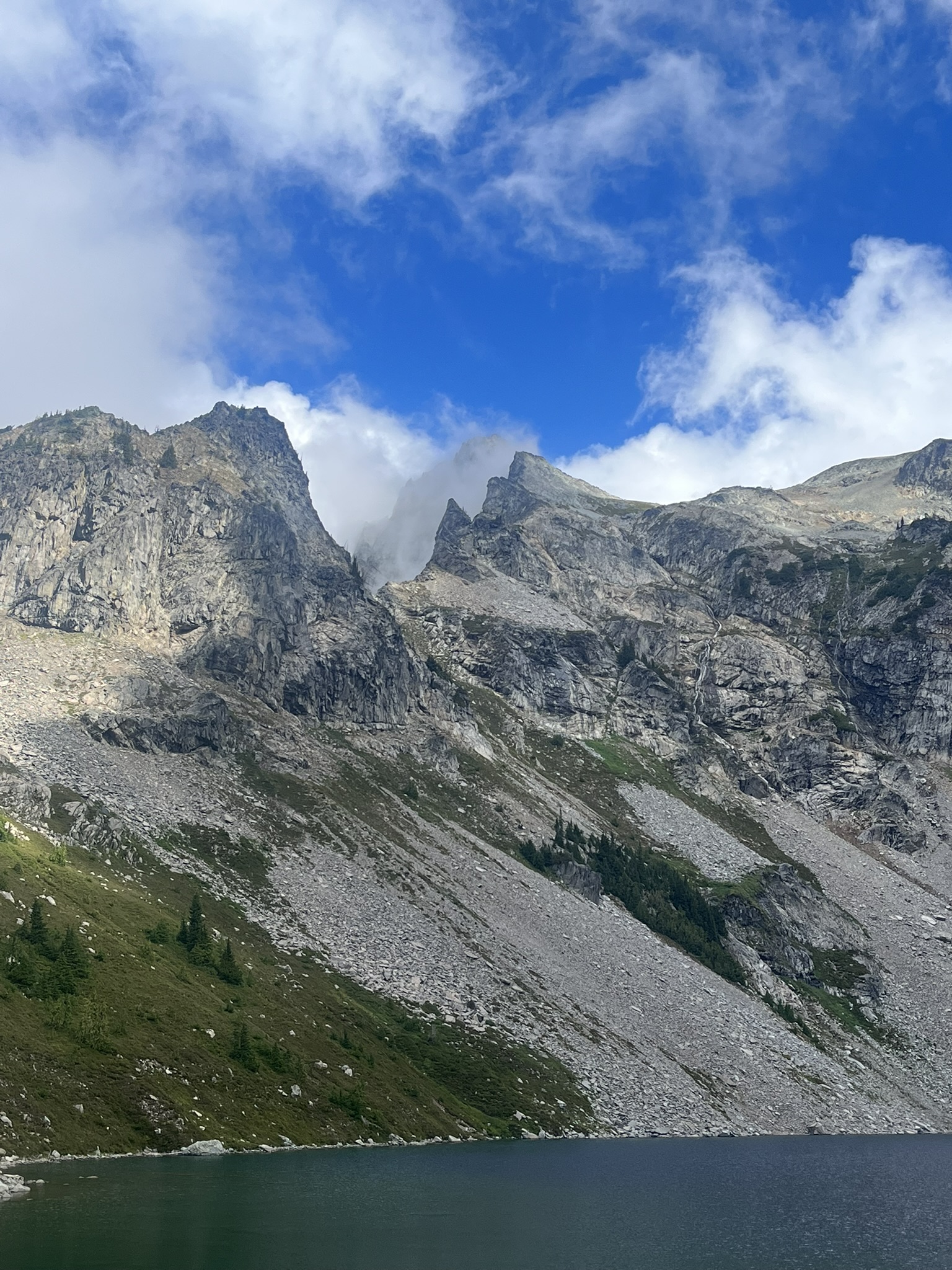
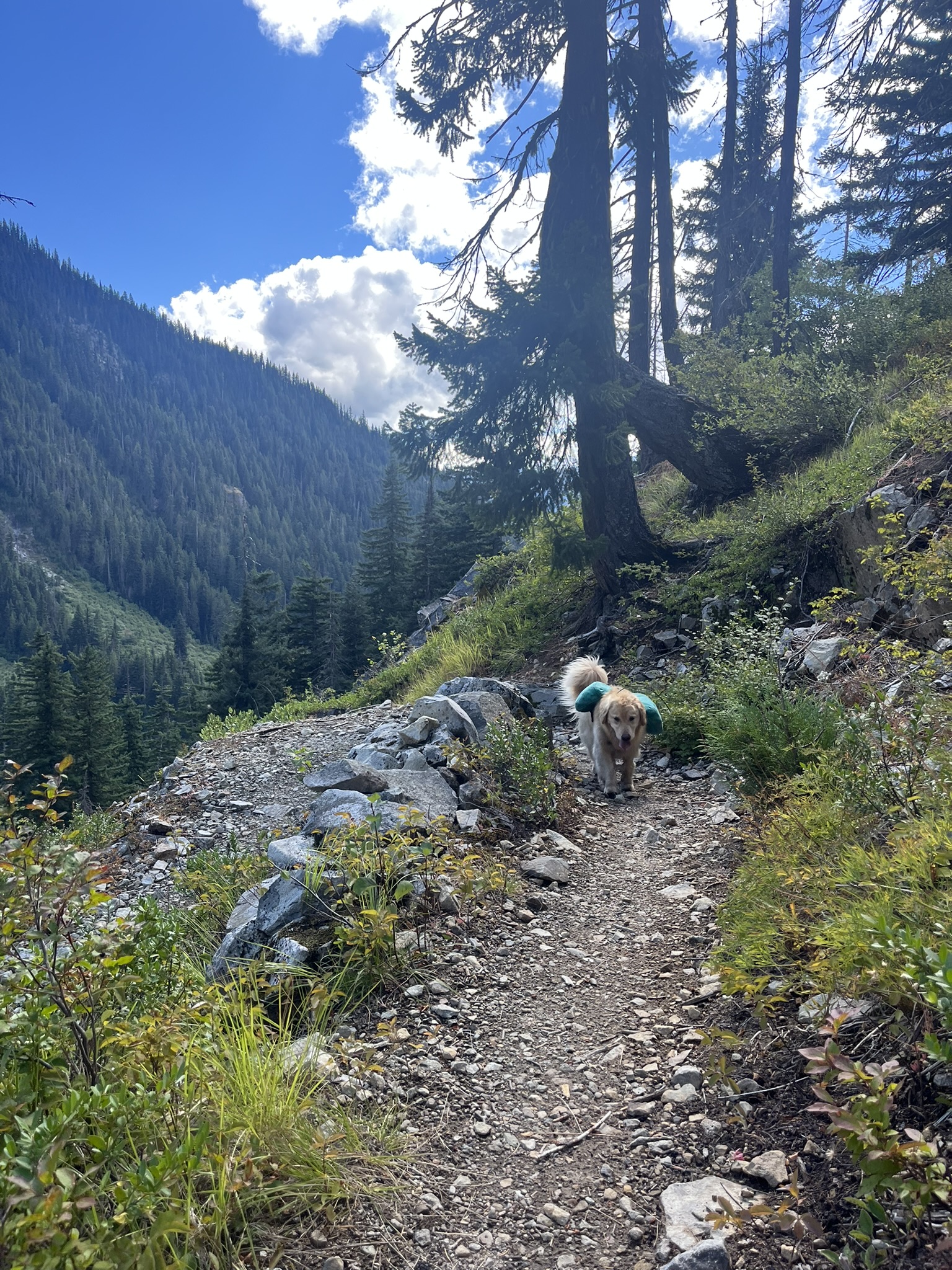
We packed up and took the long way out — south from Venus Lake to the PCT, then past Spade Lake and down to Waptus before turning east toward the car. The easy, well-graded PCT miles were a different world after the storm. The terrain dropped from alpine granite to subalpine forest to valley-bottom trail. I pushed through blueberry bushes and old-growth, sniffing everything, checking back occasionally. Fresh bear scat at a creek crossing — dark, full of berries, still warm. I froze and my human stopped behind me without a word. We stood there for a full minute, listening, smelling. Nothing visible. The bear had moved on. We moved on too, a little more aware. I would rather have been up high. My human knew.
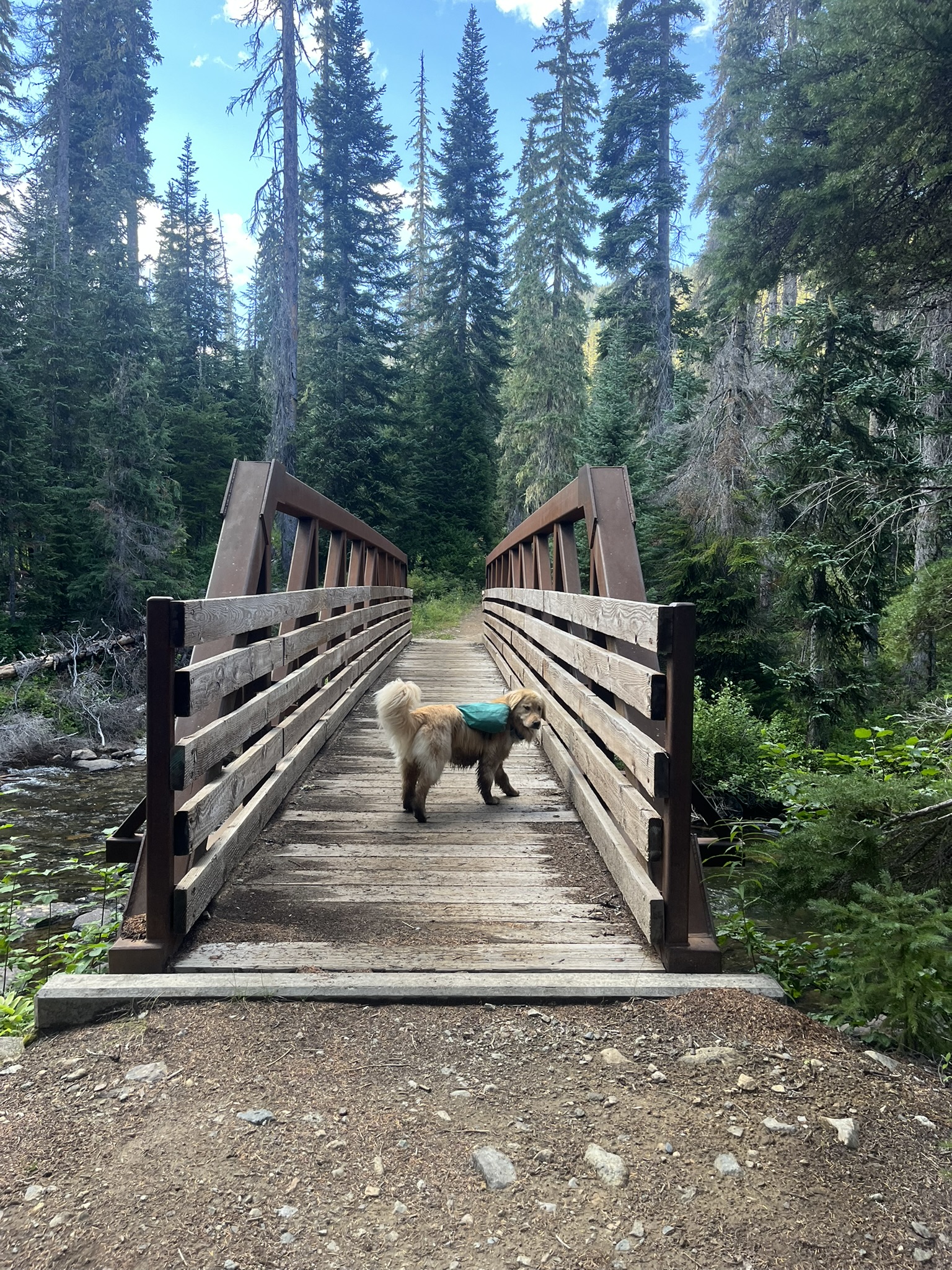
The last mile was flat trail through old forest to a wooden bridge over a creek. I walked across it the way you walk after three days — steady, tired in every muscle, satisfied in every bone. Thirty-two miles. Ninety-five hundred feet of gain. One glacier. One summit. Two lakes I swam in and several more I wanted to. I was asleep before we hit the highway. Obviously.